
Smart Infrastructure Market Forecast to Expand at 18.30% CAGR Through 2034
How IoT Integration, AI Innovation, and Renewable Energy Integration Are Transforming Global Infrastructure Systems

Market Overview
Smart Infrastructure represents the strategic integration of advanced technologies with traditional systems to create intelligent, efficient, and sustainable built environments. It encompasses the application of Internet of Things (IoT), artificial intelligence (AI), cloud computing, and data analytics to transform energy systems, water networks, transportation systems, and buildings. Smart infrastructure enables real-time monitoring, predictive maintenance, automation, and optimization of critical infrastructure operations. These systems enhance operational efficiency, reduce energy consumption, minimize environmental impact, and provide resilience against infrastructure challenges and urban pressures.
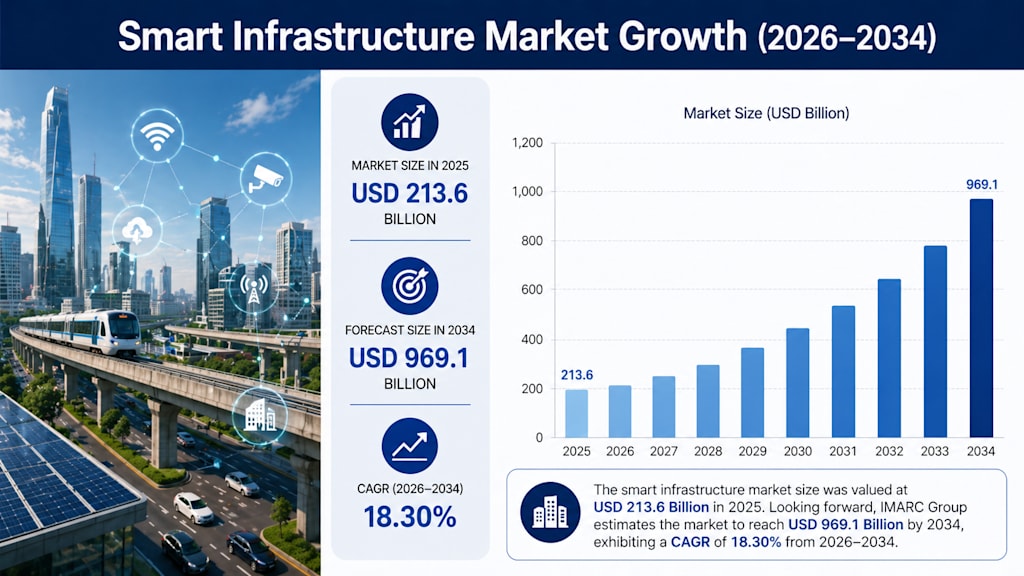
The global smart infrastructure market size was valued at USD 213.6 Billion in 2025, reflecting growing worldwide investment in intelligent urban systems and sustainable infrastructure solutions. Looking ahead, the market is projected to reach USD 969.1 Billion by 2034, supported by rapid urbanization, government initiatives promoting smart city development, renewable energy integration, and technological advancements in IoT and AI. Market growth is being driven by demographic shifts toward urban living, climate change concerns, digital transformation across industries, and collaborative investments between public and private sectors.
Request PDF Sample for more detailed market insights:
Role of Innovation in Market Development
• Internet of Things and Sensor Networks
The integration of IoT sensors and devices throughout infrastructure systems enables continuous data collection from various components. These sensors monitor energy flows, water usage, traffic patterns, building operations, and utility performance in real time. The proliferation of connected devices creates comprehensive datasets that inform operational decisions and support predictive maintenance strategies. IoT connectivity facilitates seamless communication between infrastructure systems, enabling coordinated responses to changing conditions and optimization of resource allocation across integrated networks.
• Artificial Intelligence and Advanced Analytics
Artificial intelligence algorithms process vast quantities of infrastructure data to derive actionable insights for improved operational performance. Machine learning models identify patterns in energy consumption, predict maintenance requirements, optimize traffic flow, and enhance resource utilization. AI-powered analytics systems support anomaly detection, enabling rapid identification of system failures before they impact service delivery. These intelligent systems continuously learn from operational data, becoming increasingly effective at optimizing infrastructure performance and supporting data-driven decision-making.
• Cloud Computing and Distributed Systems
Cloud infrastructure provides scalable storage, processing, and accessibility for smart infrastructure data. Cloud-based platforms enable integration of diverse systems, seamless data sharing across organizational boundaries, and remote monitoring and control capabilities. These solutions reduce capital expenditures associated with on-premise infrastructure while providing flexibility to scale systems as demand evolves. Cloud connectivity facilitates collaboration between infrastructure operators, technology vendors, and urban planners.
Global Smart Infrastructure Market Trends and Drivers
• Rapid Urbanization and Population Growth
Approximately 56% of the global population currently resides in urban areas, with that figure expected to continue rising. This concentration of population creates significant challenges for resource management, traffic congestion, and environmental sustainability. Cities increasingly adopt smart infrastructure solutions to efficiently manage water distribution, reduce energy consumption, optimize transportation networks, and minimize greenhouse gas emissions. Smart solutions enable urban areas to accommodate growing populations while reducing operational costs and environmental impacts.
• Favorable Government Initiatives and Policy Support
Governments worldwide are actively promoting and investing in smart infrastructure projects to drive economic development, enhance sustainability, and improve citizen quality of life. Policy frameworks, funding mechanisms, regulatory support, and public-private partnerships facilitate smart city initiatives. Climate change concerns and sustainability commitments encourage adoption of renewable energy integration, smart grids, and energy-efficient infrastructure. Government support provides market certainty and accelerates technology adoption across both public and private sectors.
• Renewable Energy Integration and Sustainability Goals
The growing emphasis on reducing carbon emissions and addressing climate change drives adoption of renewable energy sources and integration with smart grid systems. Smart grids enable efficient distribution of renewable energy from distributed sources such as solar and wind installations. These systems optimize energy flows, balance supply and demand, and support the stability of power systems incorporating high percentages of variable renewable generation. Energy management systems and smart meters empower consumers to monitor and reduce energy consumption, promoting sustainability at the individual level.
• Technological Advancements and Digital Transformation
Continuous advancement in IoT, AI, cloud computing, and data analytics technologies provides the foundation for increasingly sophisticated smart infrastructure systems. Digital transformation across industries accelerates adoption of smart solutions as organizations seek to increase operational efficiency, improve sustainability performance, and reduce costs. Integration of emerging technologies including blockchain and 5G connectivity enhances smart infrastructure capabilities and enables new applications.
• Rising Awareness of Smart Infrastructure Benefits
Growing public and private sector awareness of benefits including improved public safety, reduced operational costs, enhanced convenience, and environmental sustainability drives adoption of smart infrastructure. Success stories from leading smart city implementations demonstrate tangible benefits and provide templates for technology deployment in emerging markets. Increased media coverage and public discourse around smart cities and sustainability initiatives build momentum for infrastructure modernization.
Smart Infrastructure Market Segmentation
By Type
• Smart Grid
• Smart Water Network
• Intelligent Transportation Network
• Intelligent Buildings
• Others
Smart grid represents the largest segment by type, holding approximately 36.3% of the market in 2025. Smart grids utilize advanced technologies to monitor and manage energy flows in real time, optimizing resource allocation and reducing energy losses. The integration of renewable energy sources including solar and wind power increases the importance of smart grid technologies for maintaining grid stability and managing variable power supply. Smart meters and demand response systems provide consumers with detailed energy usage information, promoting conservation and enabling participation in demand management programs.
By End User
• Utility
• Transport
• Communications
• Built Environment
Built environment leads the market by end user with approximately 55.8% of the market share in 2025. This segment encompasses smart building technologies for residential, commercial, and industrial spaces. Automated lighting systems, intelligent HVAC solutions, and advanced security systems transform infrastructure operations and enable real-time monitoring and control. Smart building technologies enhance operational efficiency, reduce energy usage, and promote sustainability across diverse property types. Governments and private organizations invest in smart building solutions to meet sustainability objectives and improve resource management.
By Region
• North America
• Europe
• Asia Pacific
• Latin America
• Middle East and Africa
North America currently dominates the global market with a 30.8% market share in 2025. The region benefits from advanced technologies, significant government support for innovation, and robust public-private partnerships. Strategic collaborations among technology companies, urban planners, and cybersecurity experts drive development of integrated smart city solutions. The United States accounts for 89.80% of the North American market, driven by technological advancements, urbanization, and commitment to sustainable urban development. Federal initiatives including the Infrastructure Investment and Jobs Act provide funding for transportation network modernization, energy system upgrades, and public utility improvements.
Europe emphasizes sustainability, efficiency, and smart city development. The European Union Green Deal and related initiatives drive investment in energy-efficient infrastructure, smart grids, renewable energy integration, and intelligent transportation systems. Digital technologies including IoT, blockchain, and AI enable real-time infrastructure data collection, predictive maintenance, and optimized resource usage. Aging infrastructure across the region requires investments in upgrades that enhance resilience and service quality.
Asia Pacific experiences rapid urbanization and substantial government investments in smart city projects. The region leverages IoT, AI, and cloud computing to enhance infrastructure efficiency and enable real-time monitoring. Rising demand for energy-efficient solutions and commitment to sustainable development accelerate adoption of smart grids, intelligent transportation systems, and green building standards. Governments across China, India, and Japan pursue infrastructure modernization to serve expanding populations and improve urban living standards.
Latin America drives smart infrastructure adoption through rapid urbanization, with 81.2% of the population living in urban areas. As cities expand, demand for efficient services and infrastructure increases. Governments invest in smart infrastructure to address gaps in service delivery. Adoption of IoT and AI technologies transforms infrastructure management, enabling real-time monitoring of public utilities and services. Economic challenges drive demand for cost-effective and scalable infrastructure solutions.
The Middle East and Africa experience rapid urbanization, with 60% of the Arab region population currently residing in cities, projected to increase to 70% by 2050. Urban growth fuels smart city investments focused on energy efficiency, mobility solutions, and sustainable development. Markets including the UAE, Saudi Arabia, and South Africa adopt IoT-based systems for smart grids, transportation, and infrastructure management. Efforts to diversify economies and reduce fossil fuel dependence accelerate renewable energy integration and smart technology adoption.
Competitive Landscape
Key players in the smart infrastructure market focus on technological advancement, strategic partnerships, and product innovation to enhance market presence. Companies leverage IoT, AI, and advanced analytics to develop integrated solutions that optimize energy usage, improve operational efficiency, and support sustainability objectives. Major competitors include Aclara Technologies LLC, ABB Limited, AVEVA Group Limited, Black & Veatch Holding Company, Cisco Systems Inc., Schneider Electric SE, Sensus USA Inc., Siemens AG, and Verizon Communications Inc. Strategic collaborations between technology providers, utilities, transportation operators, and urban planners accelerate innovation and market development. Companies target emerging markets and undertake legacy system upgrades to meet evolving customer needs.
Market Outlook
The global smart infrastructure market is expected to witness substantial growth as urbanization continues and governments prioritize sustainable development. The market is projected to grow at a compound annual growth rate of 18.30% during 2026-2034. Investments in IoT-based systems, AI-driven analytics, renewable energy integration, and connected infrastructure solutions will remain critical for addressing urbanization challenges, meeting sustainability goals, and improving public services. Smart infrastructure will continue to play a vital role in supporting resilient, efficient, and sustainable cities capable of meeting the needs of growing populations while reducing environmental impact.
About the Creator
Yoshio
Market Research Analyst with 5+ years of experience in consumer insights and market segmentation. Skilled in data analysis and qualitative research.
Enjoyed the story? Support the Creator.
Subscribe for free to receive all their stories in your feed.
Comments
There are no comments for this story
Be the first to respond and start the conversation.