
Smart Camera Market Expands Rapidly as AI Surveillance and Smart Homes Transform Global Security
From AI-powered home monitoring systems to advanced military surveillance technology, smart cameras are reshaping the future of security and automation worldwide.

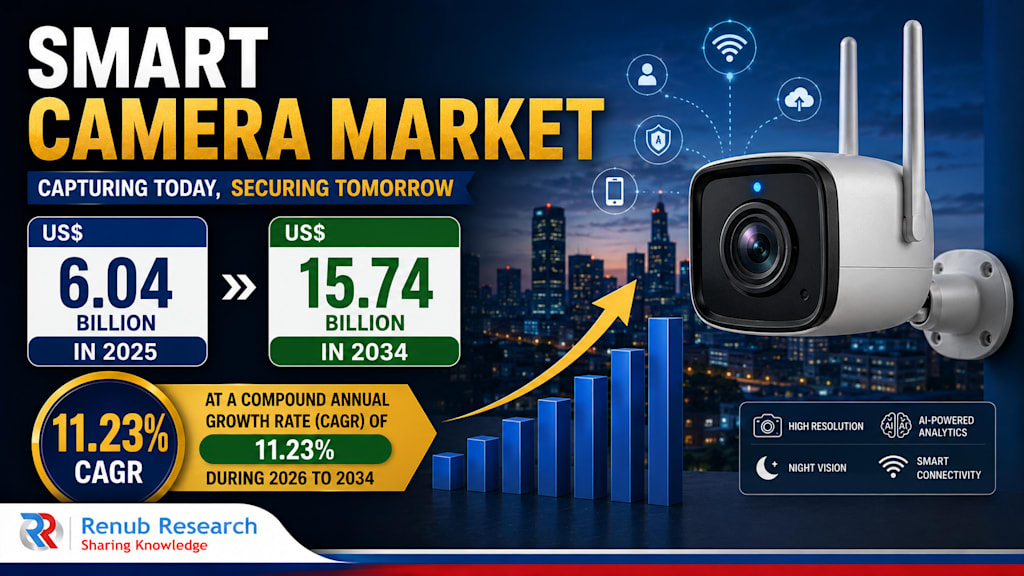
The global smart camera market is entering a period of explosive growth as artificial intelligence, IoT connectivity, and advanced image processing technologies transform how people monitor homes, businesses, industries, and public spaces.
What once started as simple surveillance equipment has evolved into a highly intelligent ecosystem capable of recognizing faces, detecting suspicious behavior, analyzing movement, and even making real-time decisions using AI-powered software.
According to Renub Research, the global smart camera market is expected to grow from US$ 6.04 billion in 2025 to US$ 15.74 billion by 2034, expanding at a strong compound annual growth rate (CAGR) of 11.23% during the forecast period from 2026 to 2034.
The rapid growth is being fueled by rising security concerns, smart city initiatives, expansion of smart homes, increasing use of edge computing, and growing adoption of artificial intelligence-based image analytics.
From residential doorbell cameras and industrial automation systems to military-grade surveillance equipment, smart cameras are becoming one of the most important technologies in the modern digital world.
Smart Cameras Are Redefining Modern Surveillance
Smart cameras are significantly more advanced than traditional cameras.
Unlike conventional surveillance systems that simply record footage, smart cameras can process and analyze images directly within the device using artificial intelligence and machine learning technologies.
These devices offer features such as:
- Facial recognition
- Motion detection
- Object tracking
- Behavior analysis
- Real-time alerts
- Cloud connectivity
- Edge computing capabilities
Smart cameras can also integrate seamlessly with IoT ecosystems, enabling communication between multiple devices and automated systems.
For example, a smart home camera can trigger alarms, activate lighting systems, or send mobile notifications when unusual activity is detected.
Businesses and governments increasingly rely on these technologies for security, operational efficiency, crowd management, and behavioral analysis.
As digital transformation accelerates globally, smart cameras are becoming central to modern surveillance infrastructure.
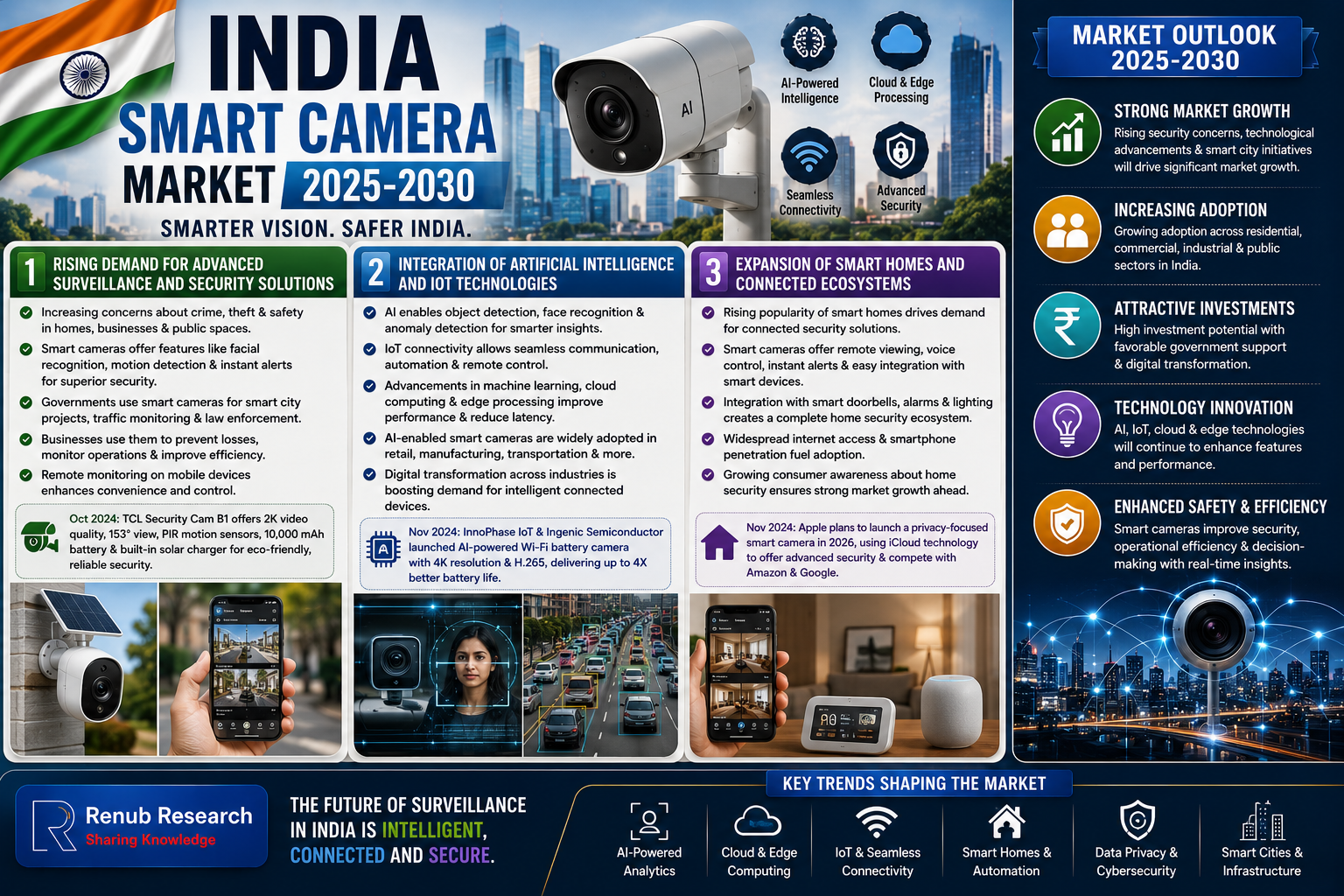
Rising Security Concerns Are Driving Demand
One of the strongest growth drivers behind the smart camera market is the increasing demand for advanced security solutions.
Concerns surrounding:
- Theft
- Crime
- Public safety
- Unauthorized access
- Workplace monitoring
- Traffic management
have encouraged governments, businesses, and homeowners to invest heavily in smart surveillance technologies.
Traditional CCTV systems are gradually being replaced by AI-powered smart cameras capable of delivering more accurate and proactive security monitoring.
Advanced features such as facial recognition and instant mobile alerts allow users to respond quickly to potential threats.
Governments worldwide are deploying smart cameras within:
- Smart city projects
- Transportation networks
- Public infrastructure
- Border security systems
- Crowd management operations
Businesses are also using smart cameras for:
- Employee monitoring
- Inventory protection
- Customer analytics
- Operational efficiency
- Loss prevention
The ability to remotely monitor live footage through smartphones and cloud platforms has made these systems even more attractive to consumers and enterprises alike.
In October 2024, TCL introduced the Security Cam B1 featuring:
- 2K video quality
- Full-color night vision
- PIR human motion detection
- Built-in solar charging
- 10,000 mAh battery capacity
The launch highlighted growing industry focus on eco-friendly and AI-powered surveillance solutions.
Artificial Intelligence Is Transforming Camera Capabilities
Artificial intelligence has become one of the most important technologies shaping the smart camera industry.
AI allows cameras to analyze video feeds in real time rather than simply recording footage for later review.
Modern AI-enabled smart cameras can:
- Recognize faces
- Detect unusual activity
- Track objects
- Identify license plates
- Analyze customer behavior
- Predict potential security threats
Machine learning algorithms continue improving accuracy and reducing false alarms.
The combination of AI with edge computing has also reduced latency significantly by allowing data processing directly on the device rather than relying entirely on cloud servers.
This improves:
- Processing speed
- Data privacy
- Operational efficiency
- Network performance
In November 2024, InnoPhase IoT and Ingenic Semiconductor introduced an AI-powered Wi-Fi battery camera supporting:
- 4K video resolution
- H.265 encoding technology
- Ultra-low power consumption
- AI video processing capabilities
The innovation demonstrated how AI and energy-efficient technologies are becoming increasingly integrated within modern smart cameras.
Smart Homes Are Fueling Massive Consumer Adoption
The rapid expansion of smart homes is another major factor accelerating smart camera demand worldwide.
Consumers increasingly seek connected devices that improve:
- Home security
- Convenience
- Energy efficiency
- Remote monitoring
- Automation
Smart cameras have become essential components of modern smart home ecosystems.
Homeowners now use cameras for:
- Doorbell monitoring
- Indoor surveillance
- Baby monitoring
- Pet tracking
- Elderly care monitoring
Integration with voice assistants and smart home platforms has further increased consumer adoption.
Many systems now work seamlessly with:
- Smart lighting
- Smart alarms
- Voice-controlled assistants
- Smart locks
- Mobile applications
Consumers especially value features such as:
- Live video streaming
- Instant notifications
- Cloud storage
- AI-powered detection
- Privacy controls
In November 2024, Apple reportedly announced plans to enter the home security camera market in 2026 with privacy-focused smart cameras integrated into its iCloud ecosystem.
The move highlights growing competition among major technology companies in the smart home security sector.
Smart Camera Memory Technology Is Advancing Rapidly
Memory technology plays a crucial role in the performance of smart cameras.
Modern devices generate massive volumes of visual data that require fast and efficient processing and storage capabilities.
Advanced memory solutions such as:
- DRAM
- Solid-state drives (SSD)
- Edge storage systems
- Cloud-integrated memory architectures
are helping improve video quality, AI analytics, and real-time processing performance.
Edge computing has become especially important because it allows cameras to process and store data locally, reducing bandwidth requirements and latency.
In 2024, semiconductor companies introduced low-power DRAM chips specifically designed for edge AI cameras, significantly improving processing speeds while reducing energy consumption.
These advancements are critical for applications involving:
- Autonomous monitoring
- Industrial automation
- Real-time analytics
- Smart transportation systems
- CMOS Image Sensors Continue Dominating the Market
Image sensors remain one of the most critical components within smart camera systems.
CMOS image sensors currently dominate the market due to their:
- Lower power consumption
- Faster processing speeds
- High image quality
- Cost efficiency
Modern CMOS sensors offer:
- Better low-light performance
- High dynamic range
- Ultra-high-definition imaging
- Enhanced motion capture
These features are essential for applications in:
- Surveillance
- Automotive safety
- Medical imaging
- Industrial inspection
- Consumer electronics
In 2023, major sensor manufacturers introduced ultra-high-definition CMOS sensors capable of capturing over 200 million pixels, reflecting the rapid pace of imaging innovation.
CCD Sensors Still Serve Specialized Applications
Although CMOS technology dominates mainstream markets, CCD sensors continue maintaining relevance in specialized applications.
CCD sensors are valued for:
- Exceptional image quality
- High light sensitivity
- Minimal image noise
- Superior dynamic range
These characteristics make CCD sensors suitable for:
- Scientific imaging
- Medical diagnostics
- Research applications
- Precision surveillance systems
In 2024, manufacturers upgraded CCD sensor designs with enhanced noise-reduction capabilities, improving performance in high-precision applications.
Commercial Businesses Are Using Cameras for Analytics
Commercial adoption of smart cameras continues growing rapidly.
Businesses increasingly use AI-powered camera systems not only for security but also for operational intelligence and customer analytics.
Retailers deploy smart cameras to:
- Analyze customer movement
- Improve store layouts
- Reduce theft
- Monitor inventory
- Study shopping behavior
Corporate offices use surveillance systems to enhance workplace security and optimize operational efficiency.
Cloud-based video analytics platforms have significantly expanded business applications.
In 2024, multinational retail companies began implementing AI-powered smart cameras capable of tracking customer behavior and improving retail decision-making.
Residential Smart Cameras Are Becoming Mainstream
Residential smart cameras represent one of the fastest-growing market segments.
Consumers increasingly prioritize home security due to rising concerns about safety and remote property monitoring.
Popular residential products include:
- Smart doorbell cameras
- Indoor security cameras
- Outdoor monitoring systems
- Wireless battery-powered cameras
Modern residential systems now include:
- Facial recognition
- Motion sensors
- Voice assistant compatibility
- Mobile app integration
- Cloud-based storage
- Privacy-focused encryption
In 2024, several major electronics companies introduced residential cameras featuring advanced AI capabilities and built-in privacy safeguards such as auto-blurring and on-device encryption.
Military and Defense Applications Continue Expanding
Military and defense organizations are also major users of smart camera technology.
Governments deploy advanced camera systems for:
- Border surveillance
- Reconnaissance missions
- Threat detection
- Drone monitoring
- Tactical operations
Military-grade smart cameras often incorporate:
- Thermal imaging
- Night vision
- AI-powered target detection
- Real-time data analysis
Integration with drones and unmanned aerial vehicles (UAVs) has significantly improved battlefield intelligence capabilities.
In 2023, multiple countries expanded deployment of drones equipped with AI-based surveillance cameras for threat detection and border monitoring.
The United States Leads the Global Market
The United States remains one of the world’s largest smart camera markets.
Strong adoption of:
- Smart home devices
- Industrial automation
- AI technologies
- Public surveillance infrastructure
continues supporting rapid market expansion.
The presence of major technology companies and strong investment in imaging innovation further strengthens the country’s leadership position.
In July 2024, Canon U.S.A. launched its EOS R1 and EOS R5 Mark II mirrorless cameras, highlighting continued advancement in intelligent imaging technologies.
India and Saudi Arabia Are Emerging Fast-Growth Markets
India’s smart camera market is growing rapidly due to:
- Urbanization
- Smart city initiatives
- Rising security concerns
- Expanding internet access
Government-backed smart city programs and increasing use of AI surveillance technologies are accelerating demand.
In August 2024, Hikvision India introduced the Turbo HD 3K Smart Hybrid Light Camera for the Indian market.
Saudi Arabia is also emerging as a strong growth market because of heavy investments in:
- Smart city infrastructure
- Transportation security
- Cloud-based surveillance systems
In September 2024, Eagle Eye Networks launched a new data center in Riyadh focused on AI-powered cloud surveillance services.
Major Challenges Continue Affecting the Industry
Despite strong growth potential, the smart camera industry faces several challenges.
Privacy concerns remain one of the biggest issues.
Smart cameras collect massive amounts of visual data, raising concerns related to:
- Data misuse
- Unauthorized surveillance
- Cybersecurity threats
- Ethical monitoring practices
Governments worldwide are introducing stricter data privacy regulations that manufacturers and businesses must comply with.
High installation and maintenance costs also remain barriers for some consumers and organizations.
Advanced AI-powered systems often require:
- Expensive hardware
- Cloud subscriptions
- Technical expertise
- Ongoing software maintenance
However, increasing competition and technological advancements are gradually reducing costs.
The Future of the Smart Camera Market
The future of the smart camera industry appears extremely promising.
Future growth will likely focus on:
- AI-powered analytics
- Edge computing
- Privacy-focused security systems
- Smart home integration
- Autonomous surveillance
- Cloud-connected ecosystems
- Energy-efficient devices
As cities, businesses, and households become increasingly connected, smart cameras are expected to play an even larger role in global digital infrastructure.
Final Thoughts
The smart camera market is rapidly evolving from a traditional surveillance industry into a highly advanced AI-driven ecosystem.
According to Renub Research, the market’s projected growth from US$ 6.04 billion in 2025 to US$ 15.74 billion by 2034 highlights the enormous transformation taking place across security, automation, and intelligent imaging technologies.
From smart homes and retail analytics to military surveillance and industrial automation, smart cameras are becoming critical tools in the modern digital economy.
As artificial intelligence, IoT connectivity, and edge computing technologies continue advancing, the smart camera industry is expected to remain one of the fastest-growing sectors within the global technology
About the Creator
Enjoyed the story? Support the Creator.
Subscribe for free to receive all their stories in your feed.
Comments
There are no comments for this story
Be the first to respond and start the conversation.