
Smart Camera Market Expands Rapidly as AI Surveillance and Smart Homes Drive Global Adoption
Renub Research highlights strong momentum in the smart camera industry as artificial intelligence, IoT integration, and connected security ecosystems transform surveillance and imaging technologies worldwide.

Smart Camera Market Overview
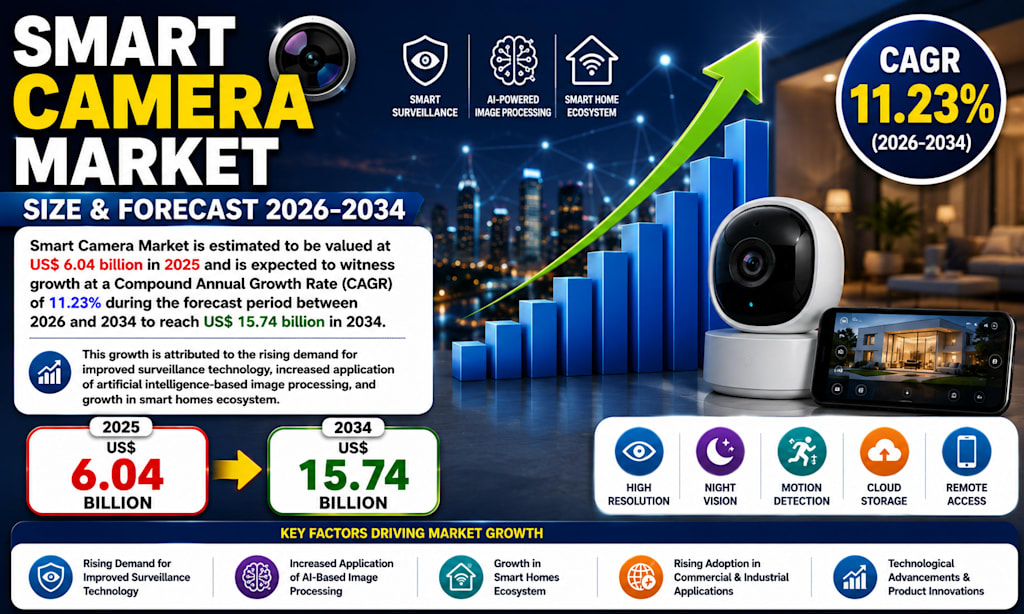
The global smart camera market is witnessing rapid expansion as demand for intelligent surveillance, AI-powered image processing, and connected home ecosystems continues to grow worldwide. According to Renub Research, the Smart Camera Market is expected to increase from US$ 6.04 billion in 2025 to US$ 15.74 billion by 2034, registering a CAGR of 11.23% between 2026 and 2034. Rising security concerns, advances in artificial intelligence, edge computing, and IoT integration are among the key factors driving market growth globally.
Smart cameras differ significantly from traditional imaging devices because they are equipped with built-in AI-powered processing and connectivity features. These devices can analyze images and videos directly on the device using machine learning algorithms without relying entirely on external systems. Features such as facial recognition, object detection, motion analysis, behavior tracking, and real-time notifications make smart cameras increasingly valuable across commercial, industrial, residential, and government applications.
The market has experienced strong adoption across smart cities, businesses, transportation systems, industrial facilities, and households. Governments are increasingly deploying intelligent surveillance systems for crowd monitoring, traffic management, and public safety, while businesses are using AI-enabled cameras for operational efficiency, theft prevention, and customer analytics. Meanwhile, homeowners are embracing smart cameras for remote monitoring and connected home security.
Rising Demand for Advanced Surveillance and Security Solutions
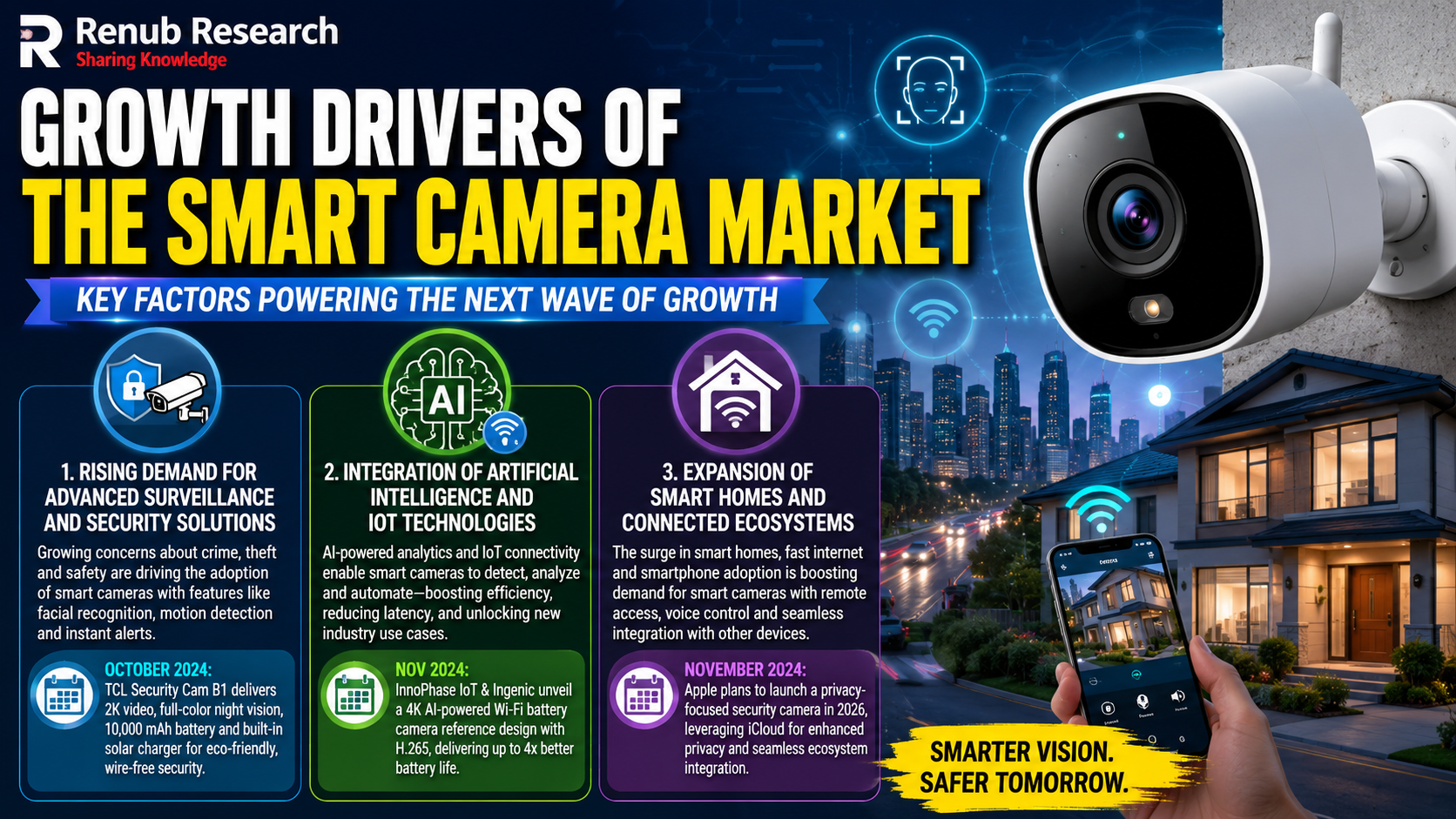
The increasing need for enhanced security remains one of the strongest growth drivers for the smart camera market. Concerns regarding crime, theft, vandalism, and public safety are encouraging governments, businesses, and consumers to invest in advanced surveillance systems that offer greater functionality than traditional cameras.
Smart cameras equipped with AI-powered capabilities such as facial recognition, motion sensing, behavior analysis, and real-time mobile alerts are becoming essential components of modern security infrastructure. Governments are deploying these technologies in smart city projects for traffic monitoring, crowd management, and law enforcement operations. Businesses are using smart surveillance systems to monitor employee activity, improve operational efficiency, and reduce losses from theft or fraud.
The ability to remotely access camera feeds through smartphones and cloud platforms has also significantly increased the appeal of smart cameras among residential users. Consumers increasingly value the convenience of monitoring homes, offices, and properties in real time from virtually any location.
In October 2024, TCL introduced the Security Cam B1 featuring a 10,000 mAh battery, integrated solar charging, 2K video resolution, full-color night vision, PIR motion detection, and customizable monitoring zones.
Artificial Intelligence and IoT Integration Transform the Industry
Artificial intelligence and IoT integration are fundamentally reshaping the smart camera market. AI technologies allow cameras to perform advanced image and video analysis directly on the device, reducing latency while improving performance and accuracy. Smart cameras can now identify objects, recognize faces, detect suspicious activity, and generate automated responses in real time.
IoT connectivity enables smart cameras to interact with other connected devices and automation systems. Cameras can now integrate seamlessly with mobile applications, smart alarms, lighting systems, voice assistants, and cloud platforms to create fully connected security ecosystems. These capabilities are becoming increasingly important as homes, businesses, and cities continue adopting digital transformation strategies.
Edge computing is also playing an important role by enabling local processing of visual data directly within the camera device. This reduces bandwidth requirements and improves response times, especially in applications involving real-time surveillance and industrial automation.
In November 2024, InnoPhase IoT and Ingenic Semiconductor introduced a reference design for an AI-powered 4K Wi-Fi battery camera using H.265 encoding technology. The collaboration combined ultra-low-power processing with improved battery efficiency for advanced surveillance applications.
Expansion of Smart Homes and Connected Ecosystems
The rapid growth of smart homes is another major factor supporting the smart camera market. Consumers increasingly seek connected devices that improve convenience, automation, energy efficiency, and security. Smart cameras have become essential components of modern smart home systems, offering remote monitoring, instant notifications, voice assistant compatibility, and integration with other connected devices.
Smart cameras can now work alongside smart doorbells, lighting systems, alarms, and home automation platforms to create comprehensive residential security ecosystems. Increasing internet penetration, smartphone usage, and awareness regarding home safety are accelerating adoption worldwide.
In November 2024, reports indicated that Apple planned to enter the home security camera market by 2026 with a privacy-focused smart camera integrated with iCloud services and advanced data protection capabilities. The move signals growing competition in the connected home security segment among major technology companies.
Privacy Concerns and Data Security Challenges
Despite strong growth prospects, privacy concerns and cybersecurity risks remain major challenges for the smart camera industry. Since smart cameras continuously capture and process visual data, concerns regarding unauthorized access, surveillance misuse, and data privacy have intensified among consumers and regulators.
Organizations deploying surveillance systems must comply with increasingly strict data protection regulations. Concerns regarding data collection, cloud storage, and information sharing have also raised ethical questions surrounding surveillance technologies. Manufacturers are therefore investing heavily in encryption, cybersecurity protections, and secure cloud infrastructure to improve user trust and regulatory compliance.
Another challenge is the relatively high cost of advanced smart camera systems. AI-enabled cameras with high-resolution imaging, cloud integration, and advanced analytics capabilities often involve substantial hardware, installation, maintenance, and subscription costs. Technical complexity can also create adoption barriers for users unfamiliar with configuring connected devices and integrated security systems.
Smart Camera Memory Market
The smart camera memory segment is growing rapidly as advanced cameras require larger storage capacity and faster data processing capabilities. Technologies such as DRAM and solid-state drives are increasingly being used to support high-definition recording, AI-based analytics, and real-time image processing.
Cloud integration and edge computing are further improving scalability and remote accessibility while reducing latency. Industries such as automotive, industrial automation, and surveillance are contributing significantly to the growth of intelligent camera memory solutions.
In 2024, semiconductor manufacturers introduced new low-power DRAM chips designed specifically for edge AI camera systems, improving processing performance while reducing energy consumption.
Smart Camera Image Sensor Market
Image sensors remain one of the most critical components within smart camera systems because they directly influence image quality, clarity, and processing performance. CMOS sensors continue dominating the market due to their high processing speed, low energy consumption, and improved low-light capabilities.
Advanced sensor technologies now support high dynamic range imaging, better night vision performance, and AI-powered image recognition capabilities. Industries including surveillance, healthcare imaging, automotive safety, and industrial automation are increasingly relying on sophisticated image sensor technologies.
In 2023, leading sensor manufacturers introduced ultra-high-definition CMOS sensors capable of delivering more than 200 million pixels, marking a major advancement in imaging performance.
Smart Commercial Camera Market
Commercial applications continue to represent one of the largest segments within the smart camera market. Retailers are using AI-enabled cameras to analyze customer behavior, optimize store layouts, and reduce theft. Corporations are implementing intelligent surveillance systems for employee monitoring, workplace safety, and operational management.
Cloud-based video analytics platforms are enabling businesses to generate actionable insights from surveillance data. During 2024, several multinational retail companies began deploying AI-powered smart cameras capable of tracking customer movement patterns and shopping behavior.
Smart Residential Camera Market
The residential smart camera market is expanding rapidly due to increasing consumer awareness regarding home security and connected living technologies. Indoor cameras, outdoor surveillance devices, and smart video doorbells are becoming standard components within modern smart homes.
Features such as motion detection, facial recognition, live mobile alerts, cloud storage, and voice assistant integration are making residential smart cameras increasingly attractive to consumers. Wireless connectivity improvements and broader internet access are also supporting growth within this segment.
In 2024, major electronics companies launched residential smart cameras equipped with AI-based privacy protections including auto-blurring features and on-device data encryption.
Smart Military and Defense Camera Market
Military and defense organizations continue adopting smart cameras for surveillance, reconnaissance, border security, and real-time threat detection applications. Advanced imaging technologies including thermal vision, night vision, AI analytics, and drone-integrated surveillance systems are increasingly important for defense operations.
The integration of smart cameras with drones and unmanned aerial vehicles has improved real-time intelligence gathering and situational awareness capabilities. In 2023, several countries expanded the use of AI-powered drone camera systems for border monitoring and defense surveillance operations.
Smart Camera Market in the United States
The United States remains one of the leading markets for smart cameras due to strong adoption of AI technologies, smart home devices, industrial automation, and advanced surveillance systems. Government investment in public safety infrastructure and the presence of major technology companies continue supporting innovation within the industry.
In July 2024, Canon U.S.A. introduced the EOS R1 and EOS R5 Mark II mirrorless camera models, reinforcing continued advancements in imaging and AI-enabled camera technologies.
Smart Camera Market in India
India’s smart camera market is expanding rapidly due to urbanization, increasing security concerns, smart city initiatives, and rising internet penetration. Retail, transportation, and e-commerce sectors are driving significant demand for intelligent surveillance systems across the country.
In August 2024, Hikvision India launched the Turbo HD 3K Smart Hybrid Light Camera, highlighting growing investment in AI-powered surveillance technologies within the Indian market.
Smart Camera Market in Saudi Arabia
Saudi Arabia continues investing heavily in smart city development, public security infrastructure, and intelligent surveillance technologies. Smart cameras are widely deployed across transportation hubs, commercial buildings, industrial facilities, and public spaces.
In September 2024, Eagle Eye Networks opened a new data center in Riyadh focused on cloud video surveillance and AI-powered security services, supporting the Kingdom’s expanding digital infrastructure initiatives.
Recent Developments from Key Companies
- Samsung Electronics continued expanding its AI-powered smart camera and connected home ecosystem portfolio across global markets.
- Canon Inc. introduced the EOS R1 and EOS R5 Mark II mirrorless camera systems in 2024, strengthening its advanced imaging technology lineup.
- Bosch Security Systems continued expanding intelligent surveillance and AI-driven commercial security solutions worldwide.
- Sony Corporation strengthened its image sensor leadership through high-performance CMOS imaging technologies for AI-enabled camera systems.
- Panasonic Corporation expanded smart surveillance and industrial imaging solutions with enhanced edge processing capabilities.
- Olympus Corporation continued focusing on advanced imaging technologies for medical and industrial applications.
- TP-Link expanded its smart home camera ecosystem through affordable connected security products and cloud-enabled surveillance solutions.
- Zebra Technologies strengthened AI-powered industrial imaging and automation technologies for logistics and manufacturing sectors.
- Philips NV continued investing in intelligent healthcare imaging and connected monitoring technologies.
- Eagle Eye Networks opened a cloud video surveillance and AI security data center in Riyadh in September 2024.
Final Thoughts
The global smart camera market is rapidly evolving into a critical component of modern digital infrastructure. The convergence of artificial intelligence, IoT connectivity, edge computing, and advanced image processing is transforming cameras from passive recording devices into intelligent analytical systems. Growing demand for security, smart homes, industrial automation, and connected ecosystems continues driving adoption across residential, commercial, and government sectors worldwide. Although privacy concerns and implementation costs remain challenges, the long-term outlook for the smart camera industry remains highly positive as organizations and consumers increasingly embrace AI-powered surveillance and intelligent imaging technologies.
About the Creator
Enjoyed the story? Support the Creator.
Subscribe for free to receive all their stories in your feed.
Comments
There are no comments for this story
Be the first to respond and start the conversation.