
Slate Auto's $24,950 Electric Truck Is Cheap Because It Removed Everything You Didn't Ask For Anyway
Jeff Bezos-backed startup finally priced the truck that's supposed to be the EV for people who don't want to spend EV money


Slate Auto just announced its electric truck starts at $24,950. That's before taxes, fees, destination charges, and all the other stuff dealerships add on. But even before those, it's half what the average American car costs.
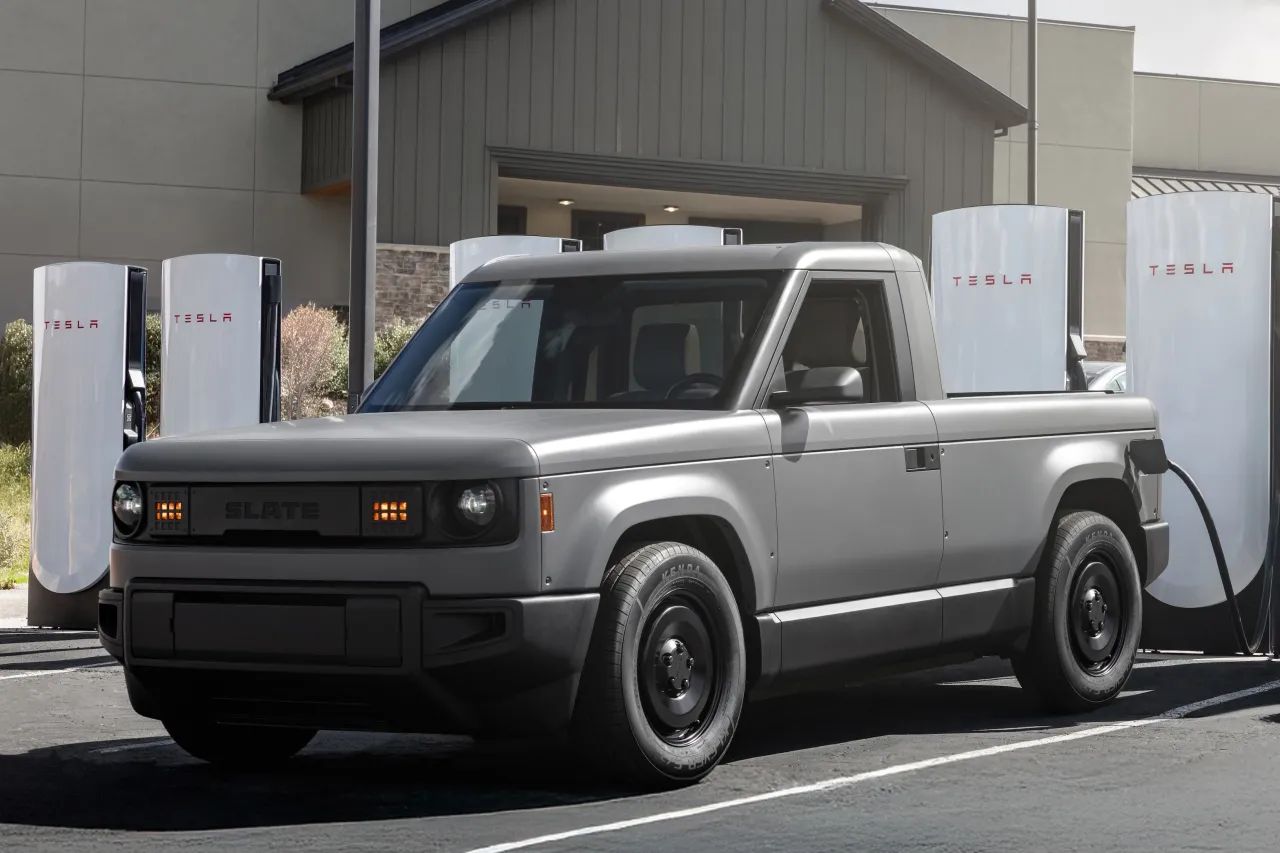
Here's the catch: it's almost aggressively basic. Hand-crank windows. No infotainment system. No paint options, just gray composite material. It's a truck because they stripped out everything that makes trucks expensive, then asked: "What's actually left?"
The answer is something that might actually work for people who just need to drive something reliable and don't care about bells and whistles.
The Price Is Real, But Here's What You're Trading
The Chevy Bolt starts around $29,000. The Nissan Leaf is roughly $32,000. Ford's teasing a $30,000 electric truck for 2027. None of those are anywhere near $24,950.
Slate hit that price by doing what traditional automakers treat as heresy: they stopped adding stuff. No heated seats. No wireless charging. No fancy head unit. No dealer markup. No expensive paint shop. Just a vehicle that moves.
The base model goes 205 miles on a charge. That's the real story here — Slate actually increased the estimated range from 150 miles, even though they ditched plans for a larger 240-mile battery pack. They optimized for what people actually need instead of what sounds impressive on a spec sheet.
The Modular Truck Thing Is Actually Clever
You get a two-seater pickup. But you can convert it into a five-seater SUV for an additional $5,000 (bringing the SUV to $29,950). You can do the conversion yourself. Slate's releasing "Slate University" how-to videos showing people how to swap the bed for a cabin, add headlight covers, basically customize the thing themselves.
That's where the real savings come from. Factory customization is expensive. Paint shops alone run hundreds of millions of dollars. If everyone just orders gray and does their own modifications or orders wraps, those costs basically disappear.
It's the closest thing to a modern Model T strategy: make the base product cheap enough that people can modify it however they want, instead of offering fifty different configurations.
What's Actually Happening Here
Slate's raised $1.4 billion. Jeff Bezos' family office is involved. Mark Walter (who runs Guggenheim Partners and owns a chunk of Carvana) is a lead investor. This isn't some scrappy startup hoping to get lucky. This is serious money betting that the market for a truly cheap electric truck exists.
The company's also gotten a warrant from Carvana, the used car platform, trying to pivot into selling new vehicles, which suggests they might collaborate on distribution. Carvana deals in volume. If Slate can manufacture trucks at scale and Carvana can move them, that's an actual channel beyond "direct-to-consumer" that sounds nice but is hard to execute.
The Political Headwind
Here's where it gets complicated. When Slate started, there was a $7,500 federal EV tax credit. That helped offset the price difference between electric and gas vehicles. The Trump administration removed it. Loosened emissions standards. Made the EV calculus harder for traditional automakers, who've started shelving EV plans.
So Slate has to hit $24,950 without federal subsidy support. That's genuinely aggressive. For comparison, the Chevy Bolt, a car that existed when the tax credit was still available, is still basically at $29,000. Slate's doing it cheaper, with no government help.
That's either brilliant execution or a company betting that they understand the EV market better than legacy automakers do. Probably both.
Who Actually Buys This
The person who buys a Slate is not the person who buys a truck for the vibes. They're buying a vehicle that works. Hand-crank windows aren't a feature; they're just part of not paying for power window motors. No infotainment means you use your phone. Gray composite paint means you wrap it or don't, but you're not paying factory paint markup.
These are trade-offs, and they're transparent trade-offs. Slate isn't pretending to be premium. They're just not charging premium prices for things that don't matter.
For someone who needs a reliable truck that can haul things and doesn't care about heated seats or a fancy screen, $24,950 is legitimately compelling. For someone who wants the truck to say something about them, probably not.
The Preorder Reality
Slate started taking preorders on Wednesday. The company has promised it "won't have traditional dealerships" and plans direct sales like Tesla and Rivian. That's fine in theory. In practice, direct-to-consumer car sales work until they don't, and then you have a logistics problem.
That's probably why Carvana's warranty exists as a backup distribution channel if direct sales get complicated. Carvana knows logistics. Slate knows engineering. Together, they might actually pull off moving volume.
What This Actually Proves
If Slate ships these trucks and they work and people buy them, it proves that the car market has a massive gap at the bottom. People don't want premium trucks. They want cheap trucks. The fact that legacy automakers struggle to build $25k EVs while Slate seems to have figured it out suggests something about how traditional car manufacturing works: it's built for margin, not volume at low prices.
That's the real story. Not that Slate is shipping an EV. That they're shipping a cheap EV without government subsidy while traditional automakers are scaling back EV investments. That suggests Slate understands something about cost structure that bigger companies don't, or can't, or won't admit.
$24,950 is genuinely cheap for a new electric truck. You're getting hand-crank windows and gray paint and no fancy features, but you're getting a vehicle that's supposed to last and work without costing the equivalent of a down payment on a house.
That's the market Slate is targeting. Not people who want their truck to be a status symbol. People who want a truck that drives. For that audience, this might actually be the play.
Whether Slate can actually deliver at that price, at scale, without losing money, that's the question. The price reveal is the easy part. Making it work is the hard part.
About the Creator
Mark Lim
Hi I am mark an automotive student and a car, tech and food enthusiast ! Im gonna try and post daily & hope you enjoy what I write and do share my page with people you know. I would gladly appreciate it! Cheers
Enjoyed the story? Support the Creator.
Subscribe for free to receive all their stories in your feed.
Comments
There are no comments for this story
Be the first to respond and start the conversation.