
Shopify vs WooCommerce vs Magento: Which Platform Wins in 2026?
Learn how Shopify Development, WooCommerce Development, and Magento Development stack up today under real-world engineering benchmarks.


Choosing an e-commerce platform in 2026 is no longer just about picking a design template and calculating transaction fees—it is a critical choice of data architecture. With Shopify rolling out its Winter ’26 AI ecosystem, WooCommerce pushing enterprise-grade database separation directly into its core engine, and Magento 2.4.8 forcing a hard pivot to OpenSearch frameworks, your choice dictates your operational overhead for the next five years.
If you are planning a high-volume build, you cannot rely on outdated 2024 advice. Here is how Shopify Development, WooCommerce Development, and Magento Development stack up today under real-world engineering benchmarks.
1. Shopify Development: The SaaS Powerhouse Enters the AI Era
Shopify has spent the last few years aggressively moving upmarket, shedding its reputation as a "small business only" platform. In 2026, Shopify Plus is a dominant enterprise force, backed by a 99.9% Checkout Uptime SLA.
The 2026 Edge: Agentic Commerce
Shopify’s Winter ’26 "Renaissance" editions have fully integrated Sidekick AI natively into the core backend. It doesn't just write product descriptions; it acts as an autonomous operational assistant. You can prompt it to "Run a flash sale on all slow-moving inventory over $50 for customers in California," and the system executes the collection parameters, alters the pricing matrices, and drafts the marketing notifications autonomously.
Furthermore, Shopify's API-first framework ensures your product data feeds seamlessly into external AI search engines like Perplexity and ChatGPT, maximizing your visibility in generative search results.
Pros: Zero server infrastructure maintenance, lightning-fast deployment, global multi-currency scaling via unified market controls.
Cons: The "App Tax" (monthly SaaS subscriptions for extra features add up quickly) and rigid API rate limits that can restrict complex, real-time ERP syncs.
2. WooCommerce Development: De-coupled, High-Performance Open Source
For years, critics argued that WooCommerce couldn't scale because it forced product data and customer orders into the exact same database tables as standard WordPress blog posts. That bottleneck is officially dead.
The 2026 Edge: Standardized HPOS
High-Performance Order Storage (HPOS) is now completely mandatory and standard across WooCommerce Development. By creating dedicated, isolated database tables for transaction logs, HPOS delivers up to 5x faster order processing speeds and 1.5x faster checkout rendering.
When combined with modern, lightweight block themes and PHP 8.3+, WooCommerce allows brands to build completely custom, deeply content-driven stores without sacrificing speed or risking database locks during high-traffic drops.
Pros: 100% data ownership, zero platform transaction fees, and the absolute freedom to build custom checkout flows without restrictive SaaS boundaries.
Cons: You are entirely responsible for security, hosting infrastructure, and patch management. A single conflicting plugin update can still take your storefront offline if not properly tested in a staging environment.
3. Magento Development: The Enterprise Monolith for Massive Catalogs
Adobe Commerce (Magento 2) remains the undisputed heavyweight champ for massive B2B operations, complex multi-vendor marketplaces, and brands managing deeply nested, highly customizable product catalogs.
The 2026 Edge: Magento 2.4.8 Architecture Upgrades
The release of Magento 2.4.8 brings massive structural shifts aimed at reducing total cost of ownership (TCO) while maximizing security.
Valkey 8.1 LTS Support: Magento has natively swapped its primary caching layer to Valkey to sidestep recent Redis licensing costs, drastically lowering server overhead.
Mandatory OpenSearch 3: Legacy search architectures have been entirely stripped out. Magento natively uses OpenSearch 3 vector data pipelines, allowing you to offer lightning-fast, concept-based semantic search across a catalog of millions of SKUs without needing expensive third-party add-ons.
PCI 4.0 Compliance: With the replacement of outdated text editors with HugeRTE, Magento remains the gold standard for satisfying stringent, modern enterprise security mandates.
Pros: Infinite customization, unrivaled native B2B account management (custom pricing tiers per corporate client), and massive database handling capabilities.
Cons: Incredibly expensive. High development costs, steep server hosting bills, and extreme structural complexity that requires dedicated, specialized engineering teams.
Technical Architecture Breakdown
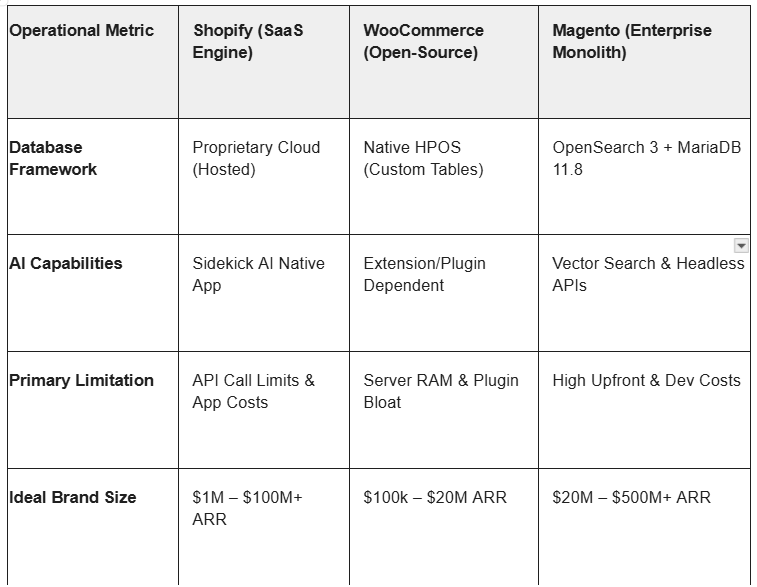
Which Platform Wins Your 2026 Build?
There is no single "winner"—only the platform that aligns with your operational budget and technical capabilities.
Choose Shopify Development if: You want a fast-to-market, highly reliable store where your team focuses purely on marketing and sales rather than server maintenance, security patches, and database optimization.
Choose WooCommerce Development if: You are a content-led brand already utilizing WordPress, want zero recurring platform fees, value total ownership over your data, and need the flexibility to build a bespoke checkout experience.
Choose Magento Development if: You are an enterprise-scale or B2B organization managing hundreds of thousands of complex SKUs, multiple localized storefronts, or deeply intricate ERP/CRM integrations that demand absolute database control.
About the Creator
Navghan Modhavadiya
I'm the founder and director of Impact Techlab, a software development company delivering innovative digital solutions to clients worldwide.
Enjoyed the story? Support the Creator.
Subscribe for free to receive all their stories in your feed.
Comments
There are no comments for this story
Be the first to respond and start the conversation.