
Shin Jin-seo Beat the AI 2–1. So Why Are Researchers Calling It a Handicapped Exhibition?
3000 rollouts, a crippled neutral mode, and a sedan worth ₩250 million. The match looked historic—until someone checked the parameters.
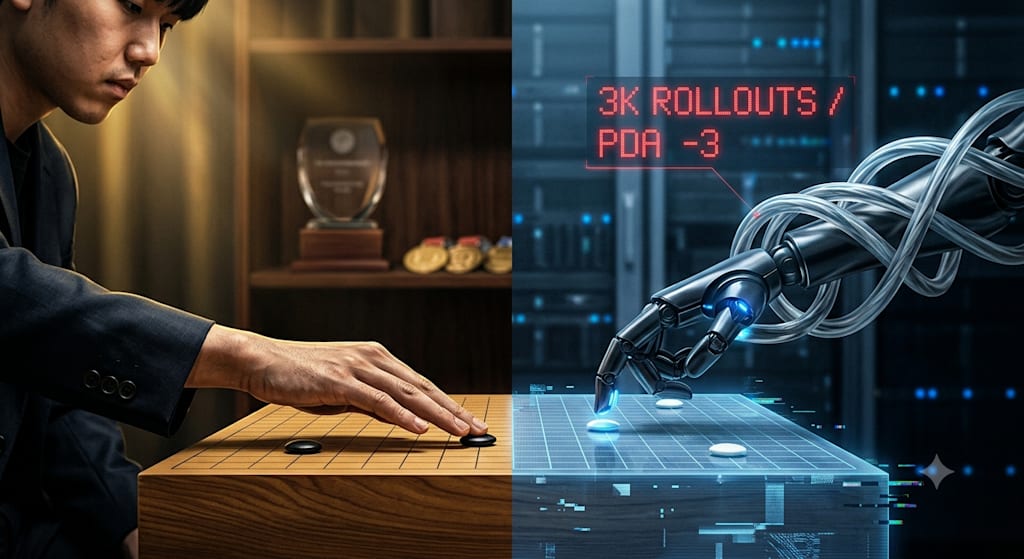
A Victory Bounded by Parameters: Technical Analysis and Credibility Reflections on Shin Jin-seo’s Match Against KataGo
In July 2026, Shin Jin-seo 9p defeated the open‑source Go AI KataGo by 2–1 in the “Strong Mathematics · Hankyung Shin‑KataGo” tournament. This was the first time in recent years that a top human player has beaten a leading AI in a public event. The match was played with a 20‑second per move time setting (byoyomi), carried a total prize of 250 million KRW (approximately 1.15 million RMB), and additionally awarded a Genesis G90 sedan to the winner.
The event drew widespread attention. However, among Go AI researchers and a portion of the enthusiast community, questions quickly arose regarding the match’s parameter settings, the AI’s operating mode, and the transparency of information. The following analysis is based on publicly available data.
I. AI Operating Parameters and Their Deviation from Common Benchmarks
KataGo is one of the most powerful open‑source Go AIs currently available. Its computational efficiency depends primarily on the number of rollouts (simulations) per move and the weight size. According to the weight information published for the event (b40c768nbt‑s11272M‑d5935M), KataGo’s per‑move simulation count was set to 3,000 (3k).
For reference, running the same weight on a typical single GPU (e.g., RTX 4090) with 20 seconds per move generally yields between 30,000 and 50,000 rollouts. The 3k setting is roughly one‑tenth of that figure, which is lower than the default computational power of many Go teaching software or mobile applications. Reducing the simulation count limits the AI’s search depth in multi‑step complex variations; in particular, when long sequences of captures or ko fights are involved, a low‑rollout setting may prevent the AI from covering all viable branches.
Another critical parameter is the PDA (Policy Dynamics Adjustment), which controls the AI’s inclination among candidate moves. For this match, the PDA was set to a negative value (publicly reported as ranging from ‑0.8 to ‑3). A positive PDA makes the AI more aggressive, while a negative one makes it more conservative, meaning it prefers moves with smaller win‑rate fluctuations, even if those moves are not the absolute win‑rate maximisers. In formal AI vs. AI matches or research settings, the PDA is usually set to 0 (neutral) or positive values to evaluate the AI’s full capability.
II. Internal Contradictions in the Move‑Agreement Data
In Go commentary, the “top‑1 AI agreement rate” is often used to measure how closely a player’s moves align with the AI’s primary recommendation. After this match, some enthusiasts re‑analysed the games using the same weight and low‑rollout environment, producing the following figures:
When PDA was set to 0 (neutral), Shin Jin‑seo’s agreement rate with KataGo’s top‑1 move was approximately 89.19%.
When PDA was set to ‑0.8, the rate rose to 98.20%.
When PDA was set to ‑3, the rate was about 97.3%.
With the same player and the same weight, a variation in PDA alone produced a nearly 9‑percentage‑point difference in agreement. This indicates that in a low‑rollout environment, a negative PDA significantly reduces the diversity of the AI’s candidate moves, making its output more homogeneous. Under such conditions, a high agreement rate likely reflects the player’s familiarity with the AI’s specific preferences under a fixed parameter set, rather than a thorough grasp of the AI’s full strategic range.
If the simulation count were increased to 30k (closer to typical consumer‑grade hardware) while keeping PDA neutral, the same re‑analysis reportedly shows the agreement rate dropping below 80%. This discrepancy suggests that the AI state used in the match was materially different from what players encounter in everyday training or in formal AI evaluation settings.
III. Information Transparency and Pre‑match Preparation
For any serious human‑vs‑AI contest, full disclosure of the AI’s logs, including per‑move simulation counts, candidate move lists, and real‑time win‑rate changes, is essential for validating the objectivity of the results. The organisers of this event have not yet released such raw data.
Given the known fixed weight, fixed low rollout count, and fixed negative PDA, it would be theoretically possible for the competing side to clone the identical environment and conduct repeated training, thereby identifying the AI’s weaknesses under that specific state (since a negative‑PDA AI tends to avoid complex fights, its move sequences become more predictable).
This type of preparation is not technically against the rules, but its outcomes cannot be equated with human performance against a full‑power AI in an unrestricted setting.
By contrast, in the 2016 AlphaGo vs. Lee Sedol match, the DeepMind team published every game record, the hardware configuration, and some internal decision data. Even though AlphaGo won 4–1, the academic community still recognises Lee Sedol’s 78th‑move “wedge” as a classic instance of human intuition exploiting a blind spot in the AI. The difference in information openness between these two events limits the possibility of independent external evaluation for the current match.
IV. Conclusion: A Valid Win, but a Limited Reference Frame
Shin Jin‑seo 9p demonstrated precise judgment and stable positional control throughout the match. His handling of the later games, particularly his sensitivity to territorial margins in the endgame, aligns with the top‑level standard he has consistently maintained over the years.
However, the AI settings used in this match—3k rollouts and negative PDA—make it essentially a “handicapped” exhibition rather than a scientific test of whether a human can directly challenge the strongest available AI. Interpreting this result as “humanity regaining victory over AI” overlooks the tangible impact that parameter variations have on AI decision quality.
The progress of Go AI has provided humans with new training tools and conceptual references. At the same time, for any AI‑related event to carry credibility, it must disclose all operational parameters and logs to allow third‑party replication and verification. This match may have achieved a commercial communication effect, but on the level of technical ethics, several questions remain for the organisers to clarify.
About the Creator
Jin
Writer of reamstories
https://reamstories.com/jin
Enjoyed the story? Support the Creator.
Subscribe for free to receive all their stories in your feed. You could also become a paid subscriber, letting them know you appreciate their work.
Comments
There are no comments for this story
Be the first to respond and start the conversation.