
She Built the AI That Hunts Her Own Voice
A programmer’s quiet rebellion against her own plagiarism detector.
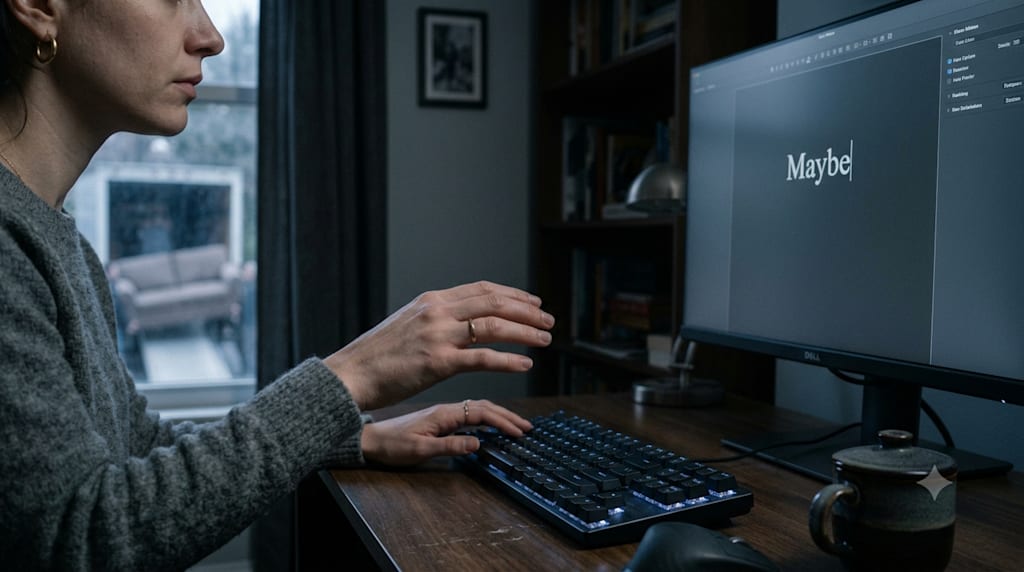
The cursor blinked seven times after "average," and Lin Shuo lifted her left hand from the keyboard.
Not lifted. She slid it off the wrist rest, fingertips grazing the ceramic edge of the teacup lid. The tea had gone cold long ago. A ring of condensation had formed on the inside of the lid, the largest bead tracking downward along the curve, stopping halfway.
The plugin pop-up was still open. Similarity: 97%.
The sentence she had typed—perhaps one's own voice is just the average of training-data contamination—glowed in pale orange, like an out-of-range marker on a lab report, arrow pointing outward. She had designed the pop-up herself. A small exclamation-mark icon sat in the upper left; in the lower right, two buttons: "View Details" and "Ignore." She stared at the exclamation mark for a while. She had picked it from an open-source icon library, a rounded, edge-free warning.
Outside the window, someone was moving. The sound of cardboard boxes dragged down the hallway came through two walls, muffled, like something collapsing far away. She listened to the sound, her finger tracing absent circles on the teacup lid.
Then she selected the sentence.
It inverted to white. The cursor on the screen became a still, vertical line.
She pressed backspace.
Deleted word by word. Stopped at "perhaps." Her finger hovered above the backspace key, maybe a centimeter from the cap. She could see a shallow indentation across the pad of her index finger, left by the edge of the mechanical keycap. She typed eight or nine hours a day. The indentation almost never faded.
The cursor still blinked.
She put her hand back on the keyboard. When her index finger came down, she angled it slightly, landing on the M key. A key she rarely used. She typed maybe.
"Maybe."
The similarity plunged to 41%. The pop-up's color shifted from pale orange to a grudging green.
She stared at the word. Maybe. No punctuation after it. She had the impulse to move the cursor to the end of the sentence and add a period, but her hand didn't move. She let her eyes scan the single word across thirty-two inches of screen. It was so short that it sat in the empty document like a nail, driven alone into the upper-left corner.
She clicked the close button in the upper-right corner of the pop-up. Not "Ignore." Close. Two different operations. She had written the code; she knew the difference precisely. "Ignore" logged the event, stored the trigger in the database. "Close" didn't. It only removed a window from the desktop, like peeling a sticky note from the bezel of a monitor, leaving no residue.
After the pop-up disappeared, the screen was much cleaner. Only the untitled document remained, the single word Maybe, and a vast field of white.
She propped her elbows on the desk and pressed her palms against her eye sockets. Through her fingertips she could feel the heat of her eyeballs, warmer than her fingers. She held the pose, counting her breaths. At the fifth breath, she lowered her hands. The desk held two symmetrical oil prints where her palms had sweated.
She got up and went to the kitchen.
The kitchen window faced north. After four in the afternoon, there wasn't much light. Three plates, two bowls, one glass sat upturned on the drying rack. She flipped the glass over, lifted the kettle, and poured. The water had been boiled that morning, already cold. The glass fogged quickly. Her hand wrapped around it, fingerprints printed on the misted surface like incomplete whorls.
She took a sip. The water had no taste.
Then she turned the glass upside down on the quartz countertop. The instant the rim pressed against the stone, it made a small, muffled sound. She watched water seep from the rim, bleeding into the dark gray quartz in an irregular oval. The oval spread slowly, met a grain of broken tea leaf that had leaked from the strainer that morning, and went around it.
When she returned to the study, the screen had entered standby. Black. The power light pulsed on and off, a slow rhythm. She touched the trackpad with a fingertip. The screen lit up. Maybe was still there, the cursor stopped behind it, still blinking.
She pressed the fingerprint sensor beside the power button.
The screen locked.
The sensor's ring of light flared once, white, then dimmed slowly. She watched the ring fade until it became nothing but matte gray metal.
The day's diary entry was blank. She didn't save the file.
She didn't open the document the next day either. On the afternoon of the third day, she changed the water for the pothos. The pothos lived in a glass bottle with a narrow mouth. Stems and roots tangled inside the bottle in a complicated, entwined structure. When she changed the water, she lifted the whole plant out. The roots were coated in something translucent and slimy. She stripped it off gently with her thumb and forefinger. Her fingers soaked in the water, cooler than her body.
She put the pothos back in the bottle, filled it with water, returned it to the third shelf of the bookcase. Then she looked at the bookcase. The books were arranged by color. She hadn't always arranged them this way. Before, she had arranged them by author. Before that, by a boundary between finished and unfinished. Color was recent. She didn't think about what that meant.
The folder holding the plugin code was still on the desktop. She didn't open it.
The untitled document was also there. White thumbnail, upper-right corner, like a wisdom tooth that never broke through.
That was three days. In three days she did laundry twice, changed the bedsheets once, cleaned the fragments of vegetable leaves and grains of rice from the sink strainer. She scraped the residue into the trash with her thumb; the steel mesh left fine grid marks across her fingertip. She stood in front of the trash can, waiting for the marks to fade.
When they faded, she washed her hands. The hand soap's scent was faint. The fragrance-free kind. It still had a smell, actually. Something close to raw starch.
On the afternoon of the fourth day, she opened the untitled document.
Maybe was still there.
She moved the cursor after the word and typed a period.
"Maybe."
No similarity pop-up appeared after the period. Because she had killed the plugin's background process three days ago. She had found the gray icon in the system tray, right-clicked, quit. No confirmation needed. The icon vanished.
Now the document before her had no detector. Only that Maybe. on the screen, the cursor blinking quietly after the period.
She began to type. Very slowly. The pause between each word stretched longer than a second.
At three this afternoon, the neighbors moved a sofa out.
She stopped, read it over. Deleted At three this afternoon, and rewrote: The neighbors' sofa was carried out. Someone in the hallway shouted "lift it higher," and the sofa leg scraped against the wall.
Stopped again. Changed scraped against the wall to scraped a patch of plaster off the wall.
She stared at the screen. No plugin to tell her the similarity score of these sentences. She didn't need it. Scraped a patch of plaster off the wall. This sentence belonged only to 3:17 that afternoon, only to that day of cardboard boxes collapsing muffled through the hallway, only to her.
She selected the whole passage, cut it, and pasted it into a newly created folder.
The folder was named Impure and Accurate.
When she saved it, the system popped up a prompt: Replace the existing folder with the same name? She paused. She had created this folder before. When? She couldn't remember. She clicked Yes. The old folder was overwritten. Whatever had been inside, she didn't look.
Outside the window, the movers hadn't left. A new sound came through. Packing tape being torn, a long rrrip, and when it snapped at the end, there was a faint elastic recoil in the tail of the sound. She listened to it, pushed the keyboard inward a little, cleared a small patch of desk, and laid her left hand there, palm down, against the wood grain.
The wood grain was fake. Veneer. But she had pressed against it for three years. The heat of her palm recognized it.
She didn't write a diary entry. She wrote a single line, not about herself.
This line would pass no detection. It was her.
About the Creator
Jin
Writer of reamstories
https://reamstories.com/jin
Enjoyed the story? Support the Creator.
Subscribe for free to receive all their stories in your feed. You could also become a paid subscriber, letting them know you appreciate their work.
Comments
There are no comments for this story
Be the first to respond and start the conversation.