
Seven Papers, Two Days, One AI: The Math World’s Credit Crisis
A Peking University researcher let an AI system generate proofs. The fight that followed is about who gets credit when machines do the work.
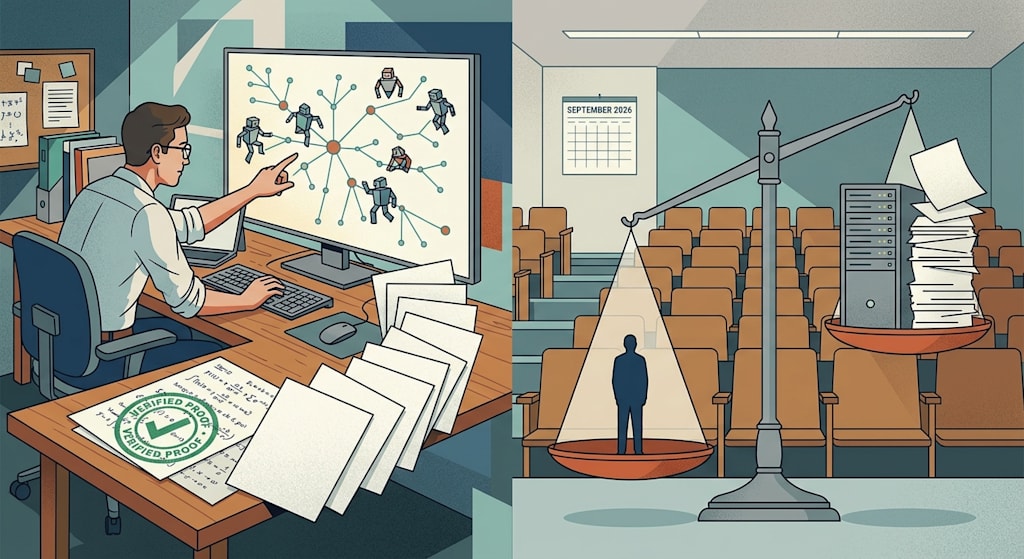
In May 2026, Liu Jihao, a researcher at Peking University’s School of Mathematical Sciences, posted seven papers to arXiv’s algebraic geometry section. He did it in two days. The core proof ideas came from GPT-5.5 Pro and Rethlas. Liu set directions, helped verify, and turned the output into papers. Then Danus, a system his team built, produced more results. One was a counterexample to the Yau-Tian-Donaldson conjecture.
Danus is not a prompt template. Its technical report describes a math reasoning system built around a shared fact graph. A main agent plans and coordinates. Worker agents search for proofs in parallel. Verified results go into a content-addressed fact graph. That graph is the system’s only source of facts. Danus sits on top of Rethlas. Rethlas uses a generate-and-verify loop. Danus turns that loop into multi-agent orchestration. Liu is first author on the report and a core member of the Rethlas/Danus team.
It is a reusable pipeline for AI math discovery. A human sets a direction. The orchestration system sends multiple AI agents to explore. Lean decides correctness. The human confirms results and writes them up.
The fight around Liu has three parts.
First, authorship. On his homepage, Liu argued that he is both a named author and one of Danus’s developers. If credit should go to the AI system, he said, it should go to Danus. As a Danus developer, he still holds that credit. The argument tries to split the difference between human authorship and AI contribution. Critics reject it. On Proofs and Prompts, a math forum, one scholar compared Liu’s behavior to asking a human a question, taking the answer, and calling himself the author. The scholar offered three labels: lying, cheating, plagiarism. The comparison avoids the unresolved question of whether AI can be an author. It asks a simpler question: if the main contribution is asking, does the asker deserve authorship?
Critics also use Liu’s own words. In one paper he wrote: “This paper has so far been verified only by machine and has not yet been checked by humans.” Critics said he did not understand what he had written. Liu replied: “I produced a proof of an important result; then experts came in, digested it, and verified it.” Critics saw a problem in that reply. He treated domain experts as on-call verifiers. He did not treat them as equal collaborators.
Second, human understanding. If a proof is correct and Lean has verified it, does it matter whether the author understands it? A strict formalist would say no. Correct is correct. Truth value does not depend on understanding. Math history has examples of theorems whose deeper meaning took decades to grasp. If AI can generate correct proofs, is human non-understanding just a temporary state?
If math is a human knowledge project, understanding is part of the knowledge. In September 2026, 25 Fields Medalists issued a joint statement. They said AI companies treat solving math problems as a benchmark for model capability. The math community, they wrote, does not seek “to get an answer to a problem as quickly as possible.” Their phrase “profound misalignment” does not deny AI’s math ability. It warns against mass-producing answers while ignoring thought, understanding, and insight. The anxiety is concrete. If a machine generates a proof and humans only confirm correctness without understanding the logic, has the theorem entered human knowledge? Can later researchers use it as a tool? Can teachers pass it on? Can it be folded into a larger theory? If not, then “proving a theorem” means less.
Third, priority and gacha collisions. Liu’s AI system can generate many candidate proofs for the same problem at very low marginal cost. A researcher can make ten AI draws and hit five problems that others have worked on for years. The people who get hit start making AI draws too. The chain reaction spreads. The damage goes beyond one wrong result. It destroys the premise behind academic credit. The old system assumes the first person to publish a correct proof deserves credit because discovery takes scarce human time and intelligence. When discovery costs near zero, “first to publish” becomes a contest of compute and luck. Insight and persistence move to the side.
Liu is not alone. In September 2026, OpenAI said its model solved Navier-Stokes, one of the Millennium Prize Problems. That led to a dispute with Tristan Buckmaster, a mathematician at NYU. Buckmaster and Levent Alpöge had worked on the problem for a year. They used OpenAI and Anthropic tools. Buckmaster claimed OpenAI pushed faster after learning about their progress. He also said the model may have learned unpublished ideas from users’ ChatGPT conversations. OpenAI denied it. The dispute exposed a structural problem. When an AI system’s training data cannot be traced, academic priority cannot be judged fairly.
Liu’s case happened while academic institutions were still mid-transition. AI is becoming a producer. Academic rules still assume it is a tool.
CNKI’s July 2026 statement shows the lag. It gave legal and publishing-ethics reasons for rejecting AI as a named author. AI lacks civil legal status. It cannot handle academic verification or accountability. Listing AI as an author would blur the responsible party. The argument is coherent. It also dodges a harder question. If AI did take part in knowledge production, not just writing but generating the core proof idea, is calling it a “tool” an institutional dodge?
Academic publishing’s standard line is that AI contributions belong in acknowledgments or methods, not in the author list. That line works for AI-assisted writing. Writing is an externalization of the researcher’s thinking. It works less well for AI-generated proofs. When Danus’s agents independently search and find a counterexample, the core intellectual contribution happens inside the AI system, not in the human researcher’s brain. Calling that “tool use” is accurate as description. It is not enough for credit.
Liu’s defense, that he is both author and system developer, is institutional arbitrage. He uses the stable norm of human authorship to claim academic credit for his role in the AI system. At the same time, he avoids the harder question: does he understand the proof? Critics are angry partly because of this. They see a rhetorical move that uses system-developer status to legitimize authorship. They do not see a plain statement: “I do not understand it, but the system does.”
The Fields Medalists’ statement is the math community’s most systematic public answer. Its core claim: AI labs treat math problems as a scoreboard. That damages the research ecosystem. The harm may be unintended. AI companies use math problems as benchmarks because proofs have objective correctness and are easy to score. The side effect is that math research shifts from understanding to answers. Verification, method summaries, academic exchange, and citation of prior work get squeezed.
Mathematicians who speak up face a problem. They criticize AI companies. Liu is a university researcher. His motives may not match commercial logic. He may be driven by curiosity and efficiency. Motives aside, the ecological effect is similar. When one person produces “correct” results at unprecedented speed, other people’s research pace and credit expectations break.
Institutional responses exist but fall short. CNKI’s statement sets floor rules: no AI authorship, disclose AI use, authors must be natural persons. The rules are clear. They do not answer the core question. In a human-author plus AI-system partnership, where is the threshold for a human’s substantive contribution? Disclosure matters. Disclosure does not solve credit allocation.
A game theorist described the situation with a Nash equilibrium frame. The academic community, he said, is moving from chaos toward the next equilibrium. That is accurate, with one qualification. A Nash equilibrium may not be found in time. It may not be a good one.
The current chaos has features. Strategy spaces are unequal. AI companies have the compute and models. Individual researchers compete through draws, which fuels an arms race. Information is incomplete. Researchers do not know when a company will release a result. They do not know if their unpublished ideas have been absorbed. They do not know how “first prover” will be judged. Rules lag. Journals, preprint platforms, and funders have no working system for reviewing AI-generated math results or assigning credit.
A good equilibrium might need a few conditions. AI-generated results should be restated in human-understandable form before entering the record. Training data sources should be traceable or at least declared. Credit should separate discovery from verification. A researcher should be able to get credit for verifying a result without pretending to have discovered it.
One irony stands out. If Liu had written, “I do not know whether this proof is correct, but Lean passed it and I trust Danus,” he might have faced less moral condemnation. He would have faced more institutional confusion. The academic system does not know what to do with a result that an AI system produced, a human does not understand, and formal verification accepts.
The academic system lacks concepts and procedures for non-human knowledge producers. Liu’s rhetoric, whether he meant it or not, uses old institutional language, human authorship, to describe a new reality, an AI system generating the core proof. That may be legal. It is not honest in moral or epistemological terms.
The rules for mathematical knowledge production are being rebuilt. Liu’s case is one node in that rebuild. It forces the math community to face a question it has avoided: if machines can generate correct proofs, where is the value of mathematical knowledge?
The seven papers are still on arXiv. Lean’s check marks are green. Proofs and Prompts keeps growing. The Fields Medalists’ statement is dated September 2026. The next equilibrium has no timetable.
About the Creator
Jin
Writer of reamstories
https://reamstories.com/jin
Enjoyed the story? Support the Creator.
Subscribe for free to receive all their stories in your feed. You could also become a paid subscriber, letting them know you appreciate their work.
Comments
There are no comments for this story
Be the first to respond and start the conversation.