
Saudi Arabia Medical Ceramic Market Set for Strong Growth as Advanced Healthcare Technologies Gain Momentum
Rising Demand for Orthopedic Implants, Dental Restorations, and Minimally Invasive Procedures Drives Market Expansion Through 2033

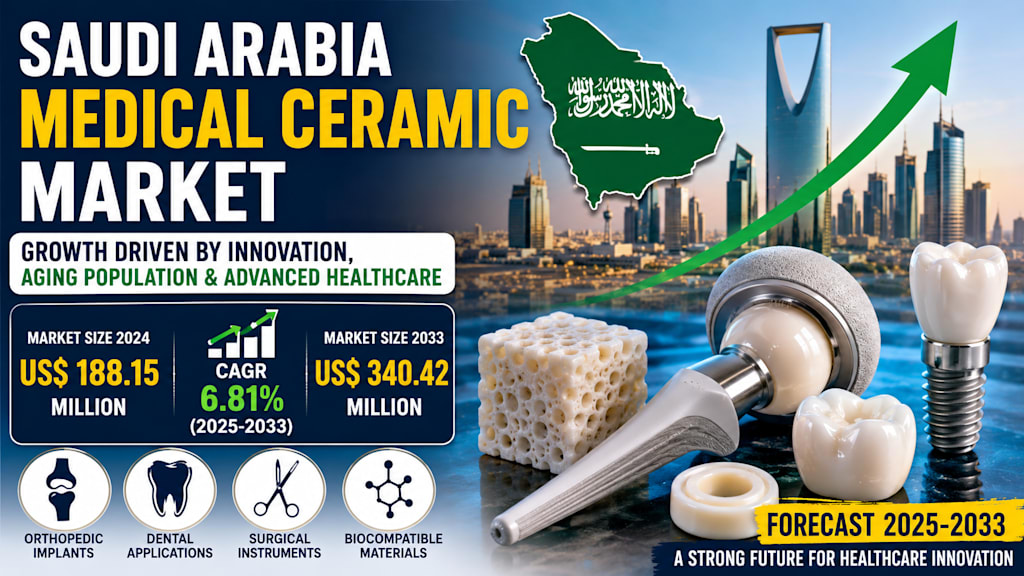
Saudi Arabia's healthcare sector is undergoing a remarkable transformation, fueled by substantial investments, technological innovation, and an increasing focus on improving patient outcomes. Among the many specialized markets benefiting from this healthcare evolution, the medical ceramic industry is emerging as one of the most promising segments.
Medical ceramics have become essential materials in modern medicine due to their superior biocompatibility, durability, and resistance to wear. From orthopedic implants and dental restorations to advanced surgical instruments, these materials are helping healthcare providers deliver more effective and long-lasting treatments.
According to Renub Research, the Saudi Arabia Medical Ceramic Market is projected to grow from US$ 188.15 Million in 2024 to US$ 340.42 Million by 2033, expanding at a CAGR of 6.81% during 2025–2033. This impressive growth reflects the increasing demand for advanced healthcare solutions and the country's commitment to modernizing its medical infrastructure.
Understanding Medical Ceramics and Their Growing Importance
Medical ceramics are specially engineered materials designed for use in healthcare applications. Unlike conventional ceramics used in construction or household products, medical ceramics are developed to interact safely with the human body.
These materials possess unique characteristics that make them highly suitable for medical applications, including:
Excellent biocompatibility
High mechanical strength
Resistance to corrosion
Superior wear resistance
Long operational lifespan
Minimal risk of adverse biological reactions
As healthcare systems worldwide seek more reliable and durable treatment solutions, medical ceramics continue to gain prominence across multiple medical disciplines.
In Saudi Arabia, healthcare providers increasingly rely on ceramic-based implants and devices because they offer exceptional performance while improving patient recovery and treatment outcomes.
Healthcare Transformation in Saudi Arabia Creates New Opportunities
Saudi Arabia's Vision 2030 initiative has accelerated healthcare investments across the country. The government continues to prioritize healthcare modernization, digital transformation, and access to advanced medical technologies.
Hospitals and specialized healthcare centers are adopting state-of-the-art equipment and treatment methods, creating a favorable environment for advanced biomaterials such as medical ceramics.
Several factors are contributing to market expansion:
Growing healthcare expenditure
Expansion of public and private hospitals
Increased adoption of advanced medical devices
Rising awareness regarding quality healthcare
Greater focus on patient-centered treatment approaches
These developments are expected to significantly increase demand for ceramic-based medical products over the coming decade.
The Rise of Minimally Invasive Surgery Boosts Ceramic Demand
One of the strongest drivers of the Saudi Arabia medical ceramic market is the growing adoption of minimally invasive surgery (MIS).
Modern patients increasingly prefer procedures that involve:
Smaller incisions
Faster recovery periods
Reduced pain
Lower infection risks
Shorter hospital stays
To achieve these benefits, surgeons require highly precise and durable instruments. Medical ceramics play a critical role because they offer exceptional wear resistance and mechanical stability.
Ceramic materials are now widely incorporated into surgical instruments and implantable devices used in minimally invasive procedures. Their reliability and long-term performance make them ideal for advanced surgical applications.
As Saudi Arabia continues to invest in modern surgical facilities, the demand for ceramic-based surgical tools is expected to rise steadily.
Growing Burden of Chronic Diseases Drives Market Growth
The prevalence of chronic diseases continues to increase across Saudi Arabia, creating greater demand for advanced medical treatments and implantable devices.
Conditions such as:
Osteoarthritis
Osteoporosis
Degenerative joint disorders
Musculoskeletal diseases
often require surgical interventions involving implants and prosthetic devices.
Medical ceramics have become a preferred material for these applications because they provide excellent durability while minimizing complications associated with long-term implantation.
Orthopedic specialists increasingly favor ceramic materials for joint replacement procedures due to their superior wear characteristics and biocompatibility.
As chronic disease rates continue to rise, the need for high-performance medical ceramics is expected to grow substantially.
Aging Population Creates Significant Demand for Orthopedic Solutions
Saudi Arabia is experiencing a gradual increase in its elderly population, which is creating new challenges and opportunities within the healthcare sector.
As people age, they become more susceptible to:
Joint deterioration
Bone density loss
Hip fractures
Knee disorders
Dental complications
These conditions often require sophisticated medical interventions involving implants and restorative procedures.
Medical ceramics are particularly valuable for elderly patients because they offer longevity, reliability, and excellent compatibility with human tissue.
The growing aging demographic is therefore expected to remain a major driver of demand for ceramic-based orthopedic and dental products throughout the forecast period.
Orthopedic Applications Remain the Largest Market Segment
Orthopedic applications represent one of the most important segments within the Saudi Arabia medical ceramic market.
Ceramic materials are widely used in:
Hip replacements
Knee replacements
Bone graft substitutes
Joint reconstruction procedures
Their low friction characteristics help improve implant performance while reducing wear over time.
Compared with traditional materials, ceramic implants often demonstrate greater longevity, making them particularly attractive for patients seeking long-term treatment solutions.
The increasing number of orthopedic surgeries performed in Saudi Arabia is expected to support sustained growth in this segment.
Dental Applications Continue to Expand
The dental sector represents another major growth area for medical ceramics.
Modern dental restorations increasingly rely on ceramic materials because they offer:
Natural appearance
Exceptional strength
Resistance to staining
Long-term durability
Common applications include:
Dental crowns
Bridges
Veneers
Dental implants
As awareness of oral health improves and cosmetic dentistry becomes more popular, demand for ceramic dental products continues to increase.
Saudi Arabia's growing middle-class population and rising healthcare awareness are expected to further strengthen this segment over the coming years.
Bioactive and Bioresorbable Ceramics Drive Innovation
The medical ceramic market is witnessing rapid innovation through the development of advanced material categories.
Bioinert Ceramics
Bioinert ceramics are designed to remain stable within the body without interacting significantly with surrounding tissues. These materials are commonly used in joint replacement applications.
Bioactive Ceramics
Bioactive ceramics actively interact with biological tissues and promote healing. These materials are increasingly utilized in bone regeneration and tissue engineering.
Bioresorbable Ceramics
Bioresorbable ceramics gradually dissolve within the body after fulfilling their intended function. They eliminate the need for secondary removal procedures and are gaining attention in regenerative medicine.
Piezo Ceramics
Piezo ceramics are used in specialized medical technologies, including imaging systems and diagnostic equipment. Their ability to convert mechanical energy into electrical signals makes them valuable in modern healthcare applications.
Challenges Limiting Market Expansion
Despite strong growth prospects, the Saudi Arabia medical ceramic market faces several challenges.
Limited Local Manufacturing Capabilities
One of the most significant obstacles is the country's reliance on imported medical ceramic technologies and materials.
While some ceramic products are produced locally, many advanced solutions still depend on international suppliers.
This dependence can result in:
Higher costs
Supply chain disruptions
Longer procurement timelines
Limited local innovation
Expanding domestic manufacturing capabilities could help address these challenges while strengthening Saudi Arabia's position within the global medical ceramics industry.
Competition from Alternative Materials
Medical ceramics also face competition from metals and polymers.
Materials such as titanium and stainless steel remain widely used due to their:
Established clinical history
Manufacturing efficiency
Cost-effectiveness
Similarly, polymers offer flexibility and lower production costs in certain applications.
To maintain competitiveness, ceramic manufacturers must continue improving product performance while reducing costs.
Technological Advancements Shape the Future
Research and development activities are accelerating innovation within the medical ceramics sector.
Emerging technologies include:
Advanced ceramic composites
Nanostructured biomaterials
Customized implants
3D-printed ceramic devices
Regenerative medicine solutions
These innovations have the potential to improve patient outcomes while expanding the range of applications for ceramic materials.
As healthcare providers increasingly seek personalized treatment solutions, advanced ceramic technologies are expected to play an even greater role in modern medicine.
Competitive Landscape
The Saudi Arabia medical ceramic market features a combination of global leaders and specialized manufacturers focusing on innovation and product quality.
Key industry participants include:
CeramTec GmbH
Kyocera Corporation
Morgan Advanced Materials
3M
DSM
NGK Spark Plug Co., Ltd.
DePuy Synthes
Zimmer Biomet Holding Inc.
Straumann
BioMérieux SA
These organizations continue investing in research, product development, and strategic partnerships to strengthen their positions in the growing medical ceramics sector.
10 Recent Industry Developments
1. CeramTec GmbH
Expanded investments in advanced ceramic biomaterials designed for orthopedic and implant applications.
2. Kyocera Corporation
Strengthened its healthcare portfolio through innovations in high-performance ceramic implant technologies.
3. Morgan Advanced Materials
Focused on developing next-generation ceramic solutions for medical and surgical applications.
4. 3M
Continued expanding healthcare material technologies supporting dental and orthopedic procedures.
5. DSM
Advanced biomaterial research initiatives aimed at improving implant performance and patient outcomes.
6. NGK Spark Plug Co., Ltd.
Increased focus on precision ceramic technologies for healthcare and diagnostic applications.
7. DePuy Synthes
Enhanced orthopedic product offerings utilizing advanced ceramic components.
8. Zimmer Biomet
Expanded innovation efforts in joint replacement technologies incorporating ceramic materials.
9. Straumann
Strengthened dental implant solutions through improved ceramic-based restorative technologies.
10. BioMérieux SA
Continued investment in advanced diagnostic technologies supporting modern healthcare systems.
Final Thoughts
Saudi Arabia's medical ceramic market is entering an exciting period of growth driven by healthcare modernization, demographic changes, and increasing demand for advanced treatment solutions.
The combination of rising chronic disease prevalence, an aging population, expanding healthcare infrastructure, and growing adoption of minimally invasive procedures creates a strong foundation for long-term market expansion.
With the market expected to increase from US$ 188.15 Million in 2024 to US$ 340.42 Million by 2033, medical ceramics are positioned to become an increasingly important component of Saudi Arabia's healthcare future.
As innovation continues and healthcare providers seek more durable, biocompatible, and high-performance materials, medical ceramics will remain at the forefront of next-generation medical technologies, helping improve patient outcomes and supporting the Kingdom's broader healthcare transformation goals.
About the Creator
Enjoyed the story? Support the Creator.
Subscribe for free to receive all their stories in your feed.
Comments
There are no comments for this story
Be the first to respond and start the conversation.