
Saudi Arabia Entertainment and Amusement Market to Reach US$ 6.10 Billion by 2033 as Vision 2030 Fuels Entertainment Boom
Saudi Arabia’s entertainment and amusement market is witnessing rapid transformation as Vision 2030 initiatives, rising consumer spending, and mega entertainment projects reshape the Kingdom’s leisure economy. The market is projected to grow from US$ 2.46 billion in 2024 to US$ 6.10 billion by 2033, expanding at a CAGR of 10.61% during 2025 to 2033. Increasing adoption of virtual reality, augmented reality, cinemas, gaming centers, and large-scale entertainment destinations is accelerating long-term industry growth.

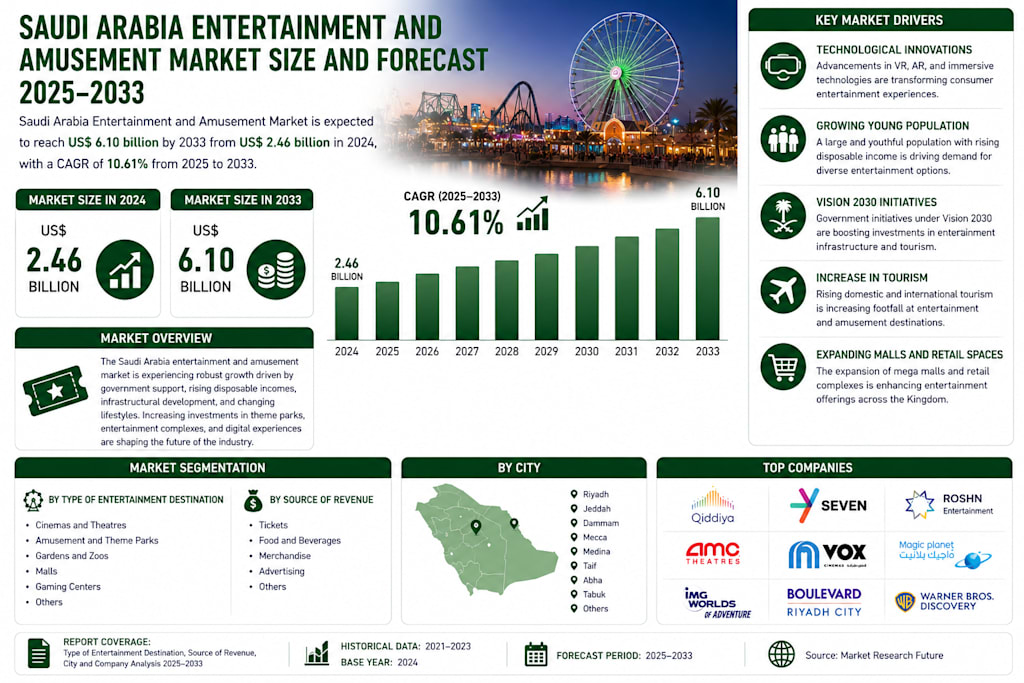
Saudi Arabia Entertainment and Amusement Market Overview
Entertainment and amusement have become central components of Saudi Arabia’s economic diversification strategy as the Kingdom moves toward a more tourism-driven and experience-based economy. The sector includes cinemas, theatres, amusement parks, gaming centers, malls, live entertainment venues, cultural attractions, and recreational experiences designed for both residents and international visitors.
Saudi Arabia’s entertainment landscape has evolved rapidly over the past few years due to changing consumer lifestyles, government reforms, and major investments in tourism and leisure infrastructure. Entertainment experiences now extend beyond traditional recreational activities to include immersive digital experiences powered by technologies such as virtual reality (VR), augmented reality (AR), live streaming, and high-definition digital entertainment systems.
The market is also benefiting from rising disposable income, increasing smartphone and internet penetration, and growing demand for premium entertainment experiences. Consumers are spending more on leisure activities, family entertainment, gaming, live events, and experiential attractions, creating strong opportunities for domestic and international entertainment operators.
Vision 2030 Driving Massive Entertainment Industry Expansion
Saudi Arabia’s Vision 2030 initiative remains the most important driver behind the entertainment and amusement market. The Kingdom’s long-term economic diversification strategy aims to reduce dependence on oil while developing tourism, leisure, and entertainment as major economic pillars.
One of the most significant milestones came in 2017 when Saudi Arabia lifted its 35-year cinema ban, opening the door for global cinema operators, entertainment brands, and investors to enter the market. Since then, the government has established specialized organizations such as the General Entertainment Authority to regulate and support entertainment sector growth.
The Public Investment Fund continues to play a central role in building entertainment infrastructure across the Kingdom. Partnerships with international operators such as VOX Cinemas and AMC Entertainment are helping expand cinema capacity nationwide, while large-scale projects like Qiddiya are positioning Saudi Arabia as a global entertainment destination.
Qiddiya alone represents one of the largest entertainment developments globally, spanning 334 square kilometers with planned theme parks, sports arenas, cultural centers, and family entertainment attractions. The project is expected to generate approximately 57,000 jobs while supporting tourism and leisure development throughout the Kingdom.
Mega Infrastructure Projects Strengthening Market Growth
Large-scale infrastructure development is transforming Saudi Arabia’s entertainment ecosystem. Mega-projects such as NEOM, the Red Sea Project, and Qiddiya are introducing world-class entertainment experiences designed to attract both local residents and international tourists.
The Red Sea Project spans approximately 28,000 square kilometers and includes more than 90 islands with luxury tourism and entertainment facilities. These developments are creating integrated entertainment ecosystems featuring amusement parks, resorts, live events, cultural attractions, and recreational centers.
NEOM, a US$ 500 billion futuristic city project, also includes major entertainment districts, media production facilities, advanced gaming experiences, and technology-driven recreational infrastructure. Such investments reflect Saudi Arabia’s commitment to becoming one of the Middle East’s largest entertainment and tourism hubs.
The rapid expansion of family entertainment centers, shopping malls, gaming facilities, and event spaces across major cities further strengthens the market by increasing accessibility and creating more entertainment options for younger consumers and families.
Young Population and Rising Consumer Spending Fueling Demand
Saudi Arabia’s young population is another major factor supporting market growth. More than 60% of the country’s population is under the age of 34, creating a large consumer base with strong interest in modern entertainment experiences, gaming, live events, sports, and leisure activities.
Saudi consumers spend approximately 6.2% of household income on leisure and entertainment activities, significantly higher than the UK household average of 4.2%. This demonstrates the strong appetite for entertainment experiences among Saudi consumers and highlights the sector’s long-term commercial potential.
Annual entertainment spending in Saudi Arabia is estimated at approximately US$ 1.6 billion, surpassing entertainment spending levels in several neighboring Gulf countries. Consumers increasingly prioritize premium experiences, including concerts, festivals, gaming events, cinemas, and destination entertainment attractions.
This spending behavior creates strong opportunities for both local and international entertainment operators, particularly in amusement parks, gaming centers, live event venues, and immersive digital entertainment platforms.
Technology Innovation Transforming Entertainment Experiences
Technology is playing an increasingly important role in shaping Saudi Arabia’s entertainment and amusement industry. The adoption of virtual reality, augmented reality, immersive gaming, and high-definition digital entertainment systems is fundamentally changing how consumers experience leisure activities.
Entertainment providers are increasingly integrating digital technologies into cinemas, gaming centers, theme parks, and live events to create more interactive and personalized experiences. Advanced technologies are helping operators attract younger audiences who expect immersive and digitally enhanced entertainment options.
The growing penetration of smartphones and internet connectivity is also creating opportunities for streaming platforms, online gaming, digital ticketing systems, and social-media-driven entertainment experiences. This digital transformation is expanding the reach of entertainment services while improving customer engagement and accessibility.
Regulatory and Bureaucratic Challenges Remain
Despite rapid market growth, the entertainment industry in Saudi Arabia still faces regulatory and administrative challenges. Companies entering the market often encounter complex licensing procedures, extended approval timelines, and strict content regulations that require careful compliance management.
Event organizers and entertainment operators must navigate local regulations regarding public gatherings, entertainment content, and safety standards. While reforms under Vision 2030 have improved the investment environment significantly, administrative complexities can still delay project launches and increase operational costs.
International companies must also adapt to cultural sensitivities and evolving regulatory frameworks when introducing new entertainment concepts into the Saudi market.
Tourism Dependency Creating Long-Term Market Risks
Saudi Arabia’s entertainment and amusement market also faces risks related to tourism dependency. Many large-scale entertainment developments are designed to attract international tourists, making the sector vulnerable to geopolitical instability, travel disruptions, or global economic slowdowns.
Fluctuations in international tourism demand can directly affect revenue generation for amusement parks, resorts, festivals, and entertainment destinations. To reduce this risk, Saudi Arabia is increasingly focusing on strengthening domestic demand and encouraging local participation in entertainment activities.
Building a strong local entertainment culture alongside international tourism development is expected to remain a strategic priority for long-term industry sustainability.
Riyadh Entertainment and Amusement Market
Riyadh has emerged as the center of Saudi Arabia’s entertainment transformation under Vision 2030. Massive investments in live events, cinemas, theme parks, gaming centers, and family entertainment facilities are reshaping the city’s leisure landscape.
Major initiatives such as Riyadh Season and the Qiddiya project are attracting international attention and positioning Riyadh as one of the Middle East’s leading entertainment destinations. The city’s young population, rising disposable income, and strong government support continue driving demand for premium entertainment experiences.
Jeddah Entertainment and Amusement Market
Jeddah’s entertainment market is growing rapidly due to its role as a tourism gateway and coastal leisure destination. Projects such as Jeddah Season and the Red Sea tourism developments are expanding the city’s entertainment infrastructure and attracting both domestic and international visitors.
The city’s seaside location and growing hospitality sector support demand for theme parks, resorts, cultural festivals, and family-oriented entertainment attractions. However, competition from neighboring Gulf entertainment markets and tourism dependency remain important considerations for long-term growth.
Makkah Entertainment and Amusement Market
Makkah’s entertainment market is unique because of its religious importance and large pilgrim population. While religious tourism remains the city’s primary focus, authorities are increasingly introducing family-friendly entertainment projects and recreational facilities designed to improve visitor experiences.
Projects such as Makkah Boulevard and growing investment in malls, recreational spaces, and cultural events are helping diversify the city’s entertainment offerings. Balancing religious sensitivities with entertainment development remains an important challenge within the Makkah market.
Recent Developments in the Saudi Arabia Entertainment and Amusement Market
Saudi Arabia accelerated development of Qiddiya as a large-scale entertainment and leisure destination.
NEOM continued expanding entertainment districts, media hubs, and immersive digital infrastructure.
Riyadh Season strengthened Saudi Arabia’s global positioning in live entertainment and tourism.
The Red Sea Project expanded luxury tourism and entertainment infrastructure across the Kingdom.
VOX Cinemas continued increasing cinema screen presence across major Saudi cities.
AMC Entertainment expanded partnerships within Saudi Arabia’s cinema industry.
Family entertainment centers and gaming venues witnessed rising investment activity nationwide.
Virtual reality and augmented reality technologies gained wider adoption across entertainment attractions.
Smartphone and internet penetration continued supporting growth in digital entertainment services.
The General Entertainment Authority expanded initiatives supporting entertainment sector regulation and growth.
Competitive Landscape and Key Players
Major companies operating in the Saudi Arabia entertainment and amusement market include Al Hokair Group, Fakieh Group, Saudi Aramco Amusement Park, E-PLUS (Event Plus), Time Entertainment, First Entertainment Company, Belle Gate, and The Marvel Experience. These companies continue investing in entertainment infrastructure, live events, gaming facilities, cinemas, and immersive recreational experiences to strengthen their market position across the Kingdom.
Final Thoughts
Saudi Arabia’s entertainment and amusement market is undergoing one of the most significant transformations in the region as Vision 2030 accelerates investment in tourism, leisure, and digital entertainment. Mega-projects, rising consumer spending, technological innovation, and a young population are creating strong long-term growth opportunities across cinemas, amusement parks, gaming centers, and live events. With the market projected to reach US$ 6.10 billion by 2033, Saudi Arabia is rapidly positioning itself as a leading entertainment destination in the Middle East.
About the Creator
Enjoyed the story? Support the Creator.
Subscribe for free to receive all their stories in your feed.
Comments
There are no comments for this story
Be the first to respond and start the conversation.