
Robotics Market on Track to Reach US$653 Billion by 2034 as Automation Revolution Accelerates Worldwide
From factory floors to hospitals and smart cities, robotics is transforming industries at an unprecedented pace while reshaping the future of work and innovation.

The world is entering a new era of automation, and at the center of this transformation stands one of the most influential technologies of the 21st century: robotics.
What was once considered futuristic science fiction has become an everyday reality across factories, hospitals, warehouses, farms, and even homes. Robots are assembling vehicles, assisting surgeons, managing logistics operations, supporting elderly care, and helping businesses operate with greater precision and efficiency than ever before.
As industries worldwide face increasing pressure to improve productivity, reduce operational costs, and address labor shortages, robotics is emerging as a critical solution. The result is a rapidly expanding global market that is attracting significant investment from governments, corporations, and technology innovators alike.
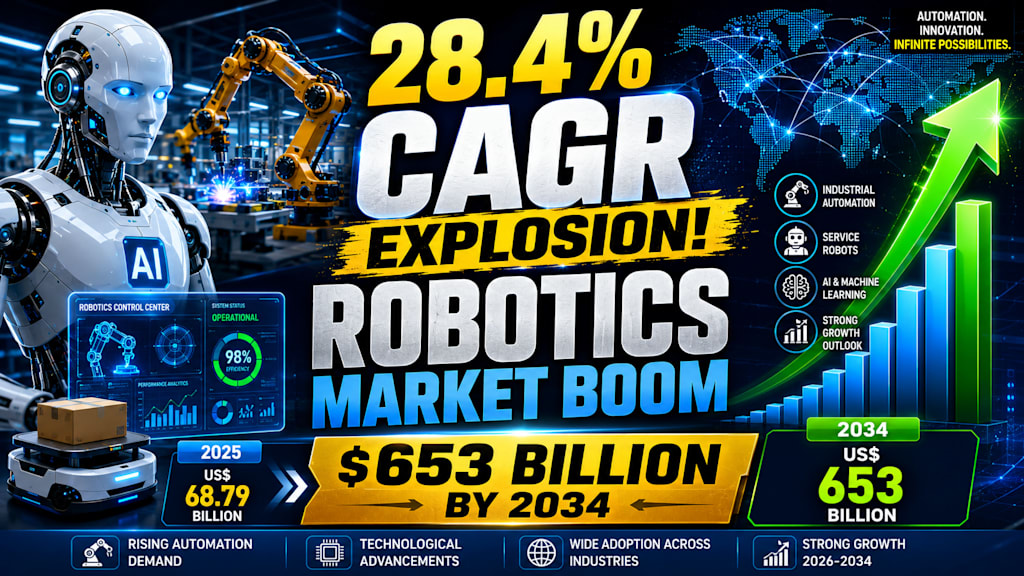
According to recent market analysis, the global Robotics Market is projected to grow from US$68.79 billion in 2025 to an extraordinary US$653 billion by 2034, representing a remarkable compound annual growth rate (CAGR) of 28.41% between 2026 and 2034. This explosive growth highlights the growing importance of robotics in shaping the future of industries and economies worldwide.
The Rise of Robotics in a Digital Economy
Robotics has evolved far beyond traditional manufacturing applications. Modern robotic systems combine mechanical engineering with cutting-edge technologies such as artificial intelligence (AI), machine learning, computer vision, cloud computing, and advanced sensors.
These innovations enable robots to perform tasks with increasing autonomy, accuracy, and adaptability. Unlike earlier generations of machines that followed rigid instructions, today's robots can analyze data, learn from experience, and respond dynamically to changing environments.
As businesses continue their digital transformation journeys, robotics has become a vital tool for improving efficiency and maintaining competitiveness. Organizations across multiple industries are deploying robots to automate repetitive tasks, reduce human error, and optimize operations.
The shift is particularly evident in manufacturing, logistics, healthcare, agriculture, hospitality, and retail sectors, where demand for automation continues to accelerate. Robotics is no longer viewed as an optional enhancement but as a strategic investment for long-term growth and operational resilience.
Why Demand for Robotics Is Surging
Several powerful trends are driving the global robotics market forward.
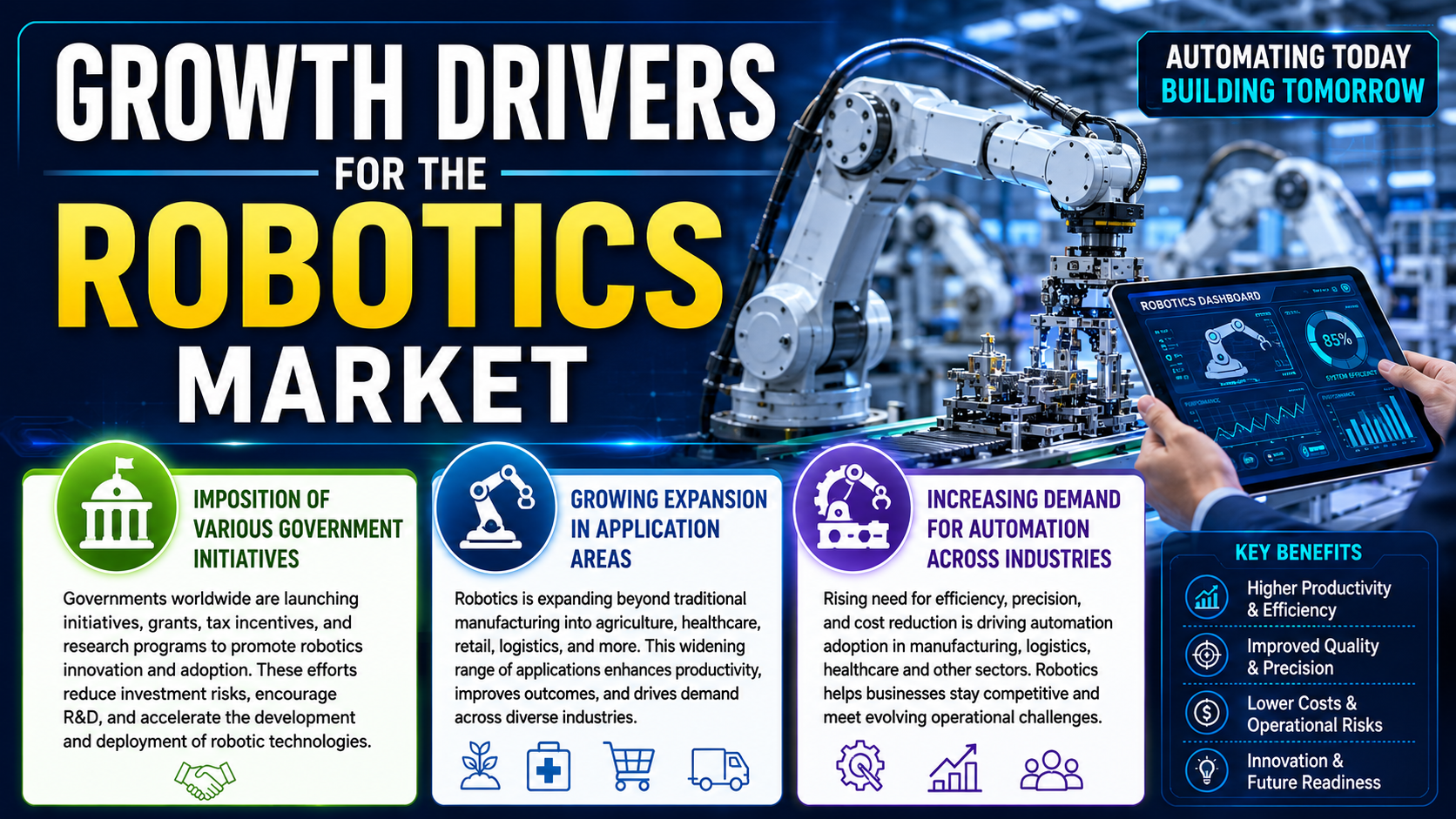
One of the most significant factors is the growing demand for automation. Companies around the world are seeking ways to improve productivity while controlling labor costs. Robotics offers a practical solution by performing repetitive and labor-intensive tasks with greater speed and consistency than traditional methods.
In manufacturing environments, robots can operate around the clock without fatigue, increasing production output and reducing operational disruptions. In logistics, robotic systems help warehouses process orders more efficiently while minimizing errors. Healthcare providers are using robotics to enhance patient care and support complex medical procedures.
The need for greater operational efficiency has become especially important in an increasingly competitive global economy. Businesses that successfully integrate automation technologies often gain significant advantages in cost management, quality control, and scalability.
Artificial Intelligence Is Transforming Robotics
Artificial intelligence has become one of the most influential forces shaping the robotics industry.
Modern robots are increasingly powered by AI algorithms that allow them to analyze information, make decisions, and adapt to changing circumstances. This advancement is expanding robotics applications far beyond traditional industrial environments.
Machine learning enables robots to improve performance over time by learning from data and experience. Computer vision allows machines to identify objects, navigate environments, and interact more effectively with people and equipment.
At the same time, advances in cloud computing and the Internet of Things (IoT) are enhancing connectivity between robotic systems and enterprise platforms. This connectivity enables real-time monitoring, predictive maintenance, and data-driven decision-making that improves operational performance.
As AI capabilities continue to mature, robotics systems are becoming smarter, more flexible, and increasingly capable of handling complex tasks that previously required human intervention.
Collaborative Robots Are Changing Workplaces
One of the most exciting developments in robotics is the rise of collaborative robots, commonly known as cobots.
Unlike traditional industrial robots that often operate within isolated safety zones, cobots are designed to work directly alongside human employees. These machines assist workers with physically demanding, repetitive, or precision-oriented tasks while allowing humans to focus on higher-value activities.
Collaborative robotics offers several advantages, including improved workplace safety, increased productivity, and greater operational flexibility. Because cobots can be deployed relatively quickly and adapted to various tasks, they are becoming increasingly popular among businesses of all sizes.
For many organizations, collaborative robotics represents a practical pathway toward automation without requiring complete replacement of existing workflows or workforce structures.
The growing adoption of cobots demonstrates that the future of robotics is not necessarily about replacing humans—it is increasingly about enhancing human capabilities through intelligent collaboration.
Expanding Beyond Traditional Manufacturing
While manufacturing remains a cornerstone of robotics adoption, the technology's reach is expanding rapidly into new industries.
Agriculture is becoming one of the most promising growth areas. Farmers are deploying robots for planting, harvesting, weeding, and crop monitoring, helping address labor shortages while improving productivity and resource efficiency.
Healthcare has also emerged as a major robotics market. Surgical robots are enabling greater precision during complex procedures, while rehabilitation robots support patient recovery and mobility. Hospitals are increasingly using automation to improve operational efficiency and patient care.
According to industry findings, robotic technologies can increase worker productivity by approximately 29% while boosting overall hospital output by between 21% and 26%. These benefits are encouraging healthcare providers to expand investments in robotic solutions.
Retail, hospitality, and customer service sectors are similarly embracing robotics for operational support, inventory management, cleaning services, and customer interactions.
The growing diversity of robotics applications is creating new opportunities for technology providers while expanding the market far beyond its industrial roots.
Government Initiatives Fuel Industry Growth
Governments around the world are playing an increasingly important role in supporting robotics innovation and adoption.
Many countries recognize robotics as a strategic technology capable of improving productivity, strengthening economic competitiveness, and driving innovation. As a result, policymakers are introducing programs that encourage research, development, and commercialization.
Support often includes research grants, tax incentives, co-financing opportunities, and investments in academic and industrial partnerships. These initiatives help reduce financial barriers while accelerating technological advancement.
Government support is particularly important for emerging technologies that require substantial investment before achieving widespread commercial adoption. By creating favorable conditions for innovation, public sector programs are helping robotics companies bring new solutions to market more quickly and effectively.
Combined with growing labor shortages and rising labor costs, these initiatives are creating a powerful environment for continued robotics market expansion.
Recent Industry Developments Signal Strong Momentum
The robotics industry has experienced several notable developments that underscore its rapid evolution.
In May 2025, ABB announced plans to float its Robotics segment by the second quarter of 2026. The move aims to provide greater strategic clarity for investors while highlighting the strong growth potential of automation-focused businesses.
The same month, DARPA's RACER program entered Phase 2 with 12-ton autonomous off-road platforms, reflecting continued government investment in advanced autonomous systems.
Meanwhile, venture capital interest remains exceptionally strong. In April 2025, Standard Bots secured US$63 million in funding to advance AI-native robotic control systems, while RLWRLD raised US$14.8 million, demonstrating investor confidence in software-driven robotics innovation.
Defense robotics has also gained momentum. In March 2025, Anduril received a 10-year U.S. Navy contract valued at US$642.2 million for counter-drone technologies, highlighting the growing importance of autonomous systems in national security applications.
These developments collectively illustrate the increasing strategic importance of robotics across commercial, industrial, and government sectors.
The United States Leads Through Innovation
The United States remains one of the world's most influential robotics markets.
Strong research and development capabilities, combined with leadership in AI, machine learning, and advanced computing, continue to drive innovation across the sector. American companies are developing sophisticated robotic solutions for manufacturing, healthcare, logistics, and defense applications.
Labor market conditions are also accelerating adoption. According to industry reports, the United States faces a labor shortfall of approximately 70%, creating significant incentives for businesses to invest in automation technologies.
Government agencies such as the National Science Foundation and DARPA continue to fund robotics research, helping foster a vibrant ecosystem that supports both startups and established technology companies.
As reshoring initiatives encourage manufacturers to bring production back to the United States, robotics is expected to play an increasingly critical role in maintaining productivity and competitiveness.
Germany Strengthens Its Industry 4.0 Leadership
Germany remains one of Europe's most advanced robotics markets, supported by its world-class manufacturing sector and strong engineering tradition.
Industries such as automotive manufacturing, electronics, and industrial machinery rely heavily on robotic systems to maintain efficiency and precision. The country's leadership in Industry 4.0 initiatives has further accelerated integration between robotics, AI, IoT technologies, and smart manufacturing systems.
German automation leaders such as Bosch and KUKA continue to drive innovation, helping the country maintain its position at the forefront of industrial robotics. Environmental regulations and sustainability goals are also encouraging businesses to adopt automation technologies that improve resource efficiency and reduce waste.
China Pushes Forward with Ambitious Automation Goals
China's robotics market is experiencing extraordinary growth, supported by industrial expansion, government initiatives, and rising labor costs.
As one of the world's largest manufacturing hubs, China has substantial demand for automation solutions across industries including electronics, automotive production, and logistics. Government programs such as "Made in China 2025" identify robotics as a strategic priority for achieving technological independence and industrial modernization.
Investments in domestic robotics companies and research initiatives are strengthening China's competitive position while accelerating adoption throughout the economy.
The country's commitment to automation is expected to remain a major driver of global robotics market growth over the coming decade.
The Middle East Embraces Robotics Innovation
The United Arab Emirates is rapidly emerging as a regional leader in robotics and automation.
Government initiatives focused on smart cities, digital transformation, and economic diversification are encouraging widespread adoption of advanced technologies. Robotics is increasingly being used across healthcare, logistics, construction, infrastructure maintenance, and security applications.
The UAE's Vision 2031 strategy places significant emphasis on robotics, AI, and future technologies as tools for driving economic development and innovation. As investments continue to increase, the country is expected to become an important regional hub for robotics deployment and research.
Challenges Still Need to Be Addressed
Despite strong growth prospects, several obstacles remain.
High upfront costs continue to be a concern, particularly for small and medium-sized businesses. Implementing robotic systems often requires substantial investment in hardware, software integration, employee training, and ongoing maintenance.
Technical complexity also presents challenges. Integrating robotics into existing operations can require significant expertise and infrastructure modifications. Additionally, workforce concerns regarding job displacement remain an ongoing topic of discussion.
However, continued innovation, declining technology costs, and increasing awareness of robotics' long-term benefits are helping address many of these barriers.
Final Thoughts
The robotics revolution is no longer a future possibility—it is happening now.
Across industries and continents, organizations are embracing robotics to improve productivity, enhance safety, address labor shortages, and unlock new levels of operational efficiency. Advances in artificial intelligence, machine learning, and connected technologies are making robotic systems smarter and more capable than ever before.
With the global market projected to surge from US$68.79 billion in 2025 to US$653 billion by 2034, robotics is positioned to become one of the defining technologies of the modern economy.
As innovation continues and adoption expands, robotics will play an increasingly central role in shaping how businesses operate, how services are delivered, and how societies adapt to the demands of a rapidly changing world. The age of intelligent automation has arrived—and its influence is only beginning.
About the Creator
Enjoyed the story? Support the Creator.
Subscribe for free to receive all their stories in your feed.
Comments
There are no comments for this story
Be the first to respond and start the conversation.