
Richard Chang Gave Up His Shares. Jensen Huang Cannot Give Up CUDA.
Two semiconductor stories, one hard truth about what people can carry across borders.
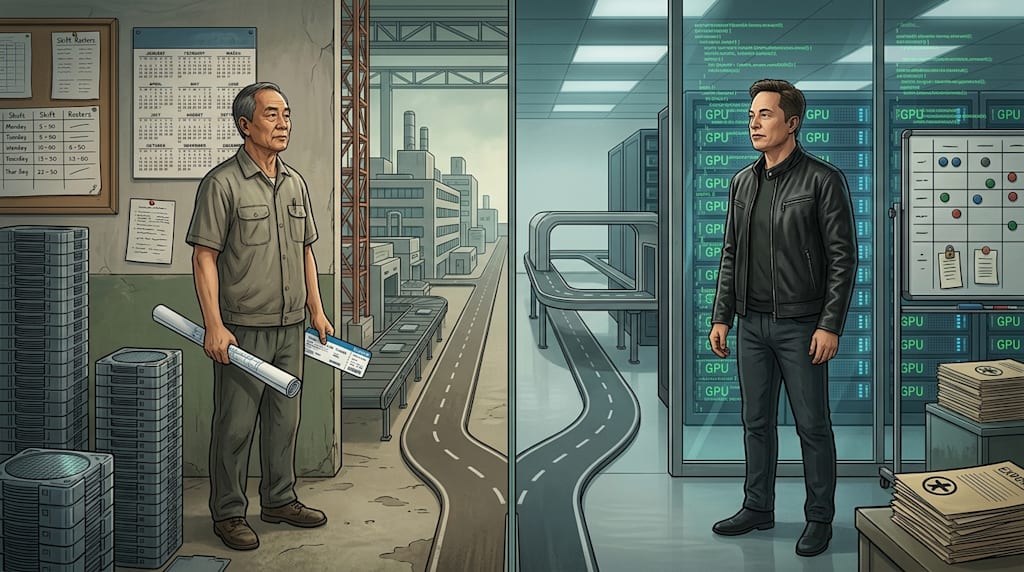
The day Richard Chang gave up his TSMC shares, no press conference took place.
TSMC wanted the shares back. He signed the waiver and booked a flight to Shanghai. In 2000, at 52, he landed in Zhangjiang with more than 400 engineers. The first 8-inch wafer fab reached production in 13 months. The number gets quoted often. Fewer people ask what happened inside those 13 months: how many revisions the equipment embargo list went through, how many demand letters from patent litigation arrived, how many of the 400-plus engineers left before the line was finished. That history lives in shift rosters and flight records, not in a press release.
People keep placing Jensen Huang inside the same story. The opening line is usually "he is also Chinese," followed by "he has the most advanced GPUs and CUDA," and then "if he came back." The logic slides forward, and it feels rude to interrupt it. Smooth logic can still be wrong. Richard Chang's trade was easy to count because the thing he surrendered had a number attached, and the thing he received had a shape you could point to: a fab, a ramp, a production date. Jensen Huang faces a different problem.
When Richard Chang returned to the mainland, chip manufacturing there was a blank sheet. That meant a body of experience from building ten wafer fabs at Texas Instruments could be transferred wholesale. The 13-month ramp proved the transfer worked. He brought back muscle memory for building fabs, ramping production, and reaching volume. That memory took root. It grew into SMIC, then Shanghai Xinsi's 300mm silicon wafers, then SiEn Semiconductor. Each node in that chain has a person, a fab, and a production start date attached to it.
Jensen Huang has no blank sheet to place anything on. CUDA is a habit written by developers over more than a decade: paths for reproducing papers, toolchains, tuning intuition, and the hiring-market price of the phrase "knows CUDA." TSMC's CoWoS packaging capacity is a set of locked numbers on a scheduling sheet. Nvidia's China revenue share has fallen to single digits. Its high-end AI chip business in China has been squeezed by export controls to near zero. Bringing a group of people back can move mid-level execution capacity. It cannot move the power to define a platform.
Among Nvidia's 36 direct reports, the only clearly identifiable Chinese face is Xinzhou Wu, who runs the automotive business. CUDA architect, CTO, and chief scientist are not slots a person can carry away because he followed the company for years. Nvidia is a machine driven by suppliers, customer schedules, developers, and the capital market. Jensen Huang is its most visible operator, not its only part. The "trusted inner team" cannot migrate as a unit. That image misreads how a modern semiconductor company distributes power.
Identity and interests sit on a different scale too. Jensen Huang immigrated to the United States at nine and has described himself as "the embodiment of the American dream." A person deeply tied to the U.S. system, with business interests spread across the globe, would need a different level of will and a different set of external conditions to give everything up and return. Richard Chang was choosing between two systems in 2000. Jensen Huang operates after those systems began accelerating toward decoupling. Chang faced a choice. Huang faces a structure.
The road Richard Chang walked is not "the best road" for Jensen Huang. It answers a different question. Chang's question was whether the industry could exist. Huang's question is whether its core platform can be replaced. People can partly bridge the first question. The second requires time, factories, schedules, developer habits, and graduates who keep arriving.
This does not make Jensen Huang "unwilling." It means two simplifications fail in the same way. One turns him into a foreign businessman who can be abandoned at any time. The other turns him into a hero who fills the AI shortfall by coming back. Both skip the hard part: some things cannot travel with people, and some things grow only through fabs, scheduling sheets, developer habits, and graduating classes.
After Richard Chang, Shanghai Xinsi is running, SiEn is running, and SMIC's lines are running. The chain keeps extending. In Jensen Huang's team, Chinese engineers sit at the base, not in the decision layer. That comparison needs no summary. Chang's shares are gone. The fabs still run. Huang's shares keep rising. Nvidia's buildings keep running too. Two sets of shift rosters. Two kinds of arithmetic. Chang's old calculation is still on the table, written in a different arithmetic. The arithmetic changed. The question did not: an industry cannot wait for one person to give up everything and return.
About the Creator
Jin
Writer of reamstories
https://reamstories.com/jin
Enjoyed the story? Support the Creator.
Subscribe for free to receive all their stories in your feed. You could also become a paid subscriber, letting them know you appreciate their work.
Comments
There are no comments for this story
Be the first to respond and start the conversation.