
Remember When AOL Came in a Box of Cheerios?
The CD-ROM years, free internet hours, and the sound of dial-up

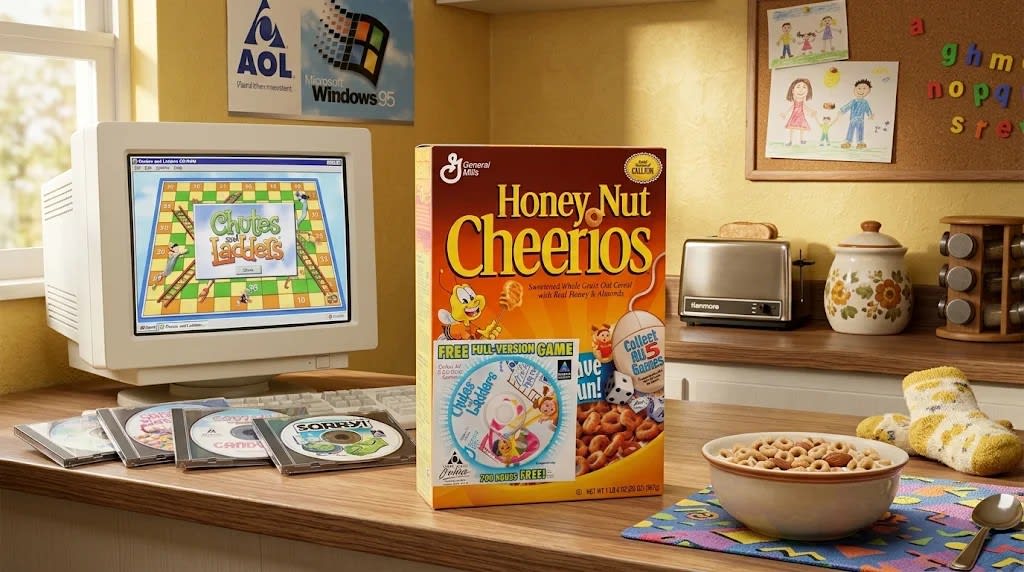
There was a time when getting on the internet could begin with breakfast. You could open a box of Cheerios, Cinnamon Toast Crunch, or Honey Nut Cheerios and find a little cardboard sleeve containing a CD-ROM. Printed across the packaging was an offer that seemed almost too good to be true: 50 Free Hours! Sometimes it was 700 Hours Free! Apparently, the internet was giving itself away, and all you needed was a bowl of cereal to get started.
For anyone who remembers the late 1990s and early 2000s, those little discs were part of everyday life. Between 1997 and 2002, AOL was practically conducting a nationwide invasion of mailboxes, grocery stores, magazines, and retail counters. Its promotional CDs seemed to turn up everywhere. You could hardly get through a week without seeing another one.
AOL had a marketing strategy that was hard to miss. The company wanted everyone online, and it was willing to send out an extraordinary number of discs to make that happen. Estimates from the era suggested AOL's CDs accounted for an astonishing proportion of worldwide CD production. Think about that for a moment. Somewhere in the world, someone was manufacturing discs, and a remarkable number of them seemed destined to end up in an American mailbox.
The cereal promotions were especially memorable. Finding one felt like getting an extra prize with breakfast. The disc came in a cardboard sleeve, usually decorated with bright graphics and a promise of free internet access. You could take it to the computer, install the software, and start the process of getting connected. It was a lot more exciting than finding another plastic toy at the bottom of a cereal box.
Of course, getting online required a little more effort than clicking an icon on a modern computer. You needed a computer, a telephone line, a modem, and the AOL installation disc. Once everything was connected, you entered your information and clicked the button to sign on.
Then came the sound.
Anyone who used dial-up internet remembers it. First, the modem dialed the telephone number. Then came the electronic screeching, buzzing, clicking, and bursts of static. It sounded like a fax machine having a disagreement with an alien spacecraft. The noises changed several times, and you could tell when the connection was getting closer. Sometimes it worked on the first attempt. Other times, the modem seemed determined to make you wait.
Finally, the noise stopped, and AOL welcomed you online.
That sound became one of the defining memories of early internet use. You could hear it from another room and know someone was getting connected. It was practically a soundtrack for the late 1990s. Even today, a recording of that dial-up sequence can take someone straight back to the days when getting online required a telephone line and a little patience.
AOL had its own personality, too. The greeting, the email notification, the chat rooms, and the familiar interface became part of the experience. You could check your email, search for information, visit websites, and discover people who shared your interests. The internet still felt new enough that every discovery could lead to another.
And then there were the other CD-ROMs.
Software companies regularly mailed trial programs and games directly to people's homes. They came in glossy paper sleeves, promotional envelopes, and occasionally little packages that made opening the mailbox feel like a trip to a software store. Some discs contained limited versions of programs, while others offered full games. You could install something new, play around with it, and see whether you liked it.
Installing software was almost an activity in itself. You inserted the disc, waited for the computer to read it, followed the instructions, and watched the progress bar move across the screen. Sometimes the installation took a while, especially on older computers. You might have to close other programs or restart the machine before everything worked properly. Still, getting a new program installed felt like adding another toy to your collection.
Computer games were a big part of the CD-ROM boom. Developers could include music, animated sequences, and video clips, giving games a much richer experience than the old floppy disks. Some promotions offered sample games, while others included complete titles. There was always something new to try, and the fact that a disc had arrived free in the mail made it even better.
The free internet hours came with a catch, naturally. AOL was hoping people would enjoy the trial service enough to become paying subscribers. The cereal companies were helping promote the service, and AOL was getting its software into millions of homes. It was clever marketing, and it worked. The company became one of the biggest names associated with the early internet.
There were a few things about dial-up that could drive a household crazy. The biggest problem was the telephone line. While someone was online, the household telephone was occupied. Anyone trying to call might get a busy signal, and anyone expecting an important call had a good reason to complain. If someone picked up the telephone while the modem was connected, the internet session could suddenly end.
Downloading files was another test of patience. A program that takes seconds to download today could take a considerable amount of time back then. If the connection dropped halfway through, you might have to start again. And if you were downloading something large, you had plenty of time to find another activity while the computer did its work.
Still, those inconveniences rarely took away from the excitement. Getting online was something you looked forward to. You sat down at the computer, listened to the modem connect, and began exploring. There were websites to discover, games to play, programs to install, and people to meet. The internet felt like a place you went to, rather than something that followed you around all day.
Today, the idea of receiving a CD-ROM in the mail to get internet access seems almost ridiculous. Software comes from online stores, games update themselves, and high-speed connections have made the old dial-up routine a distant memory. Most people would have little patience for waiting through the modem's electronic performance every time they wanted to check an email.
Those of us who experienced that era remember the excitement. We remember the cereal boxes, the cardboard sleeves, the glossy promotional mailers, and the endless AOL discs. We remember installing programs from CDs and discovering games that occupied entire afternoons. We remember the sound of the modem and the satisfaction of finally getting connected.
It was a different internet, and in many ways, it was a lot more fun to explore because everything felt new. You never quite knew what you would discover after signing on, and even a promotional disc from a box of cereal could open up hours of entertainment.
The next time someone complains about a slow internet connection, it might be worth reminding them that there was a time when getting online sounded like a robot choking on a telephone cord, tied up the household phone, and came with a promise of 50 free hours.
And we thought it was wonderful.
About the Creator
Tim Carmichael
Let your becoming be louder than your fear, and your smallest steps become the road you once thought impossible to walk. An Appalachian poet and cookbook author my book Beautiful and Brutal Things is on Amazon, Link 👇
Enjoyed the story? Support the Creator.
Subscribe for free to receive all their stories in your feed. You could also become a paid subscriber, letting them know you appreciate their work.
Comments
There are no comments for this story
Be the first to respond and start the conversation.