
Rare Earth Metals: The Invisible Chokepoint in the Global Technology Race
The market is projected to witness 8.3% of annualised growth rate totalling the market value at around USD 33.7 billion by 2033.

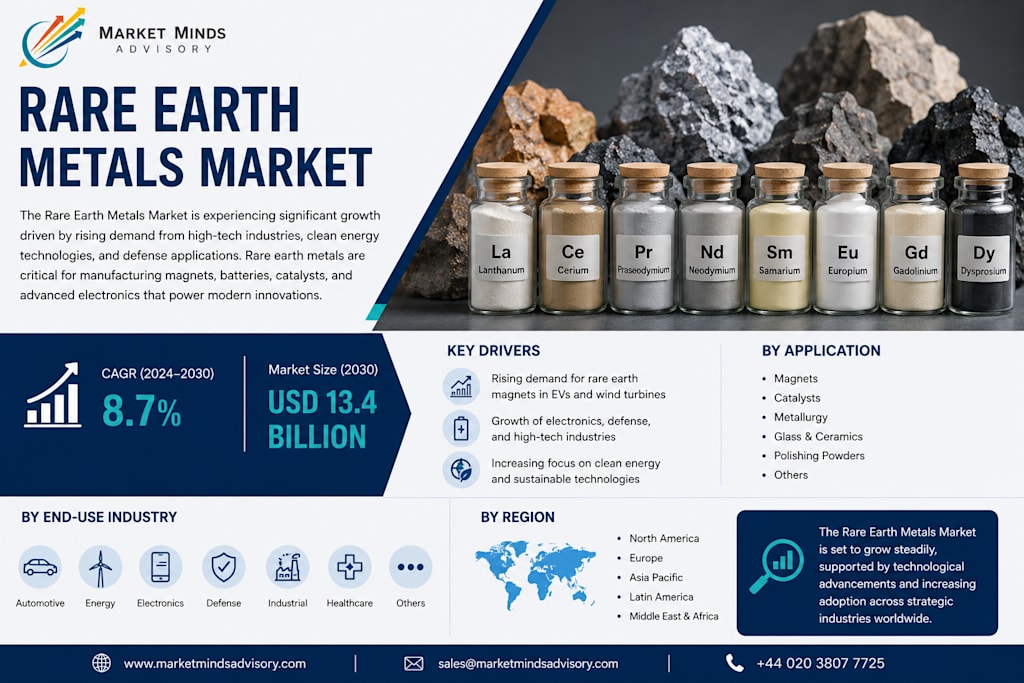
The world’s most advanced technologies depend on materials most executives can’t name, and the supply chain is controlled by a single nation with growing geopolitical leverage.
The Strategic Vulnerability Hiding in Plain Sight
Rare earth metals power everything from electric vehicle motors and wind turbines to precision-guided missiles and smartphone screens. Yet 70% of global production and 90% of processing capacity sits in China. This isn’t just a supply chain issue. It’s a strategic dependency that could reshape competitive advantage across multiple industries within the next 36 months.
The market isn’t simply growing. It’s fragmenting into winners and losers based on who secures access, who builds alternative supply chains, and who can navigate the intersection of technology demand and resource nationalism. Companies that treat this as a procurement problem rather than a strategic imperative are already behind.
Why Rare Earth Dependency Became a Boardroom Issue
Three forces converged to elevate rare earths from a niche materials concern to a C-suite priority. First, the clean energy transition created exponential demand. A single offshore wind turbine requires up to 600 kilograms of rare earth permanent magnets. Electric vehicles need 10 times more rare earth content than conventional cars. Second, defense modernization programs across NATO and Indo-Pacific allies depend on rare earth-enabled precision systems. Third, China demonstrated willingness to use export restrictions as geopolitical leverage, most notably during trade tensions in 2019 and technology disputes in 2023.
The result is a market where price volatility has become structural, not cyclical. Neodymium prices have swung 300% in 18-month periods. Long-term contracts are increasingly difficult to secure. Companies without direct supply relationships face allocation risk, not just cost risk.
This isn’t a temporary disruption. It’s a permanent recalibration of how critical materials flow through the global economy.
Three Structural Shifts Redefining the Market
The Weaponization of Supply Chain Geography
Governments are treating rare earth access as national security infrastructure. The United States, European Union, Japan, and Australia have committed over $4 billion in combined funding to develop non-Chinese supply chains. This includes mine development in Australia and Africa, processing facilities in North America and Europe, and recycling infrastructure across developed economies. The shift isn’t about eliminating Chinese supply. It’s about creating optionality and reducing single-source dependency.
For companies, this means supply chain decisions now carry geopolitical risk premiums. Sourcing strategies that made economic sense 24 months ago may expose companies to regulatory pressure, tariff structures, or allocation constraints.
Technology Substitution Versus Performance Trade-offs
R&D investment in rare earth-free technologies has accelerated, particularly in permanent magnet motors and catalysts. Some manufacturers are exploring ferrite magnets or switched reluctance motors for lower-performance applications. However, substitution comes with compromises. Rare earth magnets deliver 5 to 10 times higher energy density than alternatives. In aerospace, defense, and high-performance EVs, there is no viable substitute without significant performance degradation.
The strategic question isn’t whether substitution will happen. It’s which applications can tolerate performance trade-offs and which cannot. Companies betting on full substitution may find themselves locked out of premium segments.
The Emergence of Urban Mining and Circular Supply
Recycling rare earths from end-of-life products is shifting from pilot projects to commercial scale. Japan has recovered rare earths from discarded electronics and industrial waste, reducing import dependency by 15%. Europe is mandating recycled content in new products under circular economy regulations. The economics are improving as primary supply costs rise and processing technologies mature.
However, recycled supply won’t solve the growth problem. Even aggressive recycling scenarios cover only 10 to 15% of projected 2030 demand. The real value is in supply chain resilience and regulatory compliance, not volume replacement.
Where the Real Opportunity Lies
The highest-value opportunities are concentrated in three areas. First, midstream processing and refining capacity outside China. Companies that control separation and refining can capture margin and reduce geopolitical exposure. Second, high-purity materials for defense and aerospace applications, where performance requirements eliminate low-cost competition and long-term contracts provide revenue stability. Third, magnet manufacturing co-located with end-use industries, particularly EV and wind turbine production hubs in North America and Europe.
The mistake is chasing volume in commodity-grade materials. The strategic play is controlling high-specification supply chains where switching costs are high and customer relationships are sticky.
How Competitive Positioning Is Evolving
The market is bifurcating into two tiers. Tier one players have secured long-term offtake agreements, invested in vertically integrated supply chains, or locked in government-backed financing. Tier two players are price takers, exposed to spot market volatility and allocation risk during supply crunches.
This dynamic is accelerating consolidation. Major automotive and industrial companies are taking equity stakes in mining projects, signing joint ventures with processors, and backward integrating into materials they once treated as commodities. The message is clear: rare earths are too strategic to leave to traditional procurement models.
For smaller players, the window to secure advantageous positions is closing. Once long-term contracts are locked and capacity is allocated, late movers will face structural cost and access disadvantages.
The Cost of Delayed Action
Companies that defer rare earth strategy face compounding risks:
Supply allocation risk during demand surges: Spot market access disappears when supply tightens, leaving late movers scrambling or halting production.
Regulatory compliance gaps: New mandates around supply chain transparency, recycled content, and conflict minerals will create compliance costs and market access barriers.
Margin compression in commoditized segments: Without differentiated supply or technology, companies compete purely on price in a market with structurally higher input costs.
Loss of strategic optionality: As competitors lock in long-term supply, remaining capacity becomes more expensive and less flexible.
The financial impact isn’t hypothetical. Automotive manufacturers have delayed EV production ramps due to magnet shortages. Wind turbine producers have seen project margins evaporate due to rare earth price spikes. Defense contractors have faced delivery penalties when suppliers couldn’t meet specifications.
About the Creator
Sanjay Vane
At Market Minds Advisory, we’re more than just consultants—we’re partners in your journey to growth and success.
Enjoyed the story? Support the Creator.
Subscribe for free to receive all their stories in your feed.
Comments
There are no comments for this story
Be the first to respond and start the conversation.