
Quiet Architect: Peter Thiel’s Tech, Power, and Global Reach
Beyond Headlines How a Billionaire Investor Has Redrawn the Lines Between Business, Politics, and Governance

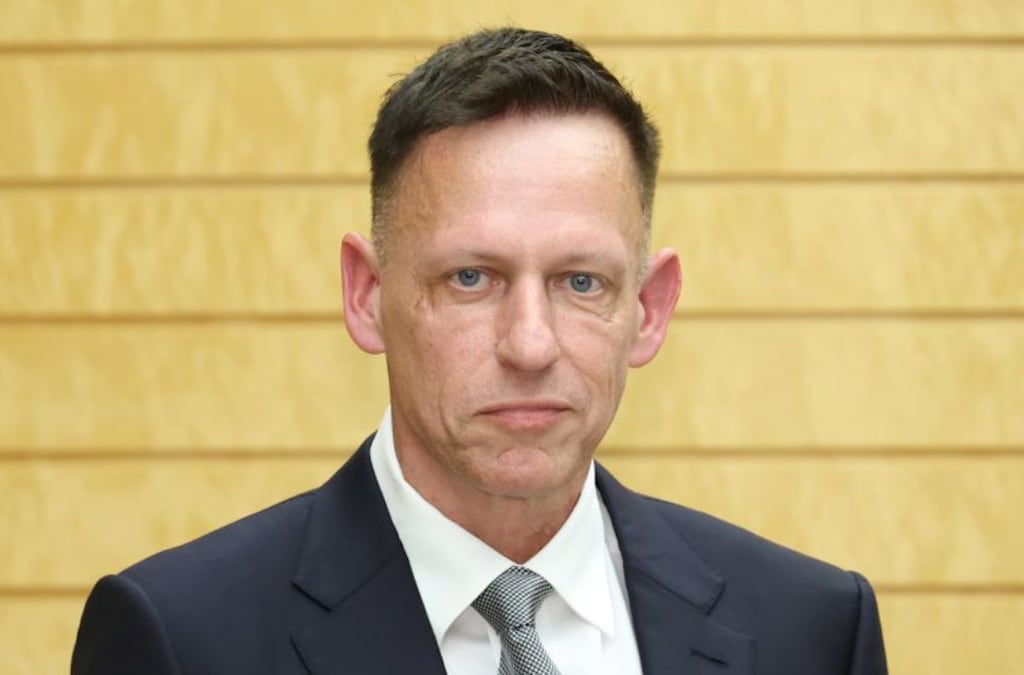
Peter Thiel may not dominate daily news cycles the way Donald Trump or Elon Musk do, but few figures rival his combined influence across technology, finance, and global politics. Born in Frankfurt am Main in 1967, he moved to the United States at age one and spent his formative years from 1971 to 1977 in then-South African-occupied Namibia, an early experience that would later shape his distinctive worldview. His rise began in technology as co-founder of digital payments giant PayPal, a company that also counted Elon Musk among its early figures, before he made arguably the most prescient investment in modern tech history: becoming the first outside investor in Facebook. Today his portfolio includes stakes in SpaceX, OpenAI, and dozens of other enterprises, with Forbes estimating his personal wealth at $35.7 billion. Yet his most consequential creation remains Palantir, the data analytics, artificial intelligence, and surveillance firm that has secured billions in contracts with the Pentagon and US Immigration and Customs Enforcement and which has become the focal point of growing global alarm.
Palantir: Promise, Power, and Backlash
In April, Palantir released a 22-point manifesto outlining its vision for technology and society a document that drew immediate and widespread condemnation. Critics described it as bearing the hallmarks of “techno-fascism,” arguing it positioned private corporate authority as superior to democratic governance. The fallout has been tangible: several European nations, including the United Kingdom, the Netherlands, France, Germany, and Spain have begun reconsidering or severing government and military ties with the company over mounting security and ethical concerns. Meanwhile, Thiel himself has relocated to Argentina, where he has held high-level discussions with right-wing President Javier Milei as the government pursues sweeping regulatory changes designed to attract foreign investment and accelerate the development of artificial intelligence data centres.
This global mobility is matched by long-standing political engagement in the United States. Thiel emerged as a major political force in 2016, donating $1.25 million to Donald Trump’s first presidential campaign and addressing the Republican National Convention at a time when Silicon Valley was broadly aligned with the Democratic Party. His political philosophy defies simple labels often described as libertarian nationalist and is anchored in a consistent conviction: “technology is the alternative to politics.” He expresses deep distrust of government regulation, elected officials, and liberal elites, framing technological progress as a solution to systemic stagnation.
Philosophy, Faith, and a Vision of Conflict
Biographer Max Chafkin, author of a 2021 account of Thiel’s career, offered a stark assessment in Time magazine: “It’s bordering on fascism. He talks about how companies are better run than governments because they have a single decision-maker a dictator, basically. He is hostile to the idea of democracy. That’s pretty scary when you consider the role the companies that he’s been involved in play.”
These contrarian instincts were visible early. As a student at Stanford University, Thiel founded The Stanford Review to push back against prevailing liberal campus culture a posture that foreshadowed his current outspoken opposition to what he terms “woke” ideology. His worldview is further shaped by his self-identification as a “small ‘o’ orthodox Christian,” a faith that visibly informs his conservative politics even as his marriage to American financier Matt Danzeisen sits in apparent tension with traditional doctrine.
In recent years, his public discourse has grown increasingly preoccupied with the concept of the Antichrist not as a biblical figure, but as a force he argues is seducing humanity into decline “by playing on our fears of technology” under the slogan “Peace and safety.” Those he has cast, however vaguely, as aligned with this force include climate activist Greta Thunberg, whom he describes as a “Luddite who wants to stop all science,” and governments seeking to regulate artificial intelligence. In July, he went further, accusing Pope Leo XIV of “working for the Chinese communists” after the pontiff warned publicly of the “risk of dehumanization” inherent in unregulated AI.
Strategic Alliances and the Succession Roadmap
Among his many connections, none carries greater strategic weight than his relationship with Vice President JD Vance widely viewed as Donald Trump’s most likely successor. The two men first met in 2011 when Thiel spoke at Yale Law School. Vance later wrote in the Christian magazine The Lamp that Thiel “defied the social template I had constructed that dumb people were Christians and smart ones atheists.” Thiel went on to donate $15 million to Vance’s 2022 Senate campaign the largest single donation ever made to a US Senate candidate, cementing a partnership that has become one of Washington’s most closely watched. Observers increasingly believe Thiel is positioning himself to protect and expand his vast interests should Vance eventually reach the presidency.
Reflecting on his approach nearly a decade ago, Thiel told the Washington Post: “I’ve built some great friendships over the years with people I’ve worked with. And I think that’s a really important part of what enables one to be successful in the long run in our society.”
It is a philosophy that has served him well. But as his influence spreads across borders and into the highest offices of state, the question is no longer whether he will succeed but for whom, and at what cost to the democratic systems he has long viewed with suspicion.
About the Creator
Mark Lim
Hi I am mark an automotive student and a car, tech and food enthusiast ! Im gonna try and post daily & hope you enjoy what I write and do share my page with people you know. I would gladly appreciate it! Cheers
Enjoyed the story? Support the Creator.
Subscribe for free to receive all their stories in your feed.
Comments
There are no comments for this story
Be the first to respond and start the conversation.