
Production Data vs. Synthetic Data: How to Test Live Systems Without Exposing PII
Balancing Security Testing with Data Privacy Compliance

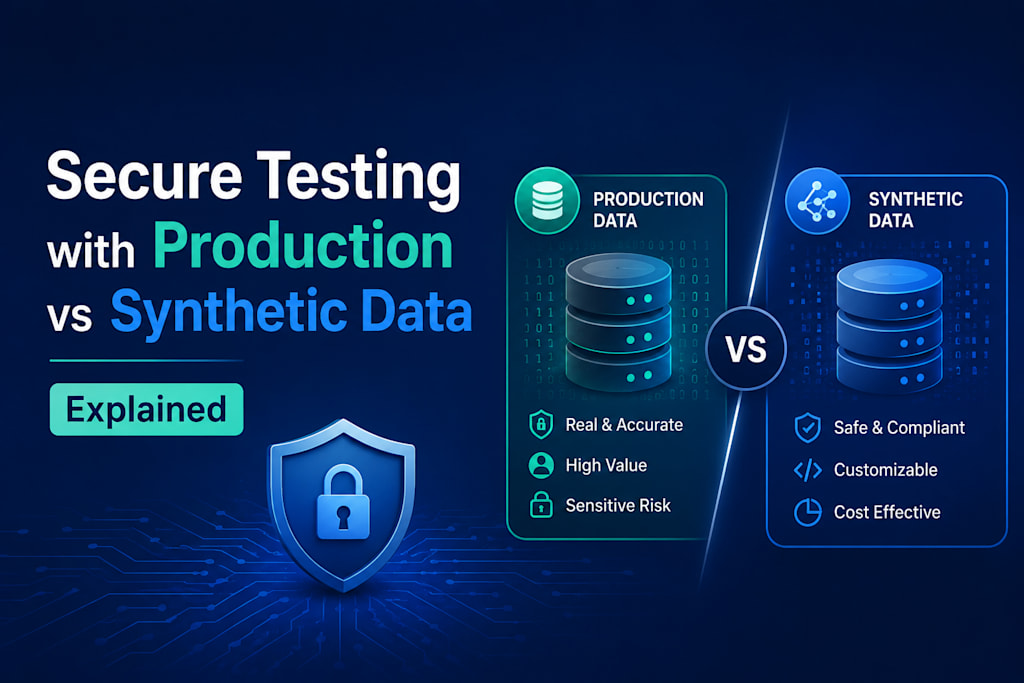
Production security testing plays a critical role in helping organizations identify vulnerabilities before attackers exploit them. However, testing live environments also introduces a major compliance challenge: how do security teams evaluate production systems without exposing sensitive customer information?
Finding a critical vulnerability in a live database may feel like a major win for an application security team. But if that same security assessment accidentally exposes customer credit card numbers, healthcare records, or personal identities inside logs or third-party systems, the result can quickly become a serious compliance failure.
Software architects, security engineers, data teams, and Data Protection Officers (DPOs) constantly face this operational challenge. Understanding the penetration testing role in HIPAA and PCI DSS compliance is increasingly important, as production security testing often requires highly realistic datasets to uncover deep logical flaws, authentication weaknesses, and multi-step vulnerabilities inside modern applications. Yet using raw production data without strict safeguards can directly violate privacy regulations such as GDPR, CCPA, and HIPAA.
Balancing security visibility with compliance does not have to be a zero-sum game. By understanding how testing-related data exposure occurs and adopting safer testing architectures built around synthetic and masked data, organizations can evaluate live systems more securely without compromising user privacy.
The Anatomy of an Accidental Leak During Production Security Testing
To protect sensitive information during production security testing, organizations must first understand how traditional testing workflows expose Personally Identifiable Information (PII).
Log Contamination
When automated scanners or security engineers inject testing payloads into live applications, these requests can trigger unexpected system exceptions or debugging events. If logging pipelines are poorly configured, the surrounding database state may be written directly into logs, SIEM dashboards, or monitoring tools in plain text.
This creates a hidden compliance risk because sensitive production data can unintentionally spread across multiple internal systems during a routine vulnerability assessment.
Third-Party Data Exposure
Modern applications rely heavily on external integrations. During production security testing, automated crawlers interacting with live forms and APIs may unintentionally trigger requests to payment gateways, CRM platforms, analytics systems, or marketing tools.
As a result, testing anomalies can leak into third-party environments and expose real user identities outside the organization’s direct control.
Shadow Environments
To reproduce vulnerabilities quickly, engineering teams sometimes clone sections of production databases into staging or local environments. These temporary shadow environments rarely maintain the same strict access controls, monitoring visibility, or firewall protections as production systems.
For example, a cloned healthcare database copied into a staging environment without proper masking could unintentionally expose patient information to internal users or external contractors.
This is one of the most common compliance risks associated with insecure production security testing workflows.
Production Data vs. Synthetic Data: Evaluating the Options
Organizations performing production security testing generally rely on three major data strategies. Each approach balances engineering realism against compliance risk differently.
Real Production Data
Using raw production data offers the highest testing accuracy because it exposes scanners and security tools to genuine edge cases, business logic behaviors, and real-world anomalies.
However, this approach also introduces the highest compliance risk. If testing systems, logs, APIs, or integrated tools accidentally expose sensitive information, organizations may violate GDPR, HIPAA, PCI DSS, or other regulatory requirements.
Anonymized and Masked Data
Masked datasets reduce risk by removing or transforming direct identifiers such as names, phone numbers, or email addresses.
For example, organizations may tokenize customer records, substitute values with randomized strings, or hash sensitive identifiers before testing begins.
This approach preserves much of the structural integrity needed for production security testing while significantly reducing the risk of exposing real user identities.
Synthetic Data
Synthetic data is artificially generated to mimic the statistical patterns and structural behavior of production datasets without containing any real user information.
Because synthetic datasets contain no genuine customer records, they offer the safest option from a compliance perspective. However, generating realistic synthetic data capable of triggering complex application workflows and backend business logic can require significant engineering effort.
Implementing a Compliance-Safe Testing Architecture
Reducing compliance risk during production security testing requires organizations to embed privacy protections directly into their testing architecture rather than relying on manual oversight alone.
Dynamic Scoping and Test Accounts
Instead of allowing scanners to interact with arbitrary live user profiles, organizations should inject dedicated test tenants and monitored dummy accounts directly into production systems.
These isolated accounts provide safe environments for executing security tests without touching real customer information.
Automated Log Sanitization
Organizations should configure logging pipelines, SIEM platforms, and web application firewalls (WAFs) with automated sanitization rules capable of detecting and masking sensitive patterns before they reach storage systems.
Regular expressions can help identify:
- payment card formats,
- healthcare identifiers,
- national ID numbers,
- email addresses,
- authentication tokens.
This significantly reduces the risk of compliance failures caused by exposed logs during security testing.
Continuous Monitoring During Security Assessments
Production security testing should always include real-time monitoring for unusual data movement, excessive API requests, authentication anomalies, and abnormal system behavior.
Continuous visibility helps security teams quickly identify accidental exposure before sensitive information spreads across connected systems.
Resolving this data dilemma requires moving away from manual workarounds toward a hardened architecture built for production-safe testing for security compliance.
Conclusion
Protecting customer privacy while performing production security testing is entirely achievable with the right data strategy and security controls.
Combining synthetic data generation, masked datasets, isolated test accounts, and automated log sanitization allows organizations to evaluate live systems more safely without sacrificing testing accuracy.
As compliance requirements under GDPR, HIPAA, PCI DSS, and other privacy regulations continue to evolve, organizations must treat secure data handling as a core part of modern production security testing rather than an afterthought.
Continuous security visibility remains essential for protecting modern applications, but it should never come at the expense of user trust, regulatory compliance, or sensitive data protection.
About the Creator
Sam Bishop
Hi there! My name is Sam Bishop and I'm a passionate technologist who loves to express my thoughts through writing. As an individual and tech enthusiast, I'm always eager to share my perspectives on various topics.
Enjoyed the story? Support the Creator.
Subscribe for free to receive all their stories in your feed.
Comments
There are no comments for this story
Be the first to respond and start the conversation.