
Procurement Software Market Surges as AI and Digital Transformation Redefine Enterprise Spending
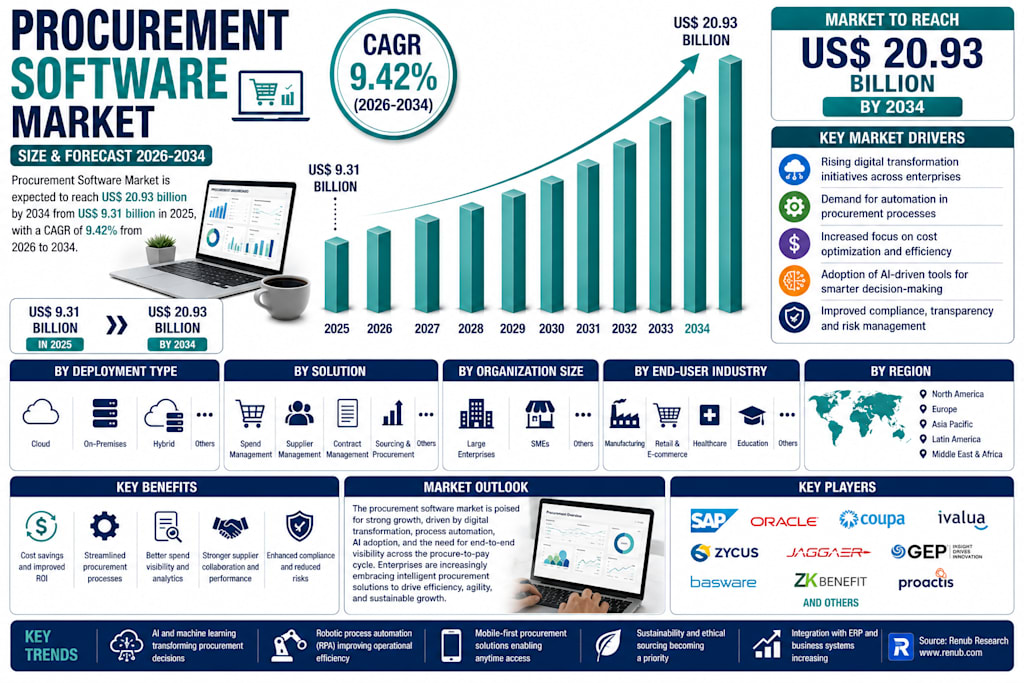
With organizations prioritizing automation, cost control, and supply chain transparency, the procurement software market is projected to grow from US$ 9.31 billion in 2025 to US$ 20.93 billion by 2034, registering a CAGR of 9.42% from 2026 to 2034.

The global procurement software market is undergoing a rapid transformation as organizations increasingly adopt digital tools to modernize purchasing operations and optimize spending. In a business environment defined by supply chain complexity, cost pressures, and the need for transparency, procurement software has emerged as a critical solution for enterprises seeking efficiency and control.
According to Renub Research, the market is expected to expand from US$ 9.31 billion in 2025 to US$ 20.93 billion by 2034, growing at a compound annual growth rate (CAGR) of 9.42% during the forecast period from 2026 to 2034. This strong growth trajectory reflects the increasing importance of intelligent procurement systems in modern enterprise operations.
Procurement software refers to digital platforms that automate and streamline purchasing processes, covering everything from requisition and sourcing to contract management and payment. These systems enable organizations to manage supplier relationships, compare vendor quotes, track orders, and monitor spending in real time. By centralizing procurement activities, businesses can reduce manual errors, accelerate workflows, and make data-driven decisions that improve financial performance.
AI Transforming Procurement into a Strategic Function
Artificial intelligence is reshaping procurement from a transactional function into a strategic business capability. Modern procurement platforms leverage AI to analyze spending patterns, evaluate supplier performance, and predict procurement risks.
In October 2023, Olive Technologies partnered with Procurify to integrate AI-driven vendor sourcing and selection capabilities, highlighting how AI is enhancing procurement accuracy and efficiency. These systems can automate repetitive tasks such as purchase order processing and invoice verification, allowing procurement teams to focus on strategic initiatives like supplier negotiation and risk management.
AI-driven tools also provide predictive insights, helping organizations anticipate supply chain disruptions, identify cost-saving opportunities, and improve decision-making. As companies increasingly prioritize agility and resilience, AI-enabled procurement platforms are becoming essential components of enterprise technology stacks.
Digital Transformation Driving Widespread Adoption
The broader wave of digital transformation across industries is a major catalyst for procurement software adoption. Organizations are moving away from manual, paper-based processes toward cloud-based, automated systems that offer real-time visibility and scalability.
Low-code and no-code platforms are further accelerating this shift. In October 2023, GEP launched GEP Quantum, an AI-driven, low-code procurement and supply chain platform that enables rapid deployment and customization. These platforms allow non-technical users to design procurement workflows, reducing reliance on IT teams and speeding up implementation.
Cloud-based procurement solutions also provide flexibility and accessibility, enabling organizations to manage procurement operations from anywhere. This is particularly important in a globalized business environment where supply chains span multiple regions and time zones.
As enterprises seek to improve efficiency, transparency, and adaptability, digital procurement systems are becoming indispensable tools for modern business operations.
Growing Demand for Cost Efficiency and Spend Control
In an era of economic uncertainty and competitive pressure, organizations are placing greater emphasis on cost optimization and financial discipline. Procurement software plays a crucial role in achieving these objectives by providing real-time insights into spending patterns and supplier performance.
Centralized procurement platforms enable businesses to standardize purchasing processes, enforce compliance, and identify cost-saving opportunities. Automated approval workflows reduce delays and improve efficiency, while advanced analytics help organizations make informed purchasing decisions.
In October 2023, Atamis partnered with Maximus UK to deliver advanced procurement tools that enhance sourcing processes and operational transparency. This reflects a broader trend of enterprises adopting integrated procurement systems to improve efficiency and maximize return on investment.
As companies continue to focus on cost control and operational excellence, demand for procurement software is expected to remain strong.
Challenges: Integration and Cybersecurity Risks
Despite its benefits, the procurement software market faces several challenges. One of the most significant is the complexity of integrating modern procurement systems with existing legacy infrastructure. Many organizations still rely on outdated ERP systems and fragmented workflows, making implementation difficult and time-consuming.
Data migration, customization, and workflow redesign can increase costs and delay deployment. Integration failures may lead to data inconsistencies and reduced user adoption, particularly among small and medium-sized enterprises with limited IT resources.
Cybersecurity is another critical concern. Procurement platforms handle sensitive information such as supplier contracts, pricing structures, and financial transactions. As these systems move to the cloud, they become potential targets for cyberattacks.
Ensuring data security and compliance with regulations such as GDPR is essential for building trust and encouraging adoption. Organizations must invest in robust cybersecurity measures to protect their procurement systems and maintain operational integrity.
Regional Insights Highlight Global Expansion
The United States leads the procurement software market, driven by strong digital transformation initiatives and widespread adoption of cloud technologies. Large enterprises across industries are investing in AI-enabled procurement tools to improve efficiency and supply chain visibility.
Germany represents a key European market, supported by its strong industrial base and focus on precision and compliance. The country’s emphasis on Industry 4.0 and automation is driving adoption of advanced procurement systems.
China is experiencing rapid growth due to large-scale manufacturing activities and increasing adoption of digital technologies. Government initiatives supporting smart supply chains and digital ecosystems are further boosting demand.
Saudi Arabia is emerging as a promising market, driven by its Vision 2030 strategy, which emphasizes digitalization and economic diversification. Investments in infrastructure and large-scale projects are increasing the need for efficient procurement systems.
These regional dynamics highlight the global nature of the procurement software market and its relevance across diverse industries and economies.
Competitive Landscape and Industry Developments
The procurement software market is highly competitive, with major players focusing on innovation, strategic partnerships, and acquisitions to strengthen their market positions. Leading companies include Coupa Software, SAP, Zycus, Microsoft, Oracle, GEP, and Jaggaer.
Recent developments illustrate the dynamic nature of the market. In May 2025, The Hackett Group acquired Spend Matters to enhance its procurement intelligence capabilities. In March 2025, Beroe acquired nnamu, expanding its market research offerings. Meanwhile, Unimarket and VendorPanel merged to create a comprehensive source-to-pay platform.
Strategic partnerships are also shaping the industry. Coupa’s collaboration with Microsoft integrates procurement with enterprise finance systems, enabling seamless data flow and improved decision-making.
These developments reflect a broader trend toward consolidation, innovation, and the creation of integrated procurement ecosystems that deliver end-to-end solutions.
Market Segmentation Reflects Diverse Use Cases
The procurement software market is segmented by deployment, organization size, and end-use industries. Deployment options include cloud-based and on-premises solutions, with cloud adoption growing rapidly due to its scalability and cost efficiency.
Organizations range from small and medium-sized enterprises to large corporations, each with unique procurement needs. End-use industries include retail, healthcare, manufacturing, BFSI, IT and telecom, and energy, highlighting the broad applicability of procurement software across sectors.
This diversity underscores the importance of procurement software as a universal business tool, capable of delivering value across different industries and organizational sizes.
Final Thoughts
The procurement software market is evolving into a cornerstone of modern enterprise strategy, driven by the need for efficiency, transparency, and data-driven decision-making. As organizations navigate complex supply chains and economic pressures, digital procurement solutions are becoming essential for maintaining competitiveness.
Renub Research’s forecast of US$ 20.93 billion by 2034 highlights the market’s strong growth potential and long-term relevance.
However, addressing challenges such as integration complexity and cybersecurity risks will be critical for unlocking the full potential of the market.
About the Creator
Enjoyed the story? Support the Creator.
Subscribe for free to receive all their stories in your feed.
Comments
There are no comments for this story
Be the first to respond and start the conversation.