
Precipitated Calcium Carbonate Is Quietly Powering Innovation Across Modern Industries
Growing Demand from Paper, Plastics, Paints, and Pharmaceuticals Is Driving the Global Precipitated Calcium Carbonate Market

From the paper used in books and packaging to the plastics found in automobiles and consumer products, many modern materials depend on specialized additives that improve quality, performance, and efficiency. One such material is precipitated calcium carbonate (PCC), a highly refined mineral that has become indispensable across numerous industries worldwide.
Although it rarely receives public attention, precipitated calcium carbonate plays a vital role in enhancing product performance, reducing manufacturing costs, and supporting sustainability initiatives. Its exceptional purity, controlled particle size, and versatility make it one of the most widely used functional fillers and additives in industrial applications.
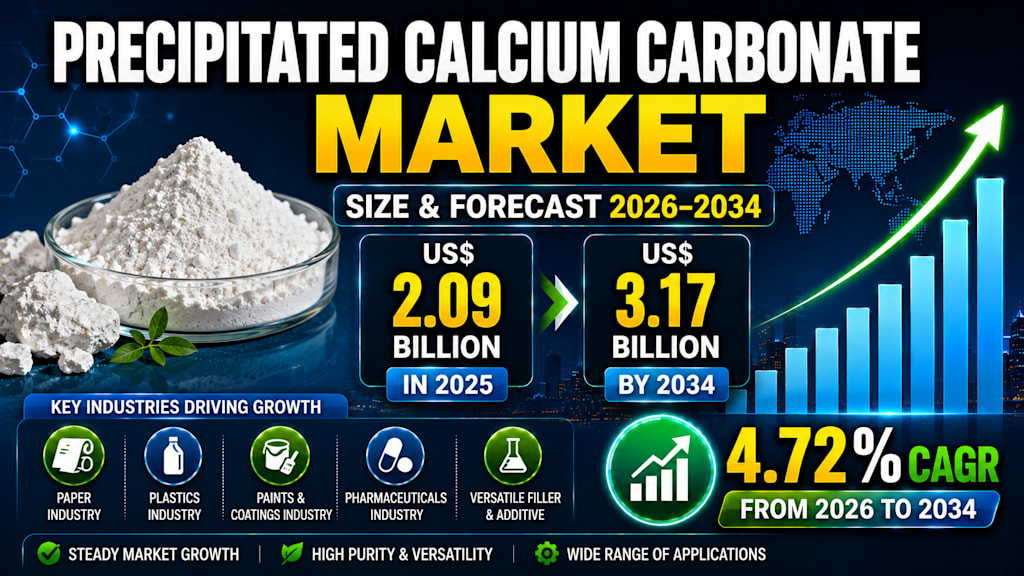
According to Renub Research, the Precipitated Calcium Carbonate Market is projected to grow from US$ 2.09 billion in 2025 to US$ 3.17 billion by 2034, expanding at a compound annual growth rate (CAGR) of 4.72% between 2026 and 2034. Increasing demand from paper, plastics, paints, coatings, pharmaceuticals, and food industries continues to drive market growth globally.
As industries seek materials that combine performance, affordability, and sustainability, precipitated calcium carbonate is emerging as a critical ingredient in the manufacturing economy.
Understanding What Makes PCC Different
Precipitated Calcium Carbonate (PCC) is a synthetic form of calcium carbonate produced through a carefully controlled chemical process involving limestone.
Unlike ground calcium carbonate (GCC), which is mechanically processed from natural limestone deposits, PCC is manufactured by precipitating calcium carbonate from a chemical solution. This process allows manufacturers to precisely control particle size, shape, surface area, and purity.
These characteristics give PCC significant advantages across a wide range of industrial applications.
Its fine particle structure improves product consistency, enhances performance, and allows manufacturers to tailor formulations according to specific requirements.
Because of its exceptional versatility, PCC is widely used in paper production, plastics manufacturing, paints, coatings, pharmaceuticals, food processing, inks, adhesives, and numerous specialty applications.
As manufacturers increasingly prioritize efficiency and product quality, PCC continues gaining popularity across industries.
The Paper Industry Remains a Major Growth Driver
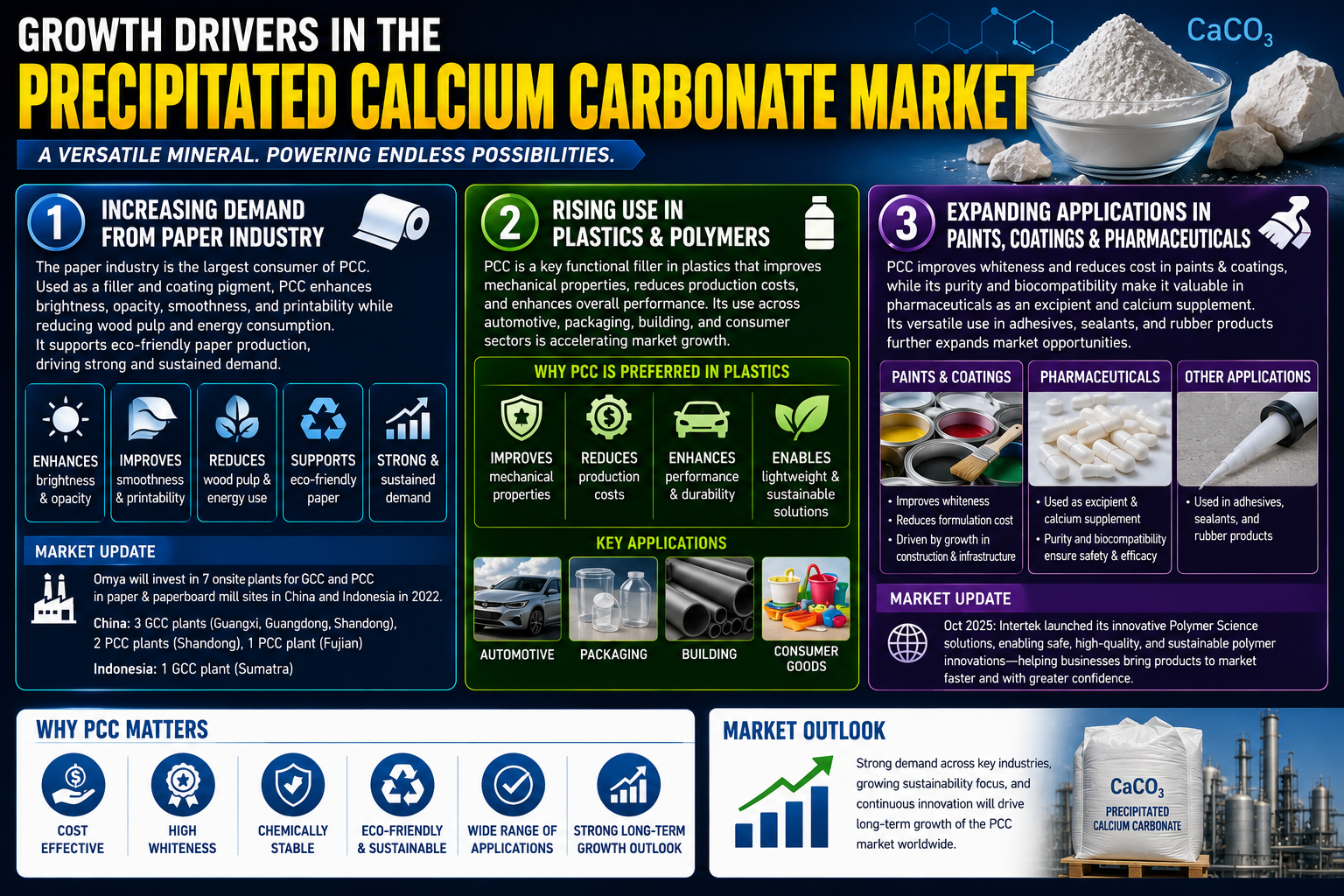
One of the largest consumers of precipitated calcium carbonate is the paper industry.
PCC serves as both a filler and coating pigment, helping improve important paper characteristics such as brightness, opacity, smoothness, and printability.
Modern paper manufacturers use PCC to reduce dependency on wood pulp while maintaining high-quality standards. This helps lower production costs while supporting more sustainable manufacturing practices.
The rise of e-commerce and packaging demand has further strengthened the importance of PCC in paper production.
Packaging materials require excellent print quality, durability, and visual appeal—all characteristics enhanced by precipitated calcium carbonate.
Major industry investments continue supporting growth in this segment. Companies are expanding PCC production capacity near paper mills to improve efficiency and reduce transportation costs.
As global demand for packaging materials and specialty paper products continues rising, PCC consumption within the paper industry is expected to remain strong.
Plastics Manufacturers Are Increasingly Adopting PCC
The plastics and polymers industry represents another significant growth opportunity for precipitated calcium carbonate.
Manufacturers use PCC as a functional filler to improve mechanical properties, enhance durability, and reduce production costs.
One of PCC's most valuable contributions is its ability to reduce material weight while maintaining strength and performance. This characteristic is particularly important in industries such as automotive manufacturing, where lightweight materials contribute to fuel efficiency and sustainability goals.
Packaging companies also utilize PCC to improve product performance while optimizing material usage.
By incorporating PCC into plastic formulations, manufacturers can achieve desired performance characteristics while lowering raw material costs.
As demand for lightweight and cost-effective materials continues growing, PCC is becoming an increasingly important component of plastic production.
Paints and Coatings Applications Continue Expanding
The paints and coatings industry is another major contributor to PCC market growth.
Precipitated calcium carbonate functions as both a filler and pigment extender, helping improve paint performance while reducing formulation costs.
PCC enhances key properties such as whiteness, opacity, surface smoothness, and durability. It also improves coating rheology, making products easier to apply and distribute evenly.
The global construction boom is creating substantial demand for paints and coatings used in residential, commercial, and infrastructure projects.
Urbanization and industrial development are further driving consumption of decorative and protective coatings worldwide.
In addition, the growing popularity of environmentally friendly, low-VOC coatings is increasing interest in PCC-based formulations.
As construction activity continues expanding globally, the paints and coatings segment is expected to remain an important growth engine for the PCC market.
Pharmaceutical Applications Are Gaining Importance
The pharmaceutical industry represents one of the most specialized and high-value applications for precipitated calcium carbonate.
Due to its purity and biocompatibility, PCC is widely used as a pharmaceutical excipient in tablets and capsules. It serves as a binding agent, stabilizer, and formulation aid.
PCC is also commonly used as a calcium supplement and antacid.
Growing healthcare awareness, aging populations, and increasing demand for nutritional supplements are supporting growth in pharmaceutical-grade PCC consumption.
Manufacturers must comply with strict quality and regulatory standards when producing pharmaceutical PCC, making this segment particularly important for premium suppliers.
As healthcare spending continues increasing worldwide, pharmaceutical applications are expected to contribute significantly to future market expansion.
Food Industry Demand Is Growing Steadily
Beyond industrial applications, PCC plays an important role in food manufacturing.
It is commonly used as a calcium fortifier in products such as dairy foods, cereals, baked goods, beverages, and nutritional supplements.
Consumers are becoming increasingly health-conscious and actively seeking products that support bone health and overall wellness.
As a result, food manufacturers are incorporating calcium-enriched ingredients into a growing number of products.
PCC also functions as an anti-caking agent and stabilizer in various food formulations.
Regulatory approvals across numerous countries have facilitated broader adoption of PCC within the food industry.
As demand for functional and fortified foods continues growing, food-grade PCC is expected to experience sustained expansion.
Inks and Printing Applications Support Market Growth
The global printing and packaging industries continue creating demand for precipitated calcium carbonate.
PCC improves print quality by enhancing brightness, opacity, and surface smoothness in ink formulations.
Packaging manufacturers increasingly require high-quality printing capabilities to support branding, product differentiation, and consumer engagement.
PCC helps achieve these objectives while reducing overall formulation costs.
The continued growth of flexible packaging, paper-based packaging, and commercial printing applications is supporting demand for PCC-based inks.
As packaging remains a critical component of global commerce, this segment is expected to contribute meaningfully to market development.
Sustainability Is Creating New Opportunities
Environmental considerations are becoming increasingly important across manufacturing industries.
Companies are under growing pressure to reduce resource consumption, lower emissions, and adopt sustainable production practices.
PCC contributes to sustainability efforts in several ways.
In paper manufacturing, it reduces reliance on wood pulp. In plastics, it supports lightweight product development. In coatings, it improves efficiency and material utilization.
Manufacturers are also exploring innovative production methods designed to reduce environmental impact while maintaining product quality.
As sustainability becomes a core business priority, materials that support environmental objectives are likely to experience stronger demand.
PCC's ability to enhance efficiency while reducing material consumption positions it favorably within this evolving landscape.
Challenges Facing the PCC Market
Despite positive growth prospects, the precipitated calcium carbonate market faces several challenges.
Fluctuating Raw Material and Energy Costs
PCC production depends heavily on limestone and energy-intensive manufacturing processes.
Variations in raw material availability, fuel prices, and electricity costs can significantly affect production expenses and profitability.
Because calcination and carbonation processes require substantial energy inputs, manufacturers remain vulnerable to fluctuations in energy markets.
Managing production costs while maintaining competitive pricing continues to be a major industry challenge.
Environmental and Regulatory Pressures
PCC manufacturing involves carbon dioxide emissions generated during calcination processes.
Governments and environmental organizations are implementing increasingly stringent regulations aimed at reducing industrial emissions.
Manufacturers must therefore invest in cleaner technologies, process optimization, and sustainability initiatives to remain compliant.
While these investments create opportunities for innovation, they can also increase operating costs and capital requirements.
Balancing environmental responsibility with economic performance remains an ongoing challenge for industry participants.
Regional Markets Show Strong Potential
United States
The United States remains one of the most mature PCC markets, supported by strong demand from paper, plastics, coatings, and pharmaceutical industries. Sustainability initiatives and advanced manufacturing capabilities continue supporting market growth.
United Kingdom
The UK market benefits from increasing demand in packaging, food, pharmaceutical, and coatings applications. Sustainability goals and innovation in materials science are creating new opportunities for PCC manufacturers.
India
India represents one of the fastest-growing PCC markets due to rapid industrialization, expanding packaging demand, infrastructure development, and government support for manufacturing growth.
Saudi Arabia
Saudi Arabia's ongoing investments in construction, industrial diversification, healthcare, and infrastructure development are creating favorable conditions for PCC market expansion.
The Future of Precipitated Calcium Carbonate
The future of PCC lies in innovation, sustainability, and advanced materials engineering.
Manufacturers are developing specialized grades tailored to emerging applications in healthcare, packaging, lightweight materials, and environmentally friendly products.
Advances in particle engineering and process technology are expected to further improve performance characteristics while enhancing production efficiency.
Growing demand for sustainable materials will likely create additional opportunities across multiple industries.
As businesses seek solutions that balance quality, cost efficiency, and environmental responsibility, PCC is expected to remain a valuable industrial material.
Final Thoughts
Precipitated calcium carbonate may not be a household name, but its impact on modern manufacturing is undeniable. From improving paper quality and strengthening plastics to enhancing pharmaceuticals and supporting food fortification, PCC plays a critical role across countless industries.
According to Renub Research, the global Precipitated Calcium Carbonate Market is expected to grow from US$ 2.09 billion in 2025 to US$ 3.17 billion by 2034, reflecting strong demand driven by industrial expansion, technological innovation, and sustainability initiatives.
As industries continue searching for versatile, high-performance, and environmentally responsible materials, precipitated calcium carbonate is positioned to remain an essential ingredient in the products and technologies that shape everyday life around the world.
About the Creator
Enjoyed the story? Support the Creator.
Subscribe for free to receive all their stories in your feed.
Comments
There are no comments for this story
Be the first to respond and start the conversation.