
Precast Concrete Is Becoming a Strategic Bottleneck for Infrastructure Execution
In 2025, the market is estimated to be valued near to USD 141.6 billion witnessing annualised growth rate of 5.3% bolstering the strong momentum to push the market to USD 214.0 billion by the end of the forecast period.

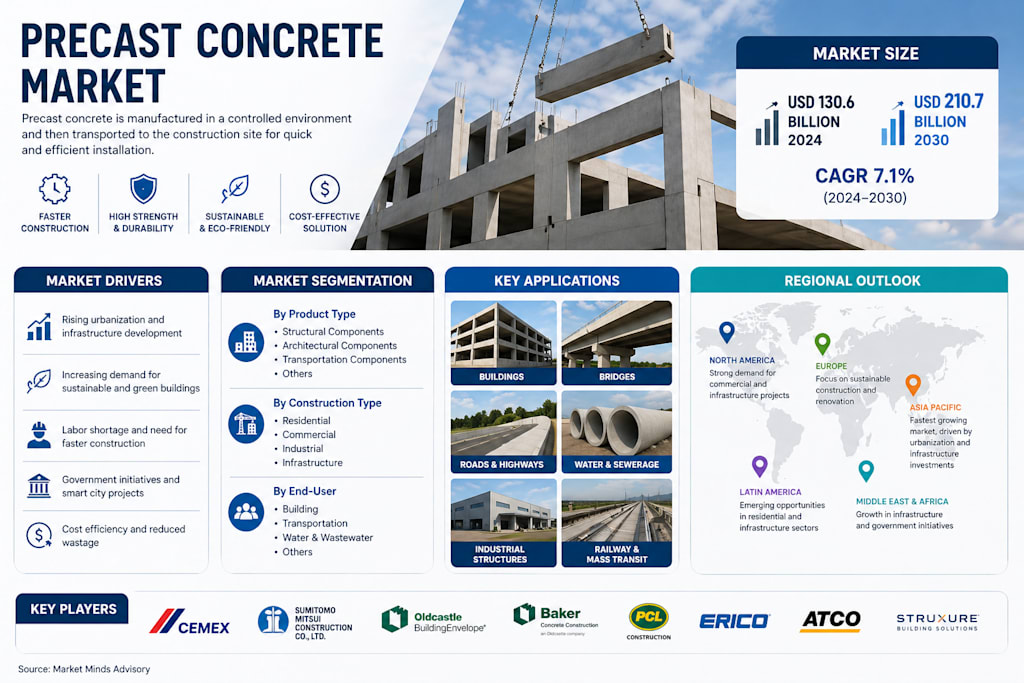
The construction industry’s shift toward speed and precision is exposing a critical vulnerability: traditional on-site concrete methods can no longer keep pace with project timelines, labor constraints, and quality demands.
The precast concrete market isn’t just growing—it’s becoming the default solution for infrastructure delivery at scale. Companies that treat this as a commodity material play are missing a fundamental restructuring of how large-scale construction gets financed, executed, and de-risked. The question is no longer whether to adopt precast, but how quickly organizations can secure capacity, lock in partnerships, and redesign project delivery models before competitors do.
Why This Market Shift Matters Now
Construction timelines are collapsing under pressure from three converging forces: chronic skilled labor shortages, tightening project financing windows, and zero tolerance for schedule overruns on public infrastructure. Precast concrete solves all three simultaneously by moving production off-site, compressing schedules by 30-50%, and delivering factory-level quality control that eliminates costly rework.
What makes this moment different is the capital reallocation happening across infrastructure investment. Governments and private developers are no longer willing to absorb the risk premium of traditional construction methods. They’re writing precast specifications directly into RFPs, effectively mandating the technology before projects even go to bid. This isn’t a gradual adoption curve—it’s a hard pivot that’s reshaping competitive positioning across general contractors, developers, and material suppliers.
The strategic implication is stark: companies without precast capabilities or partnerships are being systematically excluded from the highest-value project pipelines. The market is bifurcating between players who can deliver speed and certainty, and those stuck competing on price in a shrinking pool of conventional projects.
Structural Shifts Driving the Market
Urbanization Is Creating Permanent Capacity Constraints
Dense urban construction sites can no longer accommodate traditional concrete operations. Space limitations, noise restrictions, and environmental regulations are making on-site casting economically unviable in major metros. Precast manufacturing consolidates production in controlled facilities, then delivers finished components on precise schedules that minimize site disruption. Cities like Singapore, Tokyo, and Dubai have effectively mandated this approach through regulatory frameworks that penalize on-site concrete operations. This isn’t a trend—it’s becoming the baseline requirement for urban construction permitting.
Modular Construction Is Forcing Supply Chain Integration
The rise of modular building systems is fundamentally changing how precast concrete gets specified and procured. Developers are no longer buying individual components—they’re buying integrated building systems where precast elements must interface seamlessly with MEP systems, cladding, and structural frames. This is driving vertical integration and strategic partnerships between precast manufacturers, modular builders, and design-build contractors. Companies operating in silos are losing access to the fastest-growing segment of the market: multi-family residential and commercial projects designed for rapid occupancy.
Sustainability Mandates Are Rewriting Material Economics
Carbon accounting is moving from voluntary reporting to contractual obligation. Owners are imposing embodied carbon limits that traditional concrete methods struggle to meet. Precast manufacturing enables precise mix optimization, waste reduction, and the integration of supplementary cementitious materials at scale. More critically, it allows for carbon tracking and verification that satisfies ESG reporting requirements. Projects in the EU and parts of North America are already rejecting bids that can’t demonstrate carbon compliance—a requirement that heavily favors precast over site-cast alternatives.
Where the Real Opportunity Lies
The highest-value opportunities aren’t in replacing existing construction—they’re in enabling projects that couldn’t happen otherwise. Data centers represent a prime example: hyperscale facilities require construction speeds that only precast can deliver, with some projects compressing timelines from 24 months to 14 months purely through prefabrication strategies. Similarly, cold storage and logistics facilities are being built almost entirely with precast systems to meet the explosive demand from e-commerce fulfillment networks.
Transportation infrastructure is undergoing a parallel transformation. Bridge components, tunnel segments, and rail systems are shifting to precast to minimize traffic disruption and accelerate project delivery. State DOTs are rewriting standards to favor precast solutions, creating a multi-decade replacement cycle for aging infrastructure that heavily favors manufacturers with proven transportation portfolios.
The residential sector presents a more complex but potentially larger opportunity. Multi-family developers are adopting precast podium and structural systems to compress construction schedules and lock in fixed costs earlier in the development cycle. This is particularly acute in markets with tight housing supply, where speed to market directly impacts project returns.
Competitive or Strategic Shift
The competitive landscape is consolidating around scale and technical capability. Mid-sized regional players are being squeezed between large integrated manufacturers who can offer design-assist services and turnkey solutions, and specialized niche producers who dominate specific product categories like architectural panels or hollowcore slabs.
The strategic shift is toward becoming a manufacturing partner rather than a material supplier. Leading precast companies are embedding themselves in the design phase, offering BIM integration, structural engineering support, and logistics coordination that traditional suppliers can’t match. This creates switching costs and relationship stickiness that insulates them from pure price competition.
However, this also introduces new risks. As precast becomes mission-critical to project delivery, owners and contractors are demanding supply chain transparency, backup capacity commitments, and performance guarantees that many manufacturers aren’t structured to provide. Companies that can’t demonstrate operational resilience and financial stability are being removed from approved vendor lists, regardless of price competitiveness.
The Cost of Delayed Action
Waiting to build precast capabilities or partnerships carries specific, measurable consequences:
Project exclusion: Major infrastructure RFPs are being written with precast specifications that eliminate non-compliant bidders before price evaluation even begins
Capacity lockout: Leading manufacturers are signing multi-year capacity agreements with major contractors, creating artificial scarcity for late movers
Margin compression: Companies stuck in conventional construction are competing for a shrinking pool of projects with deteriorating economics
Talent drain: Skilled labor is migrating toward companies offering precast and modular expertise, leaving traditional players with aging workforces and limited recruitment pipelines
Regulatory exposure: Jurisdictions implementing embodied carbon limits are creating compliance costs that disproportionately impact companies without precast strategies
The window for strategic positioning is narrowing rapidly. Manufacturing capacity takes 18-36 months to bring online, and partnership agreements with established players are becoming increasingly exclusive.
About the Creator
Sanjay Vane
At Market Minds Advisory, we’re more than just consultants—we’re partners in your journey to growth and success.
Enjoyed the story? Support the Creator.
Subscribe for free to receive all their stories in your feed.
Comments
There are no comments for this story
Be the first to respond and start the conversation.