
Power Quality Equipment Market Set to Reach US$ 34.78 Billion by 2033 as Industries Prioritize Reliable Power Infrastructure
Growing dependence on automation, renewable energy integration, smart grids, and data centers is driving unprecedented demand for power quality solutions worldwide

The Hidden Technology Keeping the World's Power Stable
Electricity powers nearly every aspect of modern life. From manufacturing plants and hospitals to cloud computing centers and smart homes, uninterrupted and stable power has become a necessity rather than a luxury. Yet behind every reliable electrical system lies an often-overlooked segment of the energy industry—power quality equipment.
As businesses become increasingly dependent on sensitive electronic systems, even a brief power disturbance can result in costly downtime, damaged equipment, lost productivity, and compromised operations. This growing challenge is creating significant opportunities for manufacturers and technology providers specializing in power quality solutions.
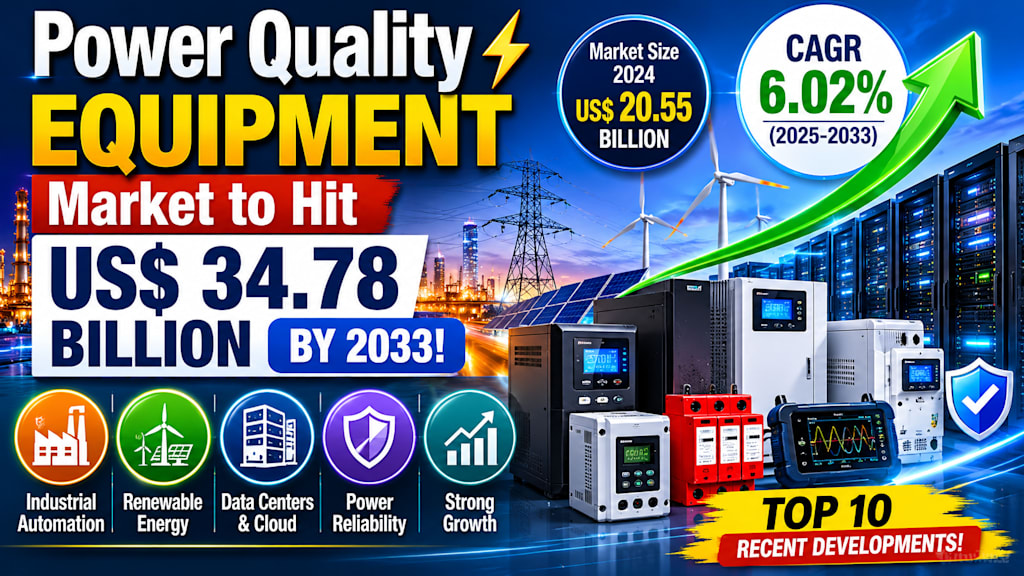
According to the latest industry analysis, the Global Power Quality Equipment Market was valued at US$ 20.55 billion in 2024 and is projected to reach US$ 34.78 billion by 2033, expanding at a CAGR of 6.02% during 2025–2033.
The market's growth reflects a global shift toward digitalization, industrial automation, renewable energy adoption, and advanced electrical infrastructure.
Why Power Quality Matters More Than Ever
Power quality refers to the consistency and reliability of electrical power supplied to equipment and systems. Voltage fluctuations, harmonic distortions, power surges, and electrical interruptions can negatively impact operations across industries.
To address these issues, organizations deploy equipment such as:
Uninterruptible Power Supply (UPS) systems
Surge protection devices
Voltage regulators
Harmonic filters
Power quality meters
Power conditioners
These technologies help maintain stable power flow, protect sensitive equipment, and reduce operational risks.
As industries continue investing in advanced technologies, maintaining high-quality power has become a strategic priority rather than merely a maintenance concern.
Industrial Automation is Transforming Market Demand
The emergence of Industry 4.0 has fundamentally changed manufacturing environments worldwide.
Factories increasingly rely on robotics, sensors, artificial intelligence, and automated production systems. These sophisticated technologies require clean and uninterrupted power to operate efficiently.
Even a short voltage fluctuation can disrupt automated processes, causing production losses and equipment damage. Consequently, manufacturers are investing heavily in power quality solutions to safeguard operations.
Industries such as automotive manufacturing, electronics production, pharmaceuticals, and semiconductor fabrication are among the largest adopters of power quality equipment.
As industrial automation expands across emerging and developed economies alike, demand for advanced electrical protection systems is expected to rise significantly throughout the forecast period.
Renewable Energy Integration Creates New Opportunities
The global transition toward renewable energy presents another major growth driver.
Solar and wind energy systems introduce variability into electrical grids due to their intermittent nature. Unlike traditional power plants, renewable sources are highly dependent on weather conditions, creating challenges related to voltage stability and frequency regulation.
Power quality equipment plays a critical role in ensuring smooth integration of renewable energy into existing power networks.
Advanced harmonic filters, voltage regulators, and power management systems help stabilize electrical supply while minimizing disruptions caused by renewable generation fluctuations.
Governments across North America, Europe, Asia-Pacific, and the Middle East continue investing heavily in clean energy infrastructure, further accelerating demand for power quality technologies.
Data Centers Are Becoming Major Consumers of Power Quality Solutions
The digital economy has created unprecedented demand for data centers.
Cloud computing, artificial intelligence applications, streaming platforms, financial services, and enterprise software all depend on reliable data center operations.
Power interruptions can lead to:
Data loss
Service disruptions
Security vulnerabilities
Financial losses
Customer dissatisfaction
To mitigate these risks, data center operators deploy sophisticated power quality systems, including UPS units, harmonic filters, voltage stabilizers, and backup power infrastructure.
The rapid expansion of hyperscale data centers worldwide is expected to remain one of the strongest contributors to market growth over the next decade.
UPS Systems Continue Dominating the Market
Among all equipment categories, Uninterruptible Power Supply (UPS) systems remain the most widely adopted solution.
UPS technology provides immediate backup power during outages while protecting critical equipment from voltage irregularities.
Major end-users include:
Hospitals
Data centers
Telecommunications facilities
Financial institutions
Government agencies
Manufacturing plants
Modern UPS systems offer improved energy efficiency, modular architecture, and remote monitoring capabilities, making them increasingly attractive across various sectors.
Residential and small-business adoption is also increasing as consumers seek greater protection against power disruptions.
Smart Buildings Are Fueling Commercial Sector Growth
Commercial establishments are becoming increasingly dependent on reliable electricity.
Office buildings, educational institutions, shopping centers, hotels, and healthcare facilities utilize complex electrical systems to support:
HVAC equipment
Lighting systems
Elevators
Security infrastructure
Information technology networks
Power quality equipment helps maintain operational continuity while improving energy efficiency and reducing maintenance costs.
The growing popularity of smart buildings and sustainable construction practices is expected to drive significant investments in commercial power quality solutions over the coming years.
Transportation Electrification Expands Market Potential
The transportation sector is undergoing a massive transformation.
Electric railways, metro systems, electric vehicle charging infrastructure, and airport operations all require stable and reliable power.
Power disturbances can affect safety, service reliability, and operational efficiency.
As governments continue promoting electric mobility and sustainable transportation initiatives, demand for harmonic filters, voltage regulators, and advanced power monitoring systems is increasing rapidly.
This trend is particularly evident in Asia-Pacific, Europe, and the Middle East, where large-scale transportation modernization projects are underway.
Regional Market Insights
United States
The United States remains one of the most important markets for power quality equipment.
Several factors support growth:
Expansion of data centers
Aging electrical infrastructure
Industrial automation investments
Smart grid initiatives
Renewable energy integration
Government policies encouraging energy efficiency and grid modernization continue creating opportunities for equipment manufacturers.
France
France is strengthening its electrical infrastructure through renewable energy projects and smart grid investments.
Growing industrial automation and stringent energy standards are increasing adoption of advanced power quality technologies across manufacturing, telecommunications, and utility sectors.
India
India represents one of the fastest-growing opportunities globally.
Rapid urbanization, infrastructure development, and increasing industrial activity have highlighted the need for reliable power systems.
Frequent voltage fluctuations and grid instability encourage businesses and households to invest in power quality solutions.
Government initiatives focused on manufacturing growth and infrastructure expansion are expected to further support market development.
Saudi Arabia
Saudi Arabia's Vision 2030 program is transforming the country's energy landscape.
Massive investments in renewable energy, smart cities, industrial zones, and digital infrastructure are increasing demand for advanced electrical management systems.
As energy diversification efforts continue, power quality equipment will play a vital role in ensuring reliable and efficient power distribution.
Challenges Facing the Industry
Despite positive growth prospects, the market faces several obstacles.
High Initial Investment Costs
Advanced power quality systems often require substantial upfront investment.
Many small and medium-sized enterprises hesitate to adopt these technologies due to budget constraints and longer payback periods.
Shortage of Skilled Professionals
Installation and maintenance of power quality equipment require specialized technical expertise.
Many developing regions continue facing shortages of trained professionals, limiting market penetration and operational efficiency.
Educational programs and workforce development initiatives will be critical for overcoming this challenge.
10 Recent Developments from Leading Industry Companies
1. Schneider Electric
In May 2025, Schneider Electric showcased software-defined automation technologies and industrial AI solutions at Automate 2025, highlighting advancements supporting power reliability and manufacturing resilience.
2. Hitachi Energy
Hitachi Energy secured major HVDC converter station contracts supporting the France-Spain electricity interconnection project, strengthening cross-border power transmission capabilities.
3. Hitachi Energy India
The company launched the Relion REF650 protection and control relay in India, designed to improve flexibility, cybersecurity, and power distribution efficiency.
4. Siemens AG
Siemens continues expanding its smart grid and digital energy management portfolio, supporting renewable integration and industrial electrification initiatives globally.
5. Eaton Corporation
Eaton has increased investments in intelligent power management technologies, helping commercial and industrial customers improve electrical reliability and energy efficiency.
6. Emerson Electric
Emerson continues strengthening its automation and energy management offerings through enhanced monitoring and predictive maintenance solutions.
7. General Electric
GE has expanded its grid modernization efforts by introducing advanced electrical infrastructure technologies that support renewable energy deployment.
8. Toshiba Corporation
Toshiba is advancing power electronics and grid-support technologies aimed at improving energy reliability and transmission performance.
9. Schaffner
Schaffner continues enhancing its electromagnetic compatibility and harmonic filtering solutions to support industrial automation and renewable energy projects.
10. JST Power Equipment
In March 2025, JST Power Equipment announced the launch of a new transformer manufacturing facility in Virginia, expanding North American production capacity and strengthening regional supply chains.
Competitive Landscape
The global power quality equipment market remains highly competitive, with leading players focusing on:
Product innovation
Smart grid technologies
Renewable energy integration
Strategic partnerships
Geographic expansion
Digital monitoring capabilities
Key companies operating in the market include:
Hitachi Energy Ltd
Siemens AG
Eaton Corporation plc
Emerson Electric Co.
Schneider Electric SE
General Electric
Toshiba Corporation
Schaffner Holding AG
Final Thoughts
The global power quality equipment market is entering a period of sustained expansion driven by digital transformation, industrial automation, renewable energy integration, smart infrastructure development, and rapid growth in data centers.
As organizations become increasingly dependent on uninterrupted electrical performance, investments in power quality solutions are shifting from optional expenditures to business-critical necessities.
With the market projected to grow from US$ 20.55 billion in 2024 to US$ 34.78 billion by 2033, companies that deliver innovative, intelligent, and energy-efficient power quality technologies are expected to play a central role in shaping the future of global energy infrastructure.
The coming decade will likely see power quality equipment move from a specialized engineering concern to a fundamental pillar supporting the world's increasingly connected and electrified economy.
About the Creator
Enjoyed the story? Support the Creator.
Subscribe for free to receive all their stories in your feed.
Comments
There are no comments for this story
Be the first to respond and start the conversation.