
PET Scanners Market Set to Reach US$ 3.80 Billion by 2033 as AI-Powered Imaging Transforms Disease Diagnosis
Advanced Molecular Imaging Technologies Are Reshaping Cancer Detection, Neurological Care, and Precision Medicine Worldwide

Introduction
Modern healthcare increasingly depends on early and accurate disease diagnosis. Among the most transformative technologies driving this shift is Positron Emission Tomography (PET), an advanced imaging method capable of revealing metabolic activity inside the human body long before structural changes become visible.
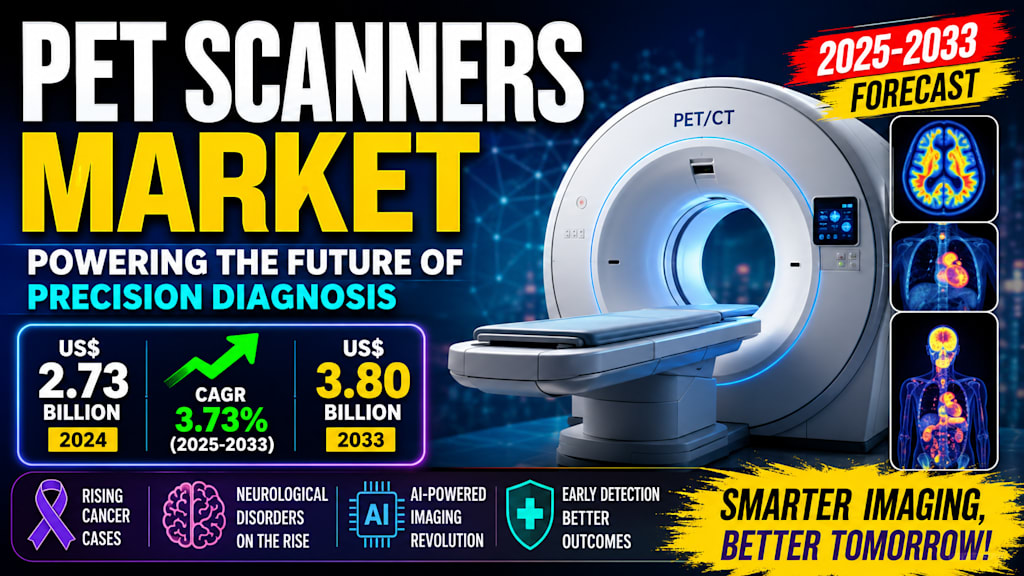
According to Renub Research, the Global PET Scanners Market is projected to grow from US$ 2.73 Billion in 2024 to US$ 3.80 Billion by 2033, expanding at a CAGR of 3.73% during 2025–2033. The market's growth is fueled by rising cancer prevalence, increasing neurological disorders, healthcare infrastructure expansion, technological advancements, and the integration of artificial intelligence into medical imaging.
As healthcare systems worldwide prioritize precision medicine and preventive care, PET scanners are becoming indispensable tools in hospitals, research centers, and diagnostic imaging facilities.
Understanding PET Scanner Technology
PET scanners provide functional imaging by detecting radioactive tracers introduced into the body. Unlike conventional imaging methods that primarily display anatomy, PET scans visualize biological processes occurring at the cellular level.
This capability enables physicians to:
Detect cancer in its earliest stages
Monitor treatment effectiveness
Evaluate neurological disorders
Assess cardiovascular diseases
Guide personalized treatment plans
The combination of PET with CT and MRI technologies has further enhanced diagnostic accuracy, creating comprehensive imaging solutions that offer both anatomical and functional insights.
As a result, PET imaging is now considered a cornerstone of modern precision healthcare.
Rising Cancer Cases Continue to Drive Market Expansion
Cancer remains one of the strongest growth catalysts for PET scanner adoption worldwide.
Healthcare providers increasingly rely on PET imaging for:
Tumor detection
Cancer staging
Treatment planning
Monitoring therapy response
Detecting recurrence
The growing global cancer burden has increased demand for sophisticated diagnostic technologies capable of delivering accurate and timely results.
PET scans enable clinicians to identify abnormal metabolic activity before visible anatomical changes emerge, providing a significant advantage in early intervention strategies.
As governments and healthcare organizations continue emphasizing cancer screening and early diagnosis programs, PET scanner installations are expected to accelerate across both developed and emerging economies.
Growing Neurological Disease Burden Creates New Opportunities
Neurological disorders are becoming a major healthcare challenge worldwide.
Conditions such as:
Alzheimer's disease
Parkinson's disease
Dementia
Epilepsy
Brain tumors
require advanced imaging tools for accurate diagnosis and monitoring.
PET imaging plays a particularly critical role in Alzheimer's disease detection by identifying amyloid plaques and abnormal brain activity patterns before significant cognitive decline occurs.
With aging populations expanding rapidly across North America, Europe, and Asia-Pacific, demand for neurological imaging services is expected to increase significantly throughout the forecast period.
Healthcare systems are investing heavily in diagnostic capabilities to address the growing burden of neurodegenerative diseases, directly benefiting the PET scanner market.
Artificial Intelligence Is Revolutionizing PET Imaging
Artificial intelligence has become one of the most influential innovations in diagnostic imaging.
AI-powered PET scanners offer several advantages:
Enhanced image reconstruction
Improved lesion detection
Faster scan processing
Reduced interpretation errors
Workflow automation
Machine learning algorithms help radiologists identify abnormalities with greater precision while reducing analysis time.
These capabilities improve patient outcomes by enabling faster diagnoses and more personalized treatment recommendations.
The growing integration of AI into PET-CT and PET-MRI platforms is expected to create substantial opportunities for equipment manufacturers over the coming decade.
Hybrid Imaging Systems Are Becoming the Industry Standard
The healthcare industry is increasingly shifting toward hybrid imaging solutions.
PET-CT and PET-MRI systems combine the strengths of multiple imaging modalities into a single platform.
PET-CT Advantages
Excellent anatomical visualization
Fast scanning times
Superior oncology applications
Broad clinical adoption
PET-MRI Advantages
Enhanced soft tissue imaging
Reduced radiation exposure
Superior neurological assessments
Advanced research capabilities
These systems provide more comprehensive diagnostic information while improving patient convenience and workflow efficiency.
As hospitals seek to maximize diagnostic performance and return on investment, hybrid imaging platforms are becoming preferred purchasing choices.
Expanding Healthcare Infrastructure Supports Market Growth
Healthcare infrastructure development is accelerating across emerging economies.
Countries such as:
China
India
Saudi Arabia
Brazil
Indonesia
are investing heavily in advanced medical technologies to improve healthcare accessibility and quality.
Government initiatives supporting modernization of healthcare facilities have increased adoption of sophisticated diagnostic equipment, including PET scanners.
Growing healthcare budgets, rising insurance coverage, and increasing public awareness regarding early disease detection are creating favorable conditions for market expansion.
As diagnostic imaging becomes more widely available, PET technology is expected to reach broader patient populations.
Challenges Continue to Impact Market Adoption
Despite strong growth prospects, several challenges remain.
High Equipment Costs
PET scanners require significant capital investment.
Hospitals must account for:
Equipment purchase costs
Installation expenses
Maintenance requirements
Radiotracer production infrastructure
Specialized workforce training
These factors create barriers for smaller healthcare facilities and institutions in developing regions.
Regulatory and Reimbursement Complexities
PET imaging involves radioactive materials, making regulatory compliance particularly stringent.
Additionally, reimbursement policies vary significantly across countries.
Insufficient reimbursement rates can discourage healthcare providers from expanding PET imaging services despite demonstrated clinical benefits.
Addressing these challenges will remain critical for broader market penetration.
Regional Market Insights
United States
The United States remains a global leader in PET imaging innovation.
The market benefits from:
Advanced healthcare infrastructure
High healthcare spending
Strong research investments
Growing precision medicine initiatives
Digital PET technologies and AI-enabled imaging solutions continue to gain traction across major healthcare networks.
United Kingdom
The UK market is driven by significant investments from the National Health Service (NHS) to improve cancer diagnostics.
The National PET Imaging Platform initiative is helping advance research, clinical trials, and drug development while strengthening imaging capabilities nationwide.
China
China is experiencing rapid market expansion due to healthcare modernization efforts and increasing chronic disease prevalence.
Government support for advanced diagnostic technologies continues to encourage adoption of PET-CT and PET-MRI systems throughout the country.
Saudi Arabia
Saudi Arabia's healthcare transformation initiatives are driving investments in advanced imaging technologies.
Growing focus on early disease detection and healthcare accessibility is expected to support long-term PET scanner demand across the Kingdom.
10 Recent Developments in the PET Scanners Market
1. Positron Corporation Expands Cardiac Imaging Presence
In November 2024, Positron Corporation partnered with a leading Pennsylvania cardiovascular practice to deploy its Attrius PET imaging system for advanced cardiac diagnostics.
2. AWSM-PET Technology Enhances Whole-Body Imaging
June 2024 witnessed the introduction of AWSM-PET technology, delivering improved image clarity and enhanced system sensitivity for whole-body PET/CT imaging.
3. Canon Medical Launches AI-Powered Workflow Solutions
Canon Medical installed its Aquilion Serve SP CT scanner integrated with INSTINX AI workflow automation technology in the United States during May 2024.
4. CDL Nuclear Technologies Unveils Mobile PET/CT Facility
In April 2024, CDL Nuclear Technologies introduced a mobile dedicated cardiac PET/CT trailer, expanding access to advanced imaging services.
5. Siemens Healthineers Advances Digital PET Platforms
Siemens Healthineers continues enhancing digital PET imaging solutions focused on improving image quality and operational efficiency.
6. GE Healthcare Strengthens Precision Imaging Portfolio
GE Healthcare is investing heavily in AI-enhanced imaging systems designed to improve disease detection and diagnostic confidence.
7. Philips Expands Hybrid Imaging Capabilities
Philips continues developing next-generation PET-MRI and PET-CT technologies supporting precision oncology and neurological care.
8. Shimadzu Corporation Focuses on High-Resolution Imaging
Shimadzu has accelerated research initiatives aimed at improving PET image resolution and diagnostic accuracy.
9. Mediso Expands Advanced Molecular Imaging Applications
Mediso continues strengthening its presence in research and clinical molecular imaging markets through innovative PET technology development.
10. PerkinElmer Enhances Research Imaging Solutions
PerkinElmer remains focused on expanding advanced imaging solutions supporting pharmaceutical research and translational medicine.
Competitive Landscape
Leading companies operating in the global PET scanners market include:
Canon Medical Systems
GE Healthcare
Philips
Mediso Ltd.
PerkinElmer
Positron Corporation
Shimadzu Corporation
Siemens Healthineers
Kindsway Biotech
These organizations are focusing on innovation, AI integration, hybrid imaging systems, strategic partnerships, and global expansion to strengthen their market positions.
Final Thoughts
The PET scanners market is entering a new phase of innovation driven by artificial intelligence, hybrid imaging technologies, and growing demand for precision diagnostics. As cancer, neurological disorders, and cardiovascular diseases continue to rise worldwide, healthcare providers are increasingly relying on PET imaging to improve patient outcomes and optimize treatment strategies.
With the market forecast to reach US$ 3.80 Billion by 2033, PET scanners are expected to remain at the forefront of medical imaging advancements. Continued investments in healthcare infrastructure, AI-powered diagnostics, and molecular imaging research will further accelerate adoption, positioning PET technology as a critical pillar of modern healthcare for years to come.
About the Creator
Enjoyed the story? Support the Creator.
Subscribe for free to receive all their stories in your feed.
Comments
There are no comments for this story
Be the first to respond and start the conversation.