
Payment Gateway Market Outlook 2026–2034: Digital Commerce, AI Security, and the Next Phase of Cashless Growth
As online shopping, mobile commerce, and cross-border digital trade continue to accelerate, payment gateways are becoming the invisible infrastructure powering modern commerce worldwide.

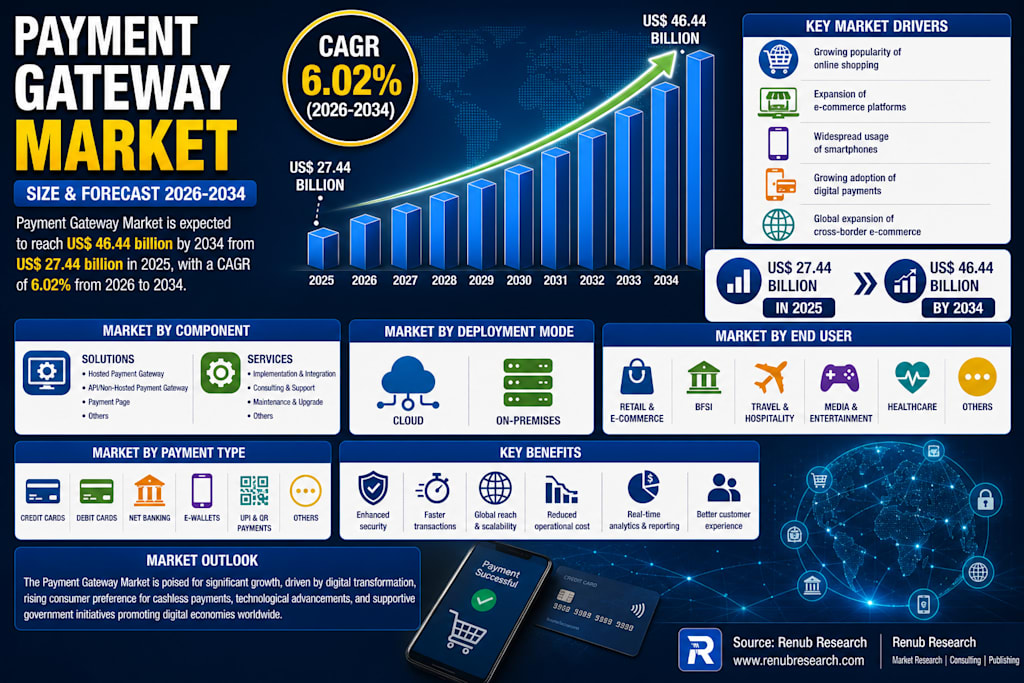
The payment gateway market is moving from being a back-end transaction tool to becoming one of the most important layers in the digital economy. According to Renub Research, the global payment gateway market is expected to grow from US$ 27.44 billion in 2025 to US$ 46.44 billion by 2034, advancing at a CAGR of 6.02% from 2026 to 2034. That expansion is being fueled by the rise of online shopping, the rapid spread of e-commerce platforms, smartphone adoption, digital payment usage, and the continued growth of cross-border commerce.
What makes this market especially interesting is that it sits at the intersection of finance, technology, consumer behavior, and trust. Every time a customer checks out online, a payment gateway silently verifies the transaction, encrypts data, moves information between banks, and helps merchants complete the sale. That makes it essential not only for e-commerce brands, but also for travel firms, digital service platforms, subscription businesses, and omnichannel retailers trying to unify online and offline payments.

A market built on digital convenience
The strongest growth engine remains the global shift toward digital commerce. As consumers increasingly shop online for convenience, speed, and variety, merchants need reliable systems that can process multiple payment methods without friction. Payment gateways now support cards, digital wallets, bank transfers, BNPL options, and even crypto-linked checkout experiences in some markets. The result is a market that is no longer defined by simple authorization, but by speed, flexibility, and conversion optimization.
At the same time, payment gateways have become more intelligent. Artificial intelligence and machine learning are now commonly used to spot fraud patterns, improve authorization rates, and reduce chargebacks. Cloud-based and API-driven models have also made it easier for businesses of all sizes to integrate payments into websites, apps, point-of-sale systems, and subscription platforms. These capabilities are especially valuable for merchants trying to grow across multiple channels and geographies.
Why the market is expanding so quickly
One of the most powerful growth drivers is the global move toward cashless economies. Governments, banks, and fintech firms are all encouraging digital payments through mobile banking, wallets, and real-time transfer systems. Consumers benefit from convenience and speed, while merchants gain better record keeping, faster settlement, and broader reach. The expansion of cross-border commerce adds another layer of demand because businesses need gateways that can handle currency conversion, compliance, and local payment preferences in different markets.
Another major driver is security. While digital commerce creates opportunity, it also creates risk. Fraud, phishing, account takeover attempts, and data breaches remain constant threats. That is why modern gateways increasingly rely on tokenization, encryption, 3D Secure, AI-based anomaly detection, and compliance-driven architecture to protect both merchants and consumers. In many cases, security has become a selling point as important as price.
Regional momentum is broadening
The United States remains a major growth market because e-commerce, mobile commerce, and digital services continue to expand across retail, travel, and subscription-based businesses. The country’s strong fintech environment and high use of digital wallets and contactless payments continue to support demand for secure and scalable gateway infrastructure.
Germany is also seeing steady growth, supported by a mature e-commerce ecosystem, high internet penetration, and increasing digital payment adoption. Compliance requirements such as PSD2 and data protection rules are reinforcing trust in the market, while cross-border shopping is increasing the need for multi-currency and flexible payment support.
China remains one of the fastest-moving digital payment environments in the world, with mobile wallets, QR-based payments, and online banking shaping consumer behavior. In Saudi Arabia, the market is advancing rapidly as e-commerce, fintech adoption, and national cashless initiatives accelerate digital transformation. Together, these regions show that the payment gateway opportunity is no longer limited to mature markets; it is becoming truly global.
A market where competition is becoming strategic
The competitive landscape is no longer just about processing transactions. It is about who can offer the best mix of security, authorization rates, omnichannel tools, embedded finance, and developer-friendly APIs. The companies active in this space, including PayPal, Amazon Pay, Stripe, PayU, Adyen, BitPay, JPMorgan Chase, Braintree, and WePay, are not simply competing on checkout—they are competing on ecosystem depth.
That strategic shift is visible in the way the biggest players are investing in AI, stablecoins, embedded payments, and merchant tooling. The latest company moves show a market that is expanding beyond classic payment processing and moving toward a broader digital commerce stack.
recent company developments shaping the payment gateway market
PayPal launched PayPal Open as a unified payments and growth platform for businesses of all sizes, aiming to simplify secure transactions and support modern commerce.
PayPal expanded into crypto-linked commerce with Pay with Crypto, enabling U.S. merchants to accept a wide range of cryptocurrencies and convert them into stablecoin or fiat, which PayPal says can lower transaction costs and broaden merchant reach.
PayPal and OpenAI partnered to bring Instant Checkout and agentic commerce into ChatGPT, allowing users to check out with PayPal and giving merchants access to a new discovery and purchase channel.
PayPal committed $100 million to the Middle East and Africa to support digital growth, entrepreneurship, and the expansion of commerce infrastructure in one of the world’s fastest-growing digital regions.
Visa introduced Trusted Agent Protocol to make AI-driven commerce safer by helping merchants verify trusted agents and reduce malicious bot activity in checkout flows.
Visa launched USDC settlement in the United States, bringing stablecoin settlement to U.S. issuer and acquirer partners and signaling a broader push toward modernized blockchain-based payment rails.
Stripe unveiled major AI and stablecoin launches in May 2025, including its first AI foundation model for payments and expanded stablecoin-powered financial account capabilities across 101 countries.
Stripe expanded in Japan with Stripe Terminal, helping businesses unify online and offline commerce while adding Tap to Pay on iPhone and local payment method integrations.
Adyen launched Adyen Uplift, an AI-powered optimization suite designed to increase conversion, improve fraud management, and reduce payment costs.
FIS launched Money Movement Hub and deepened its relationship with Visa, giving financial institutions more centralized, API-driven payment capabilities and broader access to modern payments infrastructure.
These developments show a clear pattern: the payment gateway market is no longer just about “accepting payments.” It is about intelligence, orchestration, embedded finance, stablecoins, agentic commerce, and merchant growth. The leaders are building platforms, not just gateways.
What this means for merchants and investors
For merchants, the message is straightforward: payment gateways now influence revenue, customer trust, and conversion performance. A smoother checkout can reduce abandonment, while stronger fraud protection can improve approval rates and lower losses. For businesses selling across borders, the ability to support multiple currencies and local payment preferences is becoming a competitive necessity rather than a luxury.
For investors and industry watchers, the market is attractive because growth is being supported by multiple long-term trends at once: e-commerce expansion, mobile commerce, digital banking, AI-driven fraud prevention, and the move toward cashless transactions. The sector also benefits from recurring merchant demand and a strong replacement cycle as businesses upgrade older payment systems to more flexible cloud-native platforms.
Final Thoughts
The payment gateway market is entering a new phase of maturity and innovation. Its growth is being driven not only by rising transaction volumes, but also by a deeper transformation in how commerce works. Merchants want more than payment acceptance; they want fraud control, global reach, flexible integrations, and checkout experiences that feel almost invisible to the customer.
Renub Research’s forecast of US$ 46.44 billion by 2034 underscores how important this infrastructure has become to global commerce. As AI, stablecoins, cross-border trade, and omnichannel retail reshape the digital economy, payment gateways will remain one of the most strategic layers in the entire value chain. In many ways, the future of online business will be decided at the checkout stage.
About the Creator
Enjoyed the story? Support the Creator.
Subscribe for free to receive all their stories in your feed.
Comments
There are no comments for this story
Be the first to respond and start the conversation.