
Parting the Wild Horses Mane
My First Internet Challenge
Two old friends, Clara, a mathematician and Frederick a musician had been invited to present at an international summit regarding Artificial Intelligence.
At 77, Frederick’s eyes sparkled as he spoke. “As humans, we recreate our own timeless experience of life. It may have been what was observed or wished for as a child. We hold on what we desire, that is created by experiences felt, read about or imagined and manifesting the illusion of what our genetic potentials of money can create to become a form of reality.
"Humans are like geese that imprint. We are easily programmed by the first form that moves the mind. We are like a butterfly that emerges from a chrysalis, retaining the imaginal cells that code for structures like legs and wings in the imago, the adult. Neuroscience suggests we are made of imprints laid down by experience, that are rebuilt each time we remember something that has echoed faintly across generations. AI feeds the desire to do regulate movement and thoughts, as efficient automatons, at robotic speed.”
Clara nodded. “I jumped into the cart of the unknowns of the internet around 1981. Duck Duck Go, Yahoo, Dogpile and Google were the search engines available, but Google won hands down for complex, comprehensive integrated academic searches. At the onset, information was limited to credible original scholarly sources. Shortly after, other forms of less credible information , started to fill the airways. I printed out papers from my areas of interest, knowing that they would soon become hidden in the new Tower of Babel, or inaccessible except for a price. This has since happened.
“The business model, full of deceit and trickery to make a profit at any expense, has taken over. Dreams of the days of chivalry disappeared with the computer age , that offered such potential for good. It was destroyed by the compulsive addictive disease of profit. We are witnessing the subsequent decay of short-term parasitic behaviour.”
Frederick said, “At this stage in my life, as the candle is burning low, I look for a way to guestimate what might go on beyond this death just as you use Arithmagic to do so. Ancients say we must look to the source. I am looking for the gold that forms after an earthquake, as pure elements embedded in rock solid structures are released, change form and reassemble. This is part of the natural patterns and rhythms of Nature.”
Clara chuckled adding, “I thought the source is the abacus originating in Mesopotamia. Capable of enumerating faster than marks that tallied quantities, it evolved into a slide rule by 1622, when the English mathematician William Oughtred placed two logarithmic scales side by side so they could slide against each other for multiplication and division.
“The slide rule acts as an analog calculator used to compute numbers multiplication, division exponents, roots, logarithms and other mathematical operations. It was used by astronauts, on missions after Apollo 10, and was a critical tool used in Apollo 13 when computer transmissions failed.
"When Turing established the Universal Turing machine in 1936, he made a foundational leap from continuous analog calculation to discrete symbolic computation and general-purpose programmability. It lay the foundation for calculators and computers by defining the limits of mechanical computation through all or none decisions.”
Frederick added. " I was involved in paying the hefty price for research and development. Early calculators , now sold at dollar stores, once cost upwards of $100.00.”
Clara continued. “For me, the computer age emerged in high school where I read how to, then made, a simple loop program on Fortran using punch cards that were used at the University of Waterloo Ontario’s Red Room. The machines took up over half of each of three stories in the Math building. It hummed day and night and was full of people who were very cool because they were very engaged in what they were doing. Within under three decades, the university was known for the leaders of early educational compilers, major tech spin-offs including the Blackberry, the grandfather of cell phones, cryptography, and supercomputing.
"By the end of my undergraduate studies, computer systems had reduced in size and increased in capability. When I sat in front of the Wang computer, I realized it was programmed by individuals who knew far more about how data can be transformed so it fits expected norms, than I had imagined possible. This led me to explore the effects of logarithmic, square root, reciprocal, sine and arcsine transformations, ranking scaled values based on weighted differences around standard deviations.”
“As a musician” Frederick interjected, “I learned to use Microsoft PC’s and Mac’s. To this day, I am not sure if Mac’s are a relative to the golden apple of the Hesperides that offered divine power or the forbidden fruit.”
Clara smiled. “By 1997, a dear friend in academics told me I needed to get on the worldwide internet, a secret world, known to few. Up until then, computers were used as typewriters and calculators, but now, they were a communication device and communication was relatively free. After installing a modem with dial up capacities, we had the luxury of chatting without long distance charges or needing to buy stamps, envelopes and find a post box. I was warned not to share personal thoughts, words and images through the airways that can be intercepted and potentially compromising. Epstein did not get that memo.”
Frederick sighed. “Ignoring the rules of engagement and computer etiquette show that the illusion of common sense has been lost.”
Clara agreed. “The computer world is full of various legal battles between computer companies who use lawyers to argue about legal intellectual rights better than the Devil and Daniel Webster. Perhaps computers and what goes on the internet magnifies the best and worst of human traits.
Frederick grumbled, “Most people cannot self-police and often test or ignore ethical limits. The power of Artificial intelligence is a pharmakon that can be used to heal or poison."
"The internet represents the greatest form of anarchy known to mankind. There are few laws, limits or repercussions. We use our free will to explore, risk and even condemn others. When laws are applied, it is often called oppression to control information.
"The challenge of control is not going to be easy. The Council of Trent restricted religious knowledge acknowledging that much of the information is too confusing to the general populace. The church leaders deemed what information was disperse, but could not control the interpretations, misuse and abuse of religious followers. This has had unpleasant effects that have caused a great backswing with a dangerous undercurrent.”
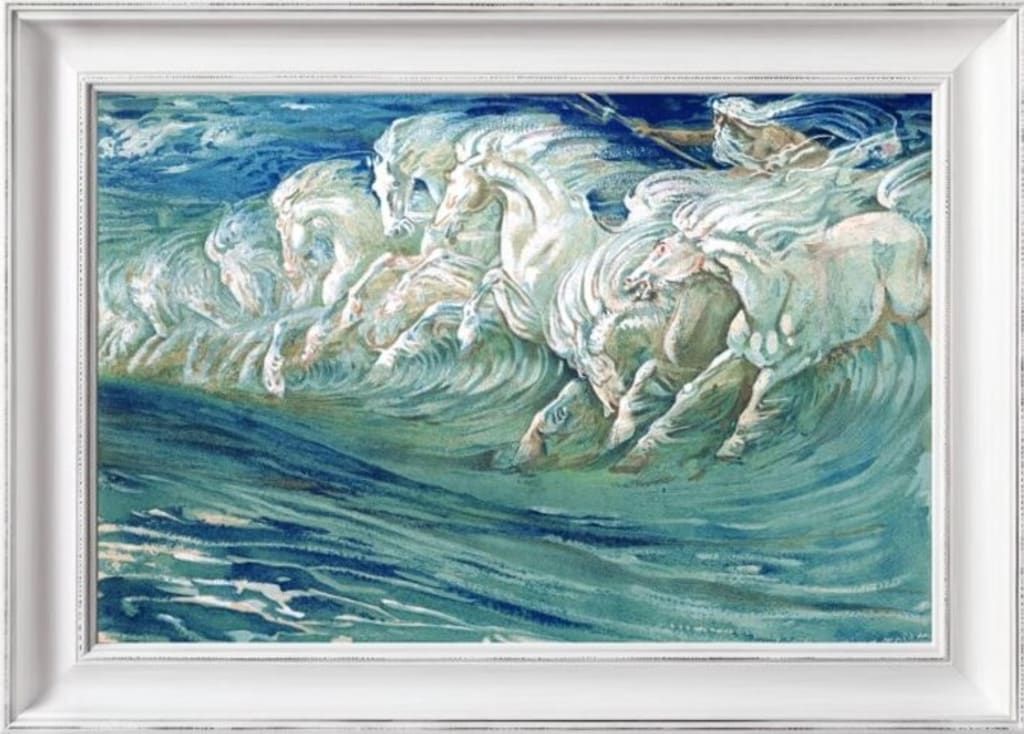
Clara said, “ It’s time for you to perform your score, 'Taming the Wild Horses'. Frederick, you have captured elements of how the waves of music can be harnessed. Perhaps this will inspire mathematics to also harness the waves of change as they are developing programs. Perhaps like in myth, a benevolent Poseidon might be able to rein in power of the untamed wild horses that permeate applications of artificial intelligence made available through the internet."
Frederick nodded. " Harnessing untamed energy while moving in opposite coordinated directions is the musical equivalent of controlling chaos. The interlocking structure, counterpoint, or rhythmic tension combines mathematical rock, progressive metal, orchestral and minimalist counterpoint and precision. Perhaps it will awaken the creative inspiration and intense focus needed to help contain what is in the Pandora's box we have unleashed."
Clara patted him of the back as he went onto the stage to perform.
About the Creator
Katherine D. Graham
My stories usually present facts, supported by science as we know it, that are often spoken of in myths. Both can help survival in an ever-changing world.
Enjoyed the story? Support the Creator.
Subscribe for free to receive all their stories in your feed. You could also become a paid subscriber, letting them know you appreciate their work.
Comments (1)
Wow, some of Frederick's ideas are truly enlightening. Some are esoteric to me, but I really tried to consider what he might mean. But it all pretty much encapsulates what AI is about, and the chaos that can ensue. Great piece, Katherine.