
Parking Smarter, Not Harder: How Intelligent Parking Systems Are Transforming Urban Mobility Worldwide
Driven by rapid urbanization, smart city investments, AI-powered parking technologies, and growing demand for cashless convenience, the global smart parking market is reshaping the future of transportation.

Finding a parking space has become one of the most frustrating aspects of urban life. In many major cities, drivers spend valuable time navigating crowded streets, searching for available parking spots, and contributing to traffic congestion in the process.
As urban populations continue to grow and vehicle ownership rises, traditional parking systems are struggling to keep pace with modern mobility demands.
This challenge has created a significant opportunity for smart parking technologies.
Leveraging innovations such as the Internet of Things (IoT), artificial intelligence, sensors, cameras, mobile applications, and cloud-based analytics, smart parking systems are helping cities optimize limited parking resources while improving the driving experience.
What was once considered a simple parking problem has evolved into a critical urban planning issue. Today, governments, businesses, and technology providers are investing heavily in intelligent parking infrastructure to improve transportation efficiency, reduce emissions, and support smart city development.
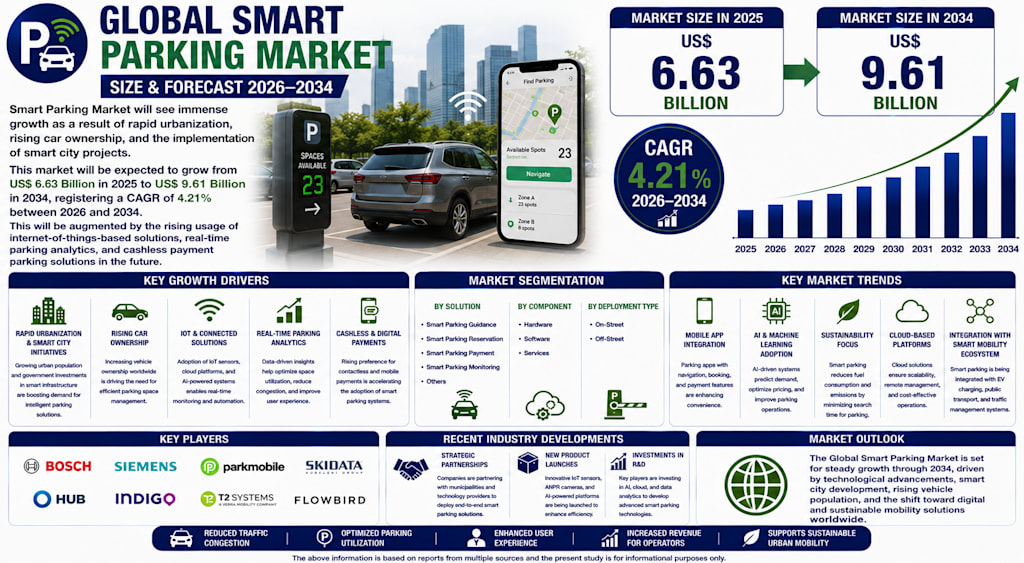
According to Renub Research, the Global Smart Parking Market is expected to grow from US$ 6.63 billion in 2025 to US$ 9.61 billion by 2034, expanding at a compound annual growth rate (CAGR) of 4.21% between 2026 and 2034. Growing urbanization, increasing vehicle ownership, expansion of smart city projects, adoption of IoT-enabled parking solutions, real-time analytics, and cashless payment technologies are among the primary drivers supporting market growth.
As cities continue embracing digital transformation, smart parking is emerging as one of the most practical and impactful applications of intelligent transportation technology.
Understanding Smart Parking Technology
Smart parking refers to the use of digital technologies to monitor, manage, and optimize parking spaces in real time.
These systems combine:
IoT sensors, cameras, license plate recognition technology, mobile applications, cloud computing platforms, and advanced data analytics.
The objective is simple yet powerful.
Drivers receive real-time information regarding parking availability, enabling them to locate open spaces quickly and efficiently.
Smart parking systems also facilitate automated payments, dynamic pricing, digital enforcement, reservation capabilities, and predictive analytics.
Applications extend across:
On-street parking, off-street facilities, airports, shopping centers, hospitals, office complexes, residential developments, and public transportation hubs.
By reducing the time spent searching for parking, these technologies improve urban mobility while reducing fuel consumption and emissions.
Urbanization Is Creating Urgent Demand
One of the strongest growth drivers for the smart parking market is rapid global urbanization.
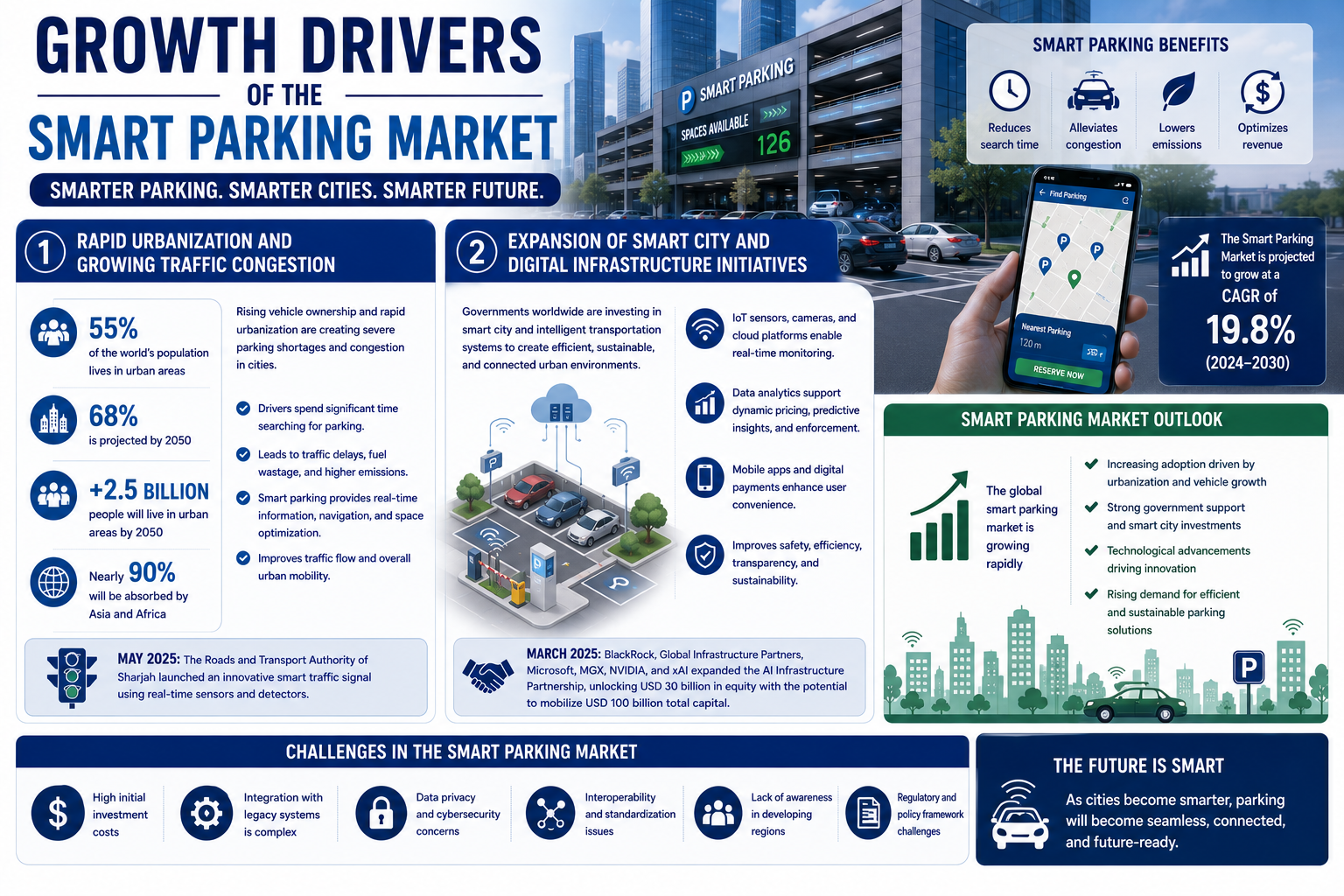
According to United Nations projections cited in the report, approximately 55% of the world's population currently lives in urban areas, a figure expected to rise significantly in the coming decades.
As cities become more densely populated, parking shortages and traffic congestion are becoming increasingly severe.
Growing vehicle ownership further intensifies these challenges.
Drivers searching for available parking spaces contribute substantially to urban traffic, increasing travel times, fuel consumption, and environmental pollution.
Smart parking systems help address these issues by providing accurate real-time parking information and guiding vehicles directly to available spaces.
This reduces unnecessary circulation, improves traffic flow, and enhances overall transportation efficiency.
A notable example occurred in May 2025 when the Roads and Transport Authority of Sharjah introduced an innovative smart traffic signal system utilizing real-time sensors and detectors to improve traffic management.
As urban populations continue expanding, demand for intelligent parking solutions is expected to increase significantly.
Smart Cities Are Accelerating Adoption
The global smart city movement is another major catalyst driving market growth.
Governments and municipalities worldwide are investing heavily in intelligent transportation infrastructure designed to improve efficiency, sustainability, and public services.
Smart parking systems are becoming a core component of these initiatives.
By integrating sensors, cameras, cloud platforms, and analytics tools, municipalities gain greater visibility into parking utilization and traffic patterns.
These systems support advanced capabilities such as:
Centralized monitoring, automated enforcement, dynamic pricing, predictive analytics, and optimized space utilization.
The expansion of digital infrastructure, coupled with widespread smartphone adoption, has made smart parking applications more accessible and user-friendly than ever before.
As cities increasingly prioritize data-driven decision-making, smart parking solutions will continue playing a critical role in urban mobility strategies.
Cashless and Automated Experiences Are Winning Consumers
Consumer preferences are evolving rapidly.
Modern drivers increasingly expect convenience, speed, and seamless digital experiences in every aspect of daily life—including parking.
Traditional parking systems often involve manual processes, paper tickets, cash transactions, and long wait times.
Smart parking solutions eliminate many of these frustrations.
Features such as:
Cashless payments, automated entry and exit, mobile app integration, digital reservations, and license plate recognition create frictionless user experiences.
These capabilities not only improve customer satisfaction but also enhance operational efficiency for parking operators.
A practical example emerged in July 2023 when Airtel Payments Bank partnered with Park+ to launch a FASTag-based smart parking solution at Biju Patnaik International Airport in India.
The system enables automatic cashless payments while reducing congestion and improving vehicle movement within parking facilities.
As digital lifestyles continue evolving, demand for automated parking experiences is expected to grow steadily.
License Plate Recognition Is Revolutionizing Parking Management
One of the most transformative technologies within the market is License Plate Recognition (LPR).
LPR systems use advanced cameras and artificial intelligence algorithms to identify vehicles automatically through their license plates.
This technology enables:
Ticketless entry and exit, automated billing, enhanced security, improved enforcement, and contactless user experiences.
LPR solutions are increasingly deployed across airports, shopping centers, office buildings, commercial complexes, and municipal parking facilities.
Advancements in artificial intelligence, machine learning, and image processing continue improving recognition accuracy under varying weather and lighting conditions.
As organizations seek greater automation and operational efficiency, LPR technology is becoming a cornerstone of modern parking infrastructure.
Mobile Applications Are Changing Driver Behavior
Smartphone technology has fundamentally changed how consumers interact with parking services.
Mobile parking applications provide drivers with a wide range of capabilities, including:
Locating available spaces, reserving parking spots, navigating to facilities, managing payments, and receiving real-time availability updates.
These applications often integrate seamlessly with sensors, parking meters, and LPR systems to create unified user experiences.
The growing popularity of mobile payments has further accelerated adoption.
Consumers increasingly prefer digital transactions over traditional cash-based methods, making mobile parking solutions particularly attractive.
As smartphone penetration continues increasing globally, mobile app-based parking services are expected to remain one of the fastest-growing segments of the market.
Parking Guidance Systems Improve Efficiency
Parking guidance systems have become increasingly important within large facilities.
These systems utilize sensors, cameras, digital displays, and analytics platforms to direct drivers toward available spaces.
Applications are especially common in:
Airports, shopping malls, hospitals, entertainment venues, and large commercial complexes.
By reducing search times, parking guidance systems improve customer satisfaction while increasing facility utilization.
These technologies also help operators optimize traffic flow and maximize revenue generation.
As organizations seek to improve visitor experiences and operational performance, parking guidance systems are expected to experience continued growth.
Commercial Applications Lead Market Demand
Commercial organizations represent one of the largest application segments within the smart parking market.
Shopping centers, hotels, office buildings, airports, hospitals, and entertainment venues increasingly invest in intelligent parking infrastructure.
The benefits are substantial.
Smart parking systems help improve customer experiences, increase operational efficiency, reduce congestion, strengthen security, and maximize revenue opportunities.
Integrated solutions often combine:
Access control systems, mobile payments, guidance technologies, analytics dashboards, and automated enforcement capabilities.
As commercial properties compete to attract customers and improve service quality, smart parking investments are becoming increasingly common.
United States Leads Market Innovation
The United States remains one of the most mature smart parking markets globally.
Cities such as New York, Los Angeles, Chicago, and San Francisco have extensively adopted smart parking technologies to address congestion and improve urban mobility.
The widespread use of smartphones and digital payment systems has accelerated consumer adoption.
Public-private partnerships have played an important role in expanding parking infrastructure across municipalities, airports, and commercial facilities.
A notable milestone occurred in November 2024 when San Antonio International Airport launched the United States' first AI-based smart parking system.
Developed with Metropolis Technologies, the solution replaced traditional tickets entirely using AI-powered computer vision technology to create a checkout-free parking experience.
Such innovations highlight the growing role of artificial intelligence within parking management.
China's Rapid Urbanization Creates Massive Opportunities
China represents one of the fastest-growing smart parking markets in the world.
Rapid urbanization, increasing vehicle ownership, and severe parking shortages in cities such as Beijing, Shanghai, Shenzhen, and Guangzhou continue driving demand.
The Chinese government actively supports smart city development, creating favorable conditions for widespread deployment of intelligent parking systems.
Mobile payment platforms are deeply integrated into Chinese consumer behavior, making digital parking solutions particularly effective.
Artificial intelligence, cloud computing, and big data technologies are increasingly used to optimize parking operations.
In July 2025, BYD announced the world's first smart parking system comparable to Level 4 autonomous parking capabilities, demonstrating China's leadership in advanced mobility innovation.
Saudi Arabia Accelerates Smart Mobility Investments
Saudi Arabia is emerging as a significant smart parking market driven by urban modernization initiatives and the country's Vision 2030 strategy.
Major cities such as Riyadh, Jeddah, and Dammam are investing heavily in intelligent transportation systems.
Government-led smart city projects and public-private partnerships are encouraging deployment of sensors, automated gates, mobile payment platforms, and integrated parking management systems.
In November 2025, IPARK and PanStreet International successfully implemented advanced smart parking enforcement technologies in Buraidah as part of a concession agreement focused on modernizing urban mobility infrastructure.
These initiatives illustrate the growing importance of smart parking within broader regional development plans.
Challenges Still Need Attention
Despite strong growth prospects, the smart parking market faces several challenges.
Implementation costs remain a major concern.
Deploying sensors, cameras, networking infrastructure, software platforms, and ongoing maintenance requires significant investment.
Smaller municipalities and organizations may struggle to justify the upfront expenses associated with large-scale deployments. Technology upgrades and system integration further increase financial complexity.
Data security and privacy concerns also represent important challenges.
Smart parking systems collect substantial amounts of information, including vehicle data, geolocation details, and payment records.
Cybersecurity risks, privacy regulations, and lack of standardization across platforms may affect public trust and adoption rates if not properly addressed.
Overcoming these challenges will be essential for sustaining long-term growth.
Final Thoughts
Smart parking is no longer simply about finding a place to park.
It has become an essential component of intelligent transportation systems and modern urban infrastructure.
Driven by urbanization, smart city initiatives, digital transformation, and consumer demand for convenience, smart parking technologies are helping cities become more efficient, sustainable, and user-friendly.
From AI-powered license plate recognition and automated payment systems to mobile applications and predictive analytics, innovation continues transforming the parking experience for drivers and operators alike.
With the Global Smart Parking Market projected to grow from US$ 6.63 billion in 2025 to US$ 9.61 billion by 2034, the future of intelligent parking looks increasingly promising.
As cities continue investing in smarter mobility solutions, smart parking will remain a critical tool for reducing congestion, improving urban efficiency, and enhancing the overall transportation experience for millions of people worldwide.
About the Creator
Enjoyed the story? Support the Creator.
Subscribe for free to receive all their stories in your feed.
Comments
There are no comments for this story
Be the first to respond and start the conversation.