
Packaging the Future: How Sustainable Paper Solutions Are Replacing Plastic Across Global Industries
Driven by environmental regulations, e-commerce growth, recycled fiber innovation, and consumer demand for eco-friendly alternatives, paper packaging is becoming the cornerstone of the circular economy.

The global packaging industry is undergoing one of the most significant transformations in its history. For decades, plastic dominated packaging solutions due to its versatility, affordability, and durability. Today, however, growing environmental concerns, stricter regulations, and changing consumer expectations are pushing businesses toward more sustainable alternatives.
At the center of this shift is paper packaging.
From corrugated shipping boxes and kraft paper wraps to molded pulp containers and recyclable food packaging, paper-based materials are becoming increasingly important across industries. Companies are embracing paper solutions not only to meet sustainability goals but also to strengthen brand reputation and comply with evolving environmental regulations.
As governments worldwide continue restricting single-use plastics and consumers prioritize eco-friendly products, paper packaging is emerging as one of the most important growth segments within the global packaging industry.
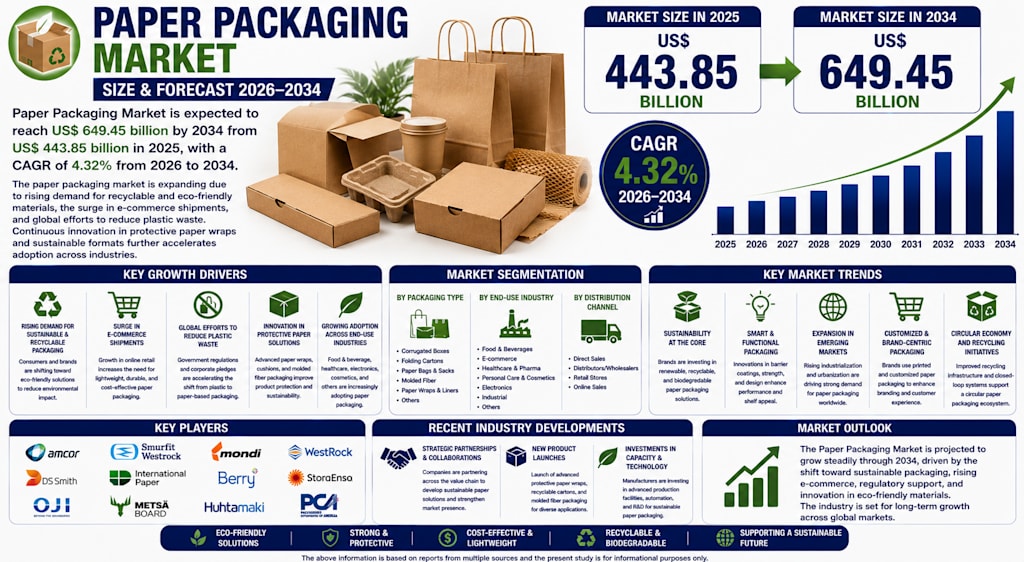
According to Renub Research, the Global Paper Packaging Market is projected to grow from US$ 443.85 billion in 2025 to US$ 649.45 billion by 2034, expanding at a compound annual growth rate (CAGR) of 4.32% between 2026 and 2034. Rising demand for recyclable materials, expanding e-commerce shipments, sustainability-focused regulations, and continuous innovation in fiber-based packaging solutions are among the key drivers supporting market growth.
As industries accelerate their transition toward environmentally responsible operations, paper packaging is becoming an essential component of the global sustainability movement.
Why Paper Packaging Matters More Than Ever
Paper packaging refers to packaging products manufactured from paper-based materials such as:
Kraft paper, paperboard, corrugated fiberboard, molded pulp, recycled paper, and specialty paper solutions.
These materials are widely used to protect, transport, store, and present products across numerous industries.
Paper packaging offers several significant advantages.
It is renewable, biodegradable, recyclable, and widely accepted within recycling systems around the world.
Unlike many plastic materials, paper packaging aligns naturally with circular economy principles by allowing materials to be recovered, reused, and reintroduced into production cycles.
Modern paper packaging has also evolved substantially in terms of strength, durability, print quality, and functionality.
Advancements in coatings, fiber engineering, and manufacturing technologies have expanded its suitability across applications that previously relied heavily on plastic.
As sustainability becomes a business priority, paper packaging continues gaining momentum across global markets.
Sustainability Is the Primary Market Driver
The most powerful force shaping the paper packaging market is the growing global focus on sustainability.
Governments, businesses, and consumers increasingly recognize the environmental challenges associated with plastic waste, landfill accumulation, and marine pollution.
In response, countries worldwide are introducing regulations aimed at reducing single-use plastics and encouraging adoption of recyclable alternatives.
Major consumer brands are also establishing ambitious sustainability targets that include reducing plastic usage and increasing recyclable content.
Paper packaging provides an attractive solution because it is derived from renewable resources and is generally easier to recycle than many plastic materials.
Consumers are increasingly rewarding brands that demonstrate environmental responsibility through packaging choices.
As sustainability expectations continue rising, demand for paper-based packaging solutions is expected to accelerate significantly.
E-Commerce Is Creating Massive Demand
The explosive growth of e-commerce has become one of the most important drivers of paper packaging demand.
Every online order requires packaging capable of protecting products during transportation while providing a positive customer experience.
Corrugated boxes, paper cushioning materials, protective wraps, and paper mailers have become essential components of modern logistics operations.
The rapid expansion of online shopping has created unprecedented demand for these products.
Consumers increasingly expect packaging that is not only protective but also environmentally responsible.
As a result, e-commerce companies are actively replacing plastic fillers, foam materials, and non-recyclable components with paper-based alternatives.
The combination of growing shipment volumes and sustainability objectives continues strengthening demand across the paper packaging sector.
Premium Sustainable Packaging Is Becoming a Brand Differentiator
Modern packaging is no longer solely about product protection.
Increasingly, it serves as a critical element of brand identity and customer experience.
Consumers often associate sustainable packaging with quality, responsibility, and premium positioning.
This trend is particularly visible in industries such as cosmetics, wellness, personal care, luxury goods, and direct-to-consumer retail.
Brands are seeking paper-based packaging solutions that combine functionality with attractive aesthetics.
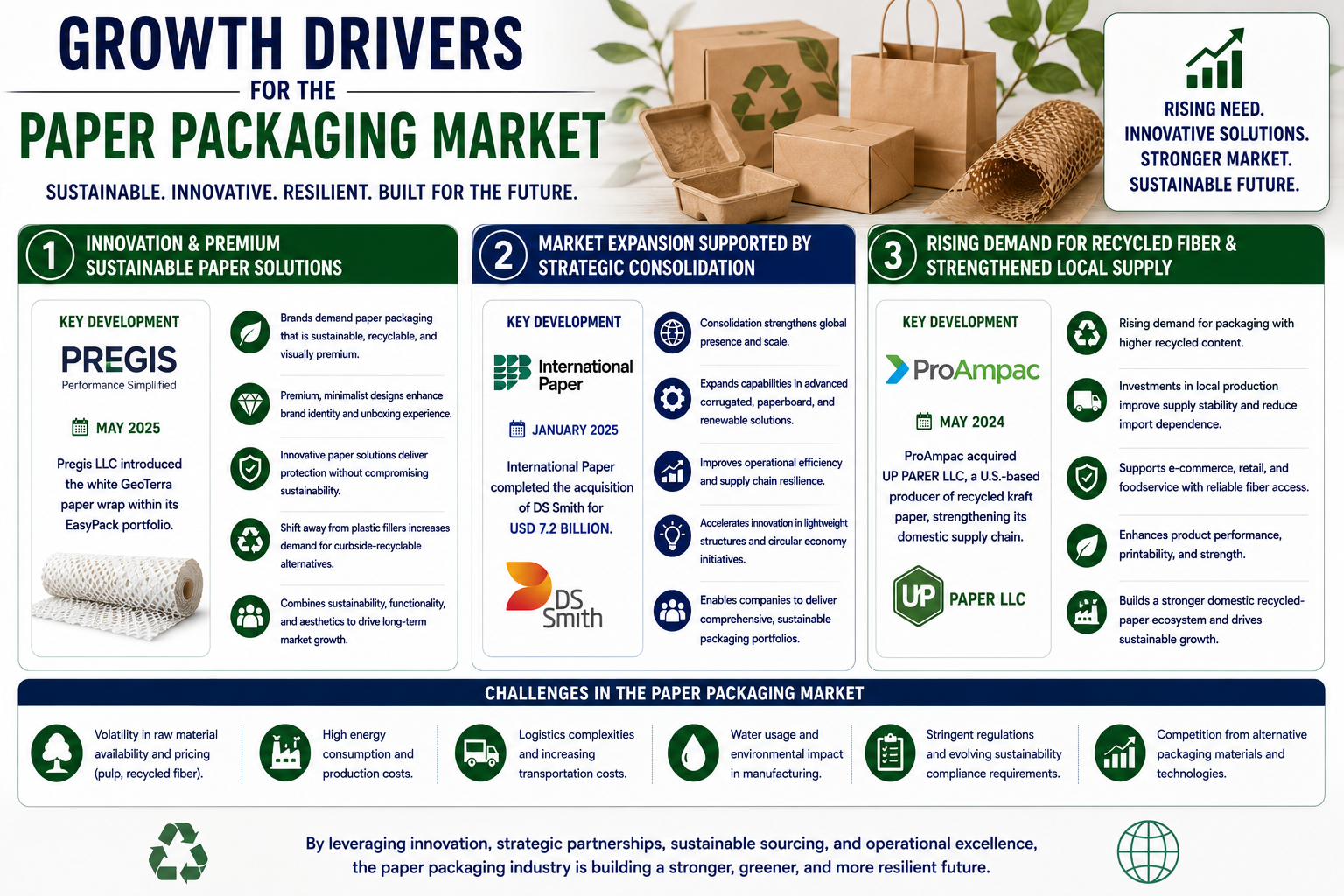
In May 2025, Pregis LLC introduced its white GeoTerra paper wrap within the EasyPack portfolio, reflecting growing demand for premium recyclable packaging materials that enhance both product protection and customer presentation.
The ability to combine sustainability with visual appeal is becoming a major competitive advantage.
As consumer expectations evolve, premium paper packaging solutions are expected to experience continued growth.
Industry Consolidation Is Strengthening Market Capabilities
Strategic acquisitions are playing an increasingly important role in shaping the future of the paper packaging industry.
Companies are pursuing consolidation strategies to expand production capacity, improve operational efficiency, and accelerate innovation.
A major example occurred in January 2025 when International Paper completed its acquisition of DS Smith in a transaction valued at approximately US$ 7.2 billion.
The acquisition significantly expanded International Paper's global presence and strengthened its ability to provide sustainable packaging solutions across multiple regions.
Industry consolidation allows companies to leverage shared expertise, optimize manufacturing operations, and invest more effectively in advanced technologies.
As customer demand for sustainable packaging continues increasing, larger integrated organizations are becoming better positioned to meet global requirements.
Recycled Fiber Is Fueling Market Expansion
Demand for recycled materials has become a major growth driver within the paper packaging industry.
Governments, businesses, and consumers increasingly favor products containing recycled content due to their environmental benefits.
As a result, manufacturers are investing heavily in recycled fiber infrastructure and domestic supply chains.
In May 2024, ProAmpac expanded its recycled paper capabilities through the acquisition of UP PAPER LLC, a producer of recycled kraft paper in the United States.
The acquisition strengthened access to recycled fiber resources while supporting broader circular economy initiatives.
Recycled fiber helps reduce dependence on virgin raw materials while supporting sustainability objectives.
As demand for environmentally responsible packaging continues growing, recycled paper will remain central to industry development.
Food Packaging Is Embracing Paper Innovation
Food and beverage manufacturers are increasingly turning to paper packaging solutions.
Historically, many food products relied heavily on plastic packaging because of its barrier properties and moisture resistance.
Advancements in paper technology are changing this dynamic.
Manufacturers are developing paper materials capable of providing improved protection against moisture, oxygen, grease, and contamination.
A significant example occurred in March 2025 when Ahlstrom introduced LamiBak Flex, a new base paper designed for flexible food packaging applications.
The material improves barrier performance while reducing the need for primer coatings and supports multiple packaging formats including pouches and sachets.
These innovations are expanding the range of food products that can utilize sustainable paper packaging solutions.
High-Barrier Paper Technologies Are Closing Performance Gaps
One of the traditional challenges facing paper packaging has been performance limitations compared with plastic.
Modern innovations are addressing these concerns.
Manufacturers are introducing high-barrier paper materials capable of delivering improved product protection while maintaining recyclability.
In March 2025, KM Packaging launched K-Nature Paper HBe, a recyclable paper packaging solution containing more than 85% paper combined with protective barrier layers.
The product offers an alternative to conventional flexible plastic packaging while maintaining required performance standards.
Similarly, in February 2025, Koehler Paper partnered with Italian pasta producer Astrabio to introduce a heat-sealable paper solution capable of replacing traditional plastic packaging in pasta applications.
Such developments demonstrate the industry's commitment to overcoming technical limitations and expanding application possibilities.
Regional Markets Driving Growth
United States
The United States remains one of the world's most advanced paper packaging markets.
Strong sustainability commitments, high e-commerce activity, advanced recycling infrastructure, and growing consumer demand for environmentally responsible packaging continue supporting growth.
Investments in automation, recycled fiber facilities, and digital printing technologies are strengthening the country's leadership position.
Germany
Germany continues leading Europe in sustainable packaging innovation.
Strict environmental regulations, strong recycling systems, and high consumer awareness encourage widespread adoption of recyclable paper packaging.
Manufacturers focus heavily on advanced engineering, barrier technologies, and carbon footprint reduction initiatives.
China
China represents one of the fastest-growing paper packaging markets globally.
Government restrictions on plastic usage, expanding e-commerce activity, and rising environmental awareness continue accelerating adoption.
Significant investments in production capacity and advanced manufacturing technologies are strengthening China's position within the global industry.
Saudi Arabia
Saudi Arabia is experiencing increasing demand for paper packaging as part of broader sustainability initiatives associated with Vision 2030.
Growing retail activity, expanding foodservice sectors, and rapid e-commerce growth continue supporting market expansion.
Challenges Still Need Solutions
Despite strong growth prospects, the paper packaging market faces several challenges.
One of the most significant involves raw material availability and pricing.
Fluctuations in wood pulp and recycled fiber supply can create cost pressures for manufacturers.
Environmental restrictions, recycling inefficiencies, labor shortages, and competition for fiber resources often contribute to market volatility. Rising energy and transportation costs further increase operational challenges.
Performance limitations also remain a concern.
Compared with plastic, paper packaging can be more vulnerable to moisture, grease, humidity, and physical damage.
Although technological advances continue improving performance, certain applications still require additional coatings or multi-layer structures that may affect recyclability and cost.
Addressing these challenges will remain a key priority for industry participants.
Final Thoughts
The paper packaging market is playing a central role in the global transition toward more sustainable business practices.
Driven by environmental regulations, e-commerce growth, recycled fiber adoption, and technological innovation, paper-based solutions are replacing traditional packaging materials across numerous industries.
Consumers increasingly expect packaging that aligns with their environmental values while maintaining performance and convenience.
With the market projected to grow from US$ 443.85 billion in 2025 to US$ 649.45 billion by 2034, opportunities for innovation and investment remain substantial.
As manufacturers continue developing stronger, lighter, and more sustainable materials, paper packaging will remain at the forefront of the circular economy and help shape a more environmentally responsible future for global commerce.
About the Creator
Enjoyed the story? Support the Creator.
Subscribe for free to receive all their stories in your feed.
Comments
There are no comments for this story
Be the first to respond and start the conversation.