
OpenAI Sold You a Bug and Called It a Feature. Now They Want Their Tokens Back.
The math behind their latest billing "correction" reveals that GPT-6.2's primary selling point is evaporating, leaving subscribers with a hollow reset button and broken trust.
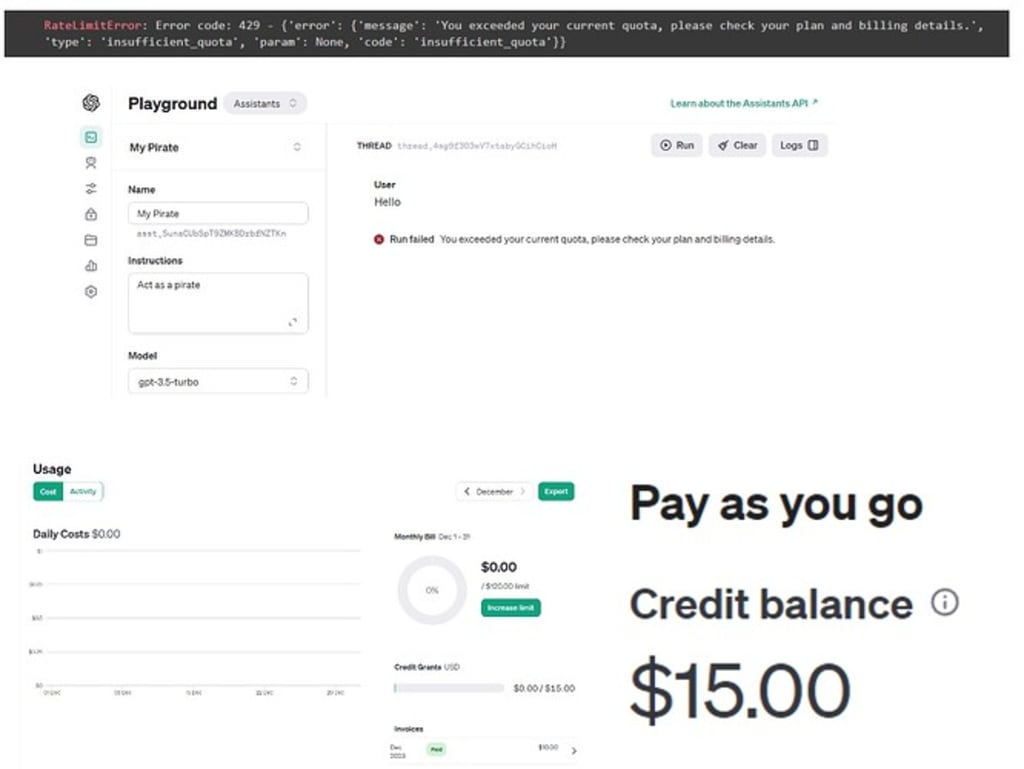
Last week, I opened my OpenAI dashboard the way I always do on Monday morning: coffee in one hand, a queue of half-finished projects in the other. The quota bar looked unusually generous. I blinked, refreshed the page, and checked the numbers again. Nothing had changed. For a moment, I allowed myself the stupid, hopeful thought that maybe the company had finally decided to reward loyal subscribers. Maybe the new architecture really was that efficient. Maybe GPT-6.2 Astra and Sol were the durable workhorses the launch posts had promised.
This week, that generosity was reclassified as a clerical error. Welcome to the reality of enterprise AI, where a “bug” is whatever the accounting department decides it is.
The email arrived on a Tuesday. OpenAI explained, in the smooth language of corporate apology, that it had incorrectly calculated usage discounts for GPT-6.2 Astra and Sol. To correct this mistake, Astra would now hit my rate limit 40% faster than last week. Sol would hit it 25% faster. The company kindly assured me that it would not retroactively charge me for past overages. How generous.
I sat at my desk and did the math I had been avoiding. If your token consumption rate increases by 40%, your available workload does not drop by 40%. It drops to roughly 71.4% of the original capacity. If I could run 100 identical tasks last week on Astra, I could now run 71. For Sol, an increased rate of 25% meant I was left with 80 tasks out of 100. That was a 28.57% shrink in actual usable work for Astra users. Calling this a “billing correction” was like a landlord telling me the free extra room in my apartment was actually a miscalculated wall, and he was taking it back.
The real sting was not just the arithmetic. It was the launch narrative. When GPT-6.2 was unveiled, OpenAI’s primary pitch was token efficiency. The promise was that the model could do more with fewer tokens. I had tolerated the slightly diminished reasoning quality because the efficiency made up for it. I thought I was getting a durable workhorse. Now OpenAI was admitting that the durability was never an architectural breakthrough. It was just a billing glitch.
So what was left of GPT-6.2? The competitive advantage had vanished into a spreadsheet correction. My workflows, carefully tuned around the old limits, suddenly needed re-engineering. My batch jobs needed smaller batches. My writing assistant needed shorter context windows. My overnight automations needed to be split, throttled, and babysat. None of this appeared in the email. The email only mentioned rate limits, as if rate limits were an abstract technical detail rather than the shape of my working day.
To soften the blow, OpenAI offered a one-time, permanent reset for Go, Plus, Pro, and Business users starting November 26. A single reset. I thought about that for a long time. I had just lost 20% to 30% of my sustainable weekly capacity, and the compensation was a button I could press once. It was a band-aid on a severed artery.
The whole episode felt like a symptom of a larger drift. Since the aggressive 28-day development sprint, OpenAI seemed less focused on the daily grind of user experience and more obsessed with chasing Anthropic’s benchmarks. The company was burning capital to win the enterprise evaluation game while treating its core subscribers as beta testers who should be grateful for the crumbs. With the short-term IPO dream looking increasingly distant, the pressure to squeeze every drop of margin out of existing infrastructure was showing. We were seeing the result in our dashboards.
I will still use the models. The ecosystem is too entrenched to abandon overnight. My files are there, my prompts are there, my habits are there. But the trust is eroding. When a company retroactively redefines your quota as a mistake, you learn a hard lesson: in the current AI landscape, you are not a customer. You are an adjustable variable.
About the Creator
Jin
Writer of reamstories
https://reamstories.com/jin
Enjoyed the story? Support the Creator.
Subscribe for free to receive all their stories in your feed. You could also become a paid subscriber, letting them know you appreciate their work.
Comments
There are no comments for this story
Be the first to respond and start the conversation.