
OpenAI Just Cut Its $200 Pro Plan in Half and Called It a Win
The company says API price cuts balance the change. Users say they’re paying the same price for half the product.
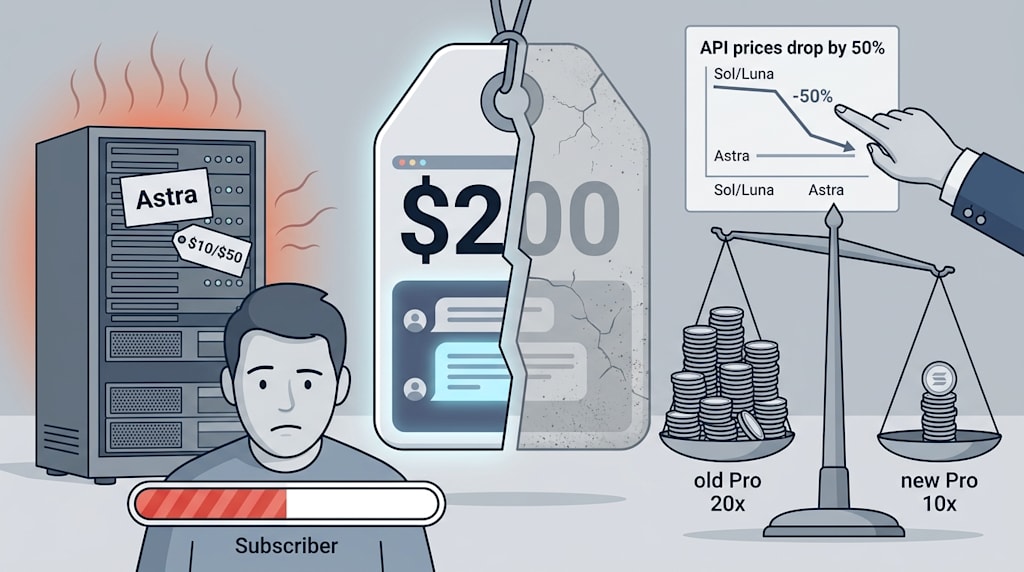
On September 30, 2026, ChatGPT $200 Pro reopened to new users. The price stayed the same. The usage did not. Codex and Work quotas fell from 20x Plus to 10x Plus. GPT-6 Pro weekly messages fell from 200 to 100. Tibo posted an explanation on X. His core logic: Sol and Luna API prices were cut by 50%, so the plan’s nominal quota was also halved, and total token volume was “roughly unchanged.”
That equation has a gap: Astra. GPT-6 Astra’s API price was not adjusted. It remains $10 input and $50 output per million tokens. For users who subscribe to $200 Pro for Astra, a halved API-equivalent spend means a halved usable quota in practice. Tibo’s other reasons: no return to a 5-hour usage window, so Pro users can freely allocate their weekly quota; model efficiency gains will be passed on through API price cuts; OpenAI does not want to create an incentive to “raise API list prices and then route the discount back through subscriptions”; and new features that do not consume usage will be added to subscriptions.
User reaction was direct. On the OpenAI developer forum, one existing $200 subscriber wrote: “This is bait-and-switch, plain and simple. The email spells it out: starting October 30, Pro 200 usage drops from 20x to 10x, and GPT-6 Pro weekly messages are cut from 200 to 100. Same price, half the product.” He added that even under the old 20x quota, his quota was exhausted after about three days of heavy work. Under the new quota, “making it through one day would be lucky.” The one-time 62,500 credits compensation from OpenAI, with a December 31 expiration date, was described by him as “insulting.” A one-time, expiring compensation cannot make up for a permanent monthly halving of usage.
The discussion on V2EX was calmer. One user analyzed that OpenAI’s core intention is to stop promising “$200 members always equal a certain dollar amount of API usage.” Instead, it wants to keep the actual compute volume of subscribers within a relatively stable range. Otherwise, every time API prices halve, the same dollar amount can buy twice as many tokens. Pro users’ actual compute would keep doubling as API prices fall, making the subscription increasingly unsustainable. This analysis points to the long-term promise that “the value of every dollar will rise,” and the present reality of a “halved quota.”
The compute math is harder. SemiAnalysis previously estimated that a maxed-out $200 ChatGPT Pro subscription, converted at API list prices, is equivalent to about $14,000 per month in usage. For comparison, Anthropic’s $200 Max plan under the same conditions is equivalent to about $8,000 in API usage. That means OpenAI’s subsidy for heavy Pro users is the highest among the two leading AI companies. This business model cannot last. After GPT-6 Astra launched on September 3, compute demand surged. OpenAI suspended new subscriptions and upgrades to $200 Pro on September 10. Tibo’s explanation at the time was that this tier puts the most pressure on the system. The suspension itself was a signal: compute supply cannot keep up with demand growth, and the most heavily subsidized tier is the first to feel it.
The $500 Pro 500 tier launched at DevDay made the commercial intent clearer. Pro 500 offers 25x Plus usage and exclusive access to Astra Ultrafast mode, with token generation speeds up to 8x the standard mode, and up to 300 tokens per second in Codex. Ultrafast pricing is equally blunt: $60 input and $300 output per million tokens, six times Astra’s standard price ($10/$50). OpenAI is telling users: if you need the old Pro’s usage level, pay two and a half times as much. If you only pay $200, accept half the usage. Price-sensitive and performance-sensitive users are separated by a $300 price gap.
Calling this a price increase misses what it is. Subscription AI services have enjoyed a hidden subsidy over the past two years. Model inference costs are falling fast, but API list prices have not fallen as quickly. This created an arbitrage space. The fixed fee paid by subscribers could buy an ever-expanding amount of API-equivalent usage. SemiAnalysis’s “$200 for $14,000” figure is the extreme expression of that arbitrage. OpenAI’s adjustment closes that arbitrage space. Tibo said it plainly: he hopes that one day prices will be low enough that most people can just buy usage on demand, and there will no longer be a big gap between how much a dollar buys in a subscription and in the API. In other words, OpenAI wants subscriptions to be reasonably priced products with clear boundaries.
The goal is reasonable. The problem is the transition. With Astra prices firm, model routing opaque, and users already accustomed to the old quotas, announcing a cut with the line that “API-equivalent spend is halved but actual value is unchanged” was bound to provoke backlash. Users want a tool that can finish work. They do not want a value prospectus that requires careful calculation to understand.
Compute costs money. Subsidies end. When a company packages a clear cut in “this is better for you” rhetoric, the trust damage is harder to repair than the quota cut.
New $200 Pro users now get 10x Plus usage, 100 GPT-6 Pro messages per week, and Astra’s API price is still $10/$50. At the end of his tweet, Tibo said: “Tomorrow, we will add more new features to subscriptions that do not consume usage.” Users will see those features tomorrow. They will remember today the next time their quota runs out.
About the Creator
Jin
Writer of reamstories
https://reamstories.com/jin
Enjoyed the story? Support the Creator.
Subscribe for free to receive all their stories in your feed. You could also become a paid subscriber, letting them know you appreciate their work.
Comments
There are no comments for this story
Be the first to respond and start the conversation.