
Online Education Market Set to Surpass US$1 Trillion as Digital Learning Transforms Global Education
Rising internet penetration, growing demand for flexible learning, and rapid advances in AI-powered educational technology are driving unprecedented growth in the online education industry.

Introduction: Education Enters a Digital-First Era
The way people learn is changing faster than ever before. Traditional classrooms are no longer the only pathway to education, professional development, or career advancement. Today, millions of students, working professionals, and organizations rely on digital platforms to gain knowledge, develop new skills, and stay competitive in an increasingly technology-driven world.
What began as a supplementary learning tool has evolved into a global educational ecosystem that reaches learners regardless of location, age, or professional background. From university degree programs and corporate training to mobile learning apps and virtual classrooms, online education is reshaping how knowledge is delivered and consumed.
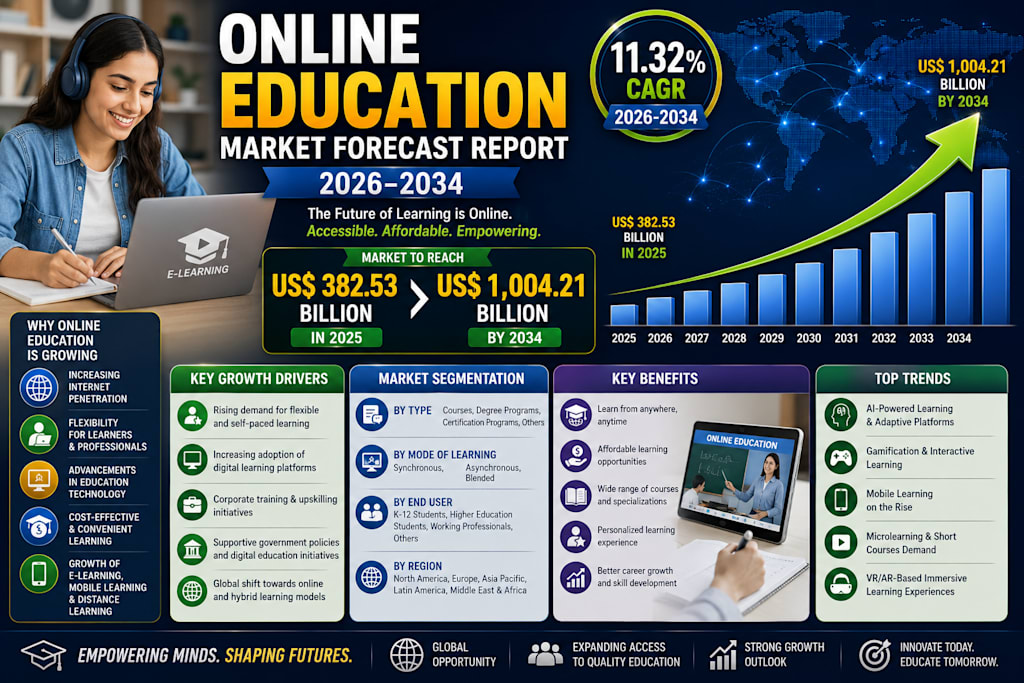
According to Renub Research, the Global Online Education Market is projected to grow from US$ 382.53 billion in 2025 to US$ 1,004.21 billion by 2034, registering a remarkable compound annual growth rate (CAGR) of 11.32% between 2026 and 2034. The market's rapid expansion is fueled by increasing internet penetration, growing demand for flexible learning solutions, and continuous technological advancements across the education sector.
As digital transformation accelerates worldwide, online education is becoming one of the most influential industries of the 21st century.
The Evolution of Online Learning
Online education refers to learning delivered through internet-connected digital platforms that allow students to access educational content remotely. Learners can participate in live classes, watch recorded lectures, complete assignments, take assessments, and earn certifications using computers, tablets, and smartphones.
Unlike traditional classroom learning, online education offers the flexibility to learn at any time and from virtually any location. This accessibility has made digital learning particularly attractive to students, professionals, and organizations seeking convenient and cost-effective educational solutions.
Over the past decade, improvements in digital infrastructure and educational technology have transformed online learning from a niche alternative into a mainstream educational model. Universities, schools, corporations, and training institutions now view digital learning as a permanent and essential component of modern education.
This shift is expected to continue as learners increasingly prioritize flexibility, affordability, and personalized educational experiences.
Internet Expansion Is Fueling Market Growth
One of the most significant factors driving online education adoption is the rapid growth of internet access worldwide.
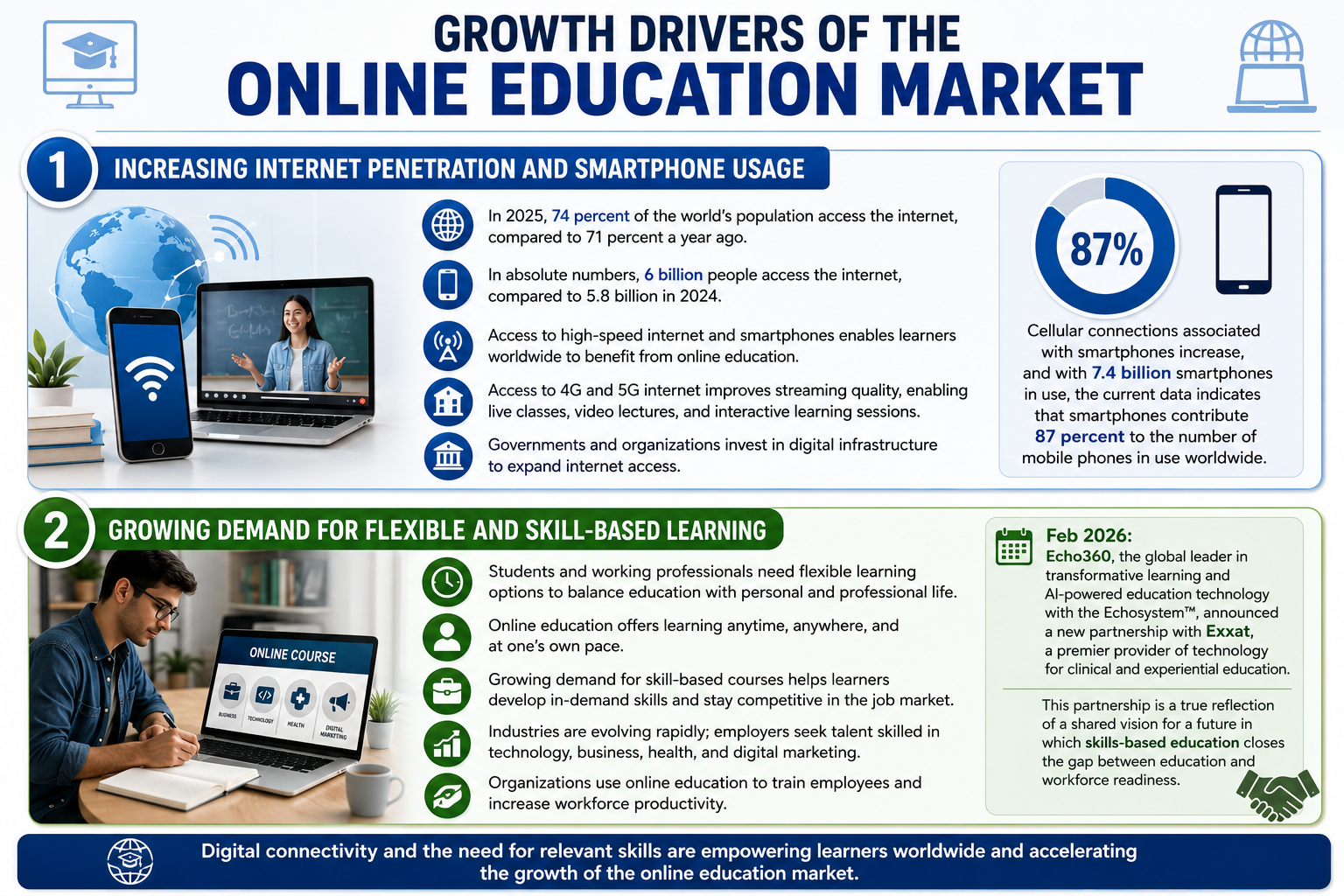
According to the report, approximately 74% of the global population had internet access in 2025, compared to 71% the previous year. This translates to around 6 billion internet users worldwide, up from 5.8 billion in 2024. The continued expansion of internet connectivity has dramatically increased access to educational content across both developed and emerging markets.
At the same time, smartphone adoption continues to rise. The report notes that there are approximately 7.4 billion smartphones in use globally, accounting for around 87% of all mobile phones currently in operation. These devices have become powerful educational tools, enabling learners to participate in courses, access study materials, and communicate with instructors from virtually anywhere.
The rollout of 4G and 5G networks has further enhanced the online learning experience by supporting high-quality video streaming, interactive virtual classrooms, and real-time collaboration.
As governments and private organizations continue investing in digital infrastructure, access to online education is expected to expand significantly.
Flexible Learning Is Meeting Modern Needs
The growing demand for flexibility is another major force driving market expansion.
Modern learners often balance multiple responsibilities, including education, employment, family commitments, and personal development. Traditional classroom schedules may not always accommodate these competing priorities.
Online education solves this challenge by allowing learners to study at their own pace and according to their own schedules. Students can access lessons, assignments, and learning materials whenever it is convenient for them, making education more accessible than ever before.
This flexibility is particularly valuable for working professionals seeking career advancement. Many individuals enroll in online courses to acquire new skills, earn certifications, and remain competitive in rapidly evolving industries.
Employers are also increasingly supporting digital learning initiatives because they provide cost-effective ways to train employees while minimizing workplace disruptions.
As workforce requirements continue evolving, demand for flexible education solutions is expected to remain strong.
Skill-Based Learning Is Reshaping Education
The global labor market is changing rapidly, creating increased demand for practical and job-oriented education.
Employers are increasingly prioritizing skills over traditional qualifications in many industries. Fields such as technology, data science, cybersecurity, artificial intelligence, healthcare, business management, and digital marketing require continuous learning to keep pace with innovation.
Online education platforms have responded by offering specialized courses designed to address specific workforce needs. These programs focus on practical skills, industry certifications, and professional development opportunities that can be immediately applied in the workplace.
The report highlights a partnership announced in February 2026 between Echo360 and Exxat aimed at supporting skills-based education and workforce readiness. Such initiatives reflect the growing alignment between online education providers and labor market demands.
As industries continue evolving, skill-based learning is expected to become an increasingly important segment of the online education market.
Artificial Intelligence Is Revolutionizing Learning Experiences
Artificial intelligence is emerging as one of the most transformative technologies in online education.
AI-powered learning systems can analyze student performance, identify strengths and weaknesses, and deliver personalized learning experiences tailored to individual needs. This approach allows learners to progress at their own pace while receiving targeted support when needed.
AI also enhances educational efficiency by automating administrative tasks, grading assessments, generating learning recommendations, and supporting intelligent tutoring systems.
Beyond AI, technologies such as virtual reality, augmented reality, cloud computing, and advanced video conferencing tools are creating more immersive and engaging learning environments.
These innovations are helping online education move beyond simple video lectures toward interactive, adaptive, and highly personalized educational experiences.
Online Higher Education Continues to Expand
Higher education remains one of the most important segments within the online education market.
Universities and colleges increasingly offer undergraduate degrees, postgraduate programs, diplomas, and professional certifications through online platforms. These programs provide learners with opportunities to earn recognized qualifications without relocating or attending physical campuses.
Online higher education is particularly attractive to working professionals seeking career advancement while maintaining full-time employment. International students also benefit from access to globally recognized educational institutions without the costs associated with international travel and accommodation.
As acceptance of online degrees continues to increase among employers and academic institutions, demand for digital higher education programs is expected to grow substantially.
Corporate Learning Is Becoming a Strategic Investment
The corporate sector has emerged as a major consumer of online education solutions.
Large enterprises increasingly use digital learning platforms to train employees, improve productivity, and address skill gaps. Online training programs cover leadership development, technical skills, compliance training, professional certifications, and workforce upskilling initiatives.
Cloud-based learning management systems allow organizations to monitor employee progress, assess learning outcomes, and customize training programs according to business needs.
As technological change accelerates across industries, organizations recognize that continuous employee development is essential for maintaining competitiveness.
The growing focus on talent development and workforce readiness is expected to drive sustained growth within the corporate online education segment.
Mobile Learning Is Expanding Accessibility
Mobile learning has become one of the fastest-growing areas within online education.
Smartphones and tablets allow learners to access educational content wherever they are, making learning more convenient and accessible. Mobile learning applications offer video lessons, quizzes, assessments, and interactive content specifically optimized for smaller screens.
Microlearning, which delivers content in short, focused segments, has become particularly popular among mobile learners. This approach helps students absorb information more effectively while fitting education into busy schedules.
The widespread availability of smartphones, combined with growing mobile internet access, is expected to continue driving adoption of mobile learning solutions worldwide.
E-Learning Platforms Are Becoming More Sophisticated
Online e-learning platforms remain at the center of the industry's growth.
These platforms provide educational content across a wide range of subjects, including business, technology, healthcare, language learning, finance, and personal development. Modern e-learning systems incorporate video lectures, interactive assessments, virtual classrooms, discussion forums, and certification programs.
Cloud computing has significantly improved platform performance by enabling secure content storage, seamless scalability, and remote accessibility.
The report also highlights recent initiatives such as the European Labour Authority's e-learning platform launched in March 2025 to improve understanding of European Union legislation. Such examples demonstrate how digital learning is expanding beyond traditional academic environments into professional and governmental applications.
Regional Markets Show Strong Growth Potential
United States
The United States remains one of the world's largest and most mature online education markets. Strong technological infrastructure, widespread internet access, and the presence of leading educational technology companies continue to drive growth.
The report notes that in January 2025, zSpace introduced an augmented reality and virtual reality learning platform designed for elementary school students, demonstrating the growing role of immersive technologies in education.
United Kingdom
The United Kingdom continues to experience steady growth in online education due to widespread acceptance among universities, businesses, and training organizations. Government support for digital skills development further strengthens market prospects. The UK government's £100 million investment in digital skills training announced in 2024 highlights this commitment.
India
India represents one of the fastest-growing online education markets globally. Rapid smartphone adoption, increasing internet access, government support for digital learning, and strong demand for affordable education are driving market expansion.
The report notes that Vedantu secured additional funding in September 2024, reflecting continued investor confidence in India's education technology sector.
Saudi Arabia
Saudi Arabia's online education market is expanding rapidly due to government-led digital transformation initiatives and investments in educational modernization. The launch of the "Multiversity" initiative by the National eLearning Center in January 2026 reflects the country's commitment to advancing digital higher education.
Challenges Remain Despite Strong Growth
Despite its impressive growth trajectory, the online education industry faces several challenges.
One major issue is unequal access to digital infrastructure. Many rural and developing regions still lack reliable high-speed internet connectivity, limiting participation in online learning programs. Additionally, some students do not have access to appropriate devices such as smartphones, tablets, or computers.
Student engagement also remains a concern. Online learning environments can sometimes struggle to replicate the social interaction, collaboration, and hands-on experiences associated with traditional classrooms.
Subjects requiring practical training, including medicine and engineering, present additional challenges for fully digital education models.
Addressing these issues will be critical for ensuring inclusive and effective online learning experiences in the future.
Leading Companies Shaping the Industry
The online education market includes numerous technology companies, educational institutions, and digital learning providers competing to enhance learning experiences and expand access.
Key companies highlighted in the report include Coursera Inc., Instructure Holding Inc., Adobe Inc., Alphabet Inc., Udemy, Pearson plc, Stride Inc., and NetEase Inc. These organizations continue investing in artificial intelligence, cloud-based learning systems, mobile education technologies, and personalized learning solutions.
Their innovations are helping define the future of digital education worldwide.
Final Thoughts
The global online education market is entering a transformative period of growth fueled by technological innovation, expanding internet access, and increasing demand for flexible, skill-based learning.
With the market projected to rise from US$ 382.53 billion in 2025 to US$ 1,004.21 billion by 2034, online education is rapidly becoming one of the largest and most influential segments of the global digital economy.
As artificial intelligence, virtual reality, mobile learning, and cloud computing continue to evolve, educational experiences will become more personalized, interactive, and accessible than ever before. While challenges related to infrastructure and engagement remain, the long-term outlook for online education is exceptionally strong.
The future of learning is no longer confined to classrooms. It is increasingly digital, flexible, and global, creating opportunities for millions of learners to access knowledge, develop new skills, and shape their futures from virtually anywhere in the world.
About the Creator
Enjoyed the story? Support the Creator.
Subscribe for free to receive all their stories in your feed.
Comments
There are no comments for this story
Be the first to respond and start the conversation.