
One-Third of Retail's Core Systems Are End-of-Life. Peak Season Exposes Everyone.
Legacy infrastructure holds through quiet months, then fails under holiday traffic. Cloud-native modernization decides which retailers stay online when volume spikes.

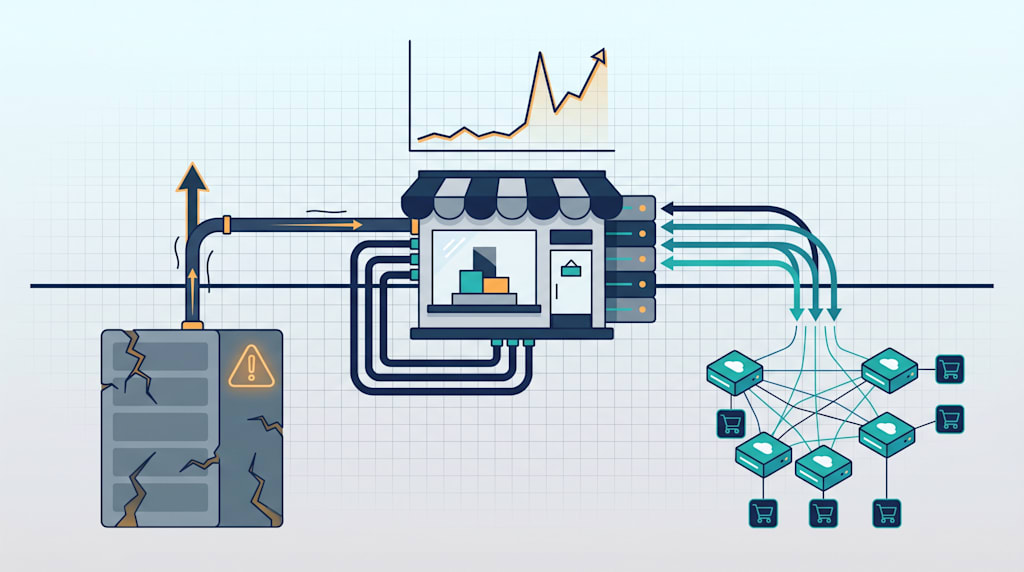
A retail platform that runs fine in March can collapse in November. The traffic is the difference.
Most retail systems never reach their limits during normal months. Peak season removes that comfort. The systems that hold steady in spring meet their breaking point in the fourth quarter.
The scale of the exposure is documented. Nearly one-third of retail leaders report that mission-critical networks, storage, and servers sit at end-of-service. Nearly half say foundational tech-stack problems delay innovation.
End-of-service means no vendor patches, no support, and no upgrade path. The system keeps running because nobody dares to touch it. Peak traffic does not respect that fragility.
This is the problem CIOs and engineering leads carry into every holiday planning cycle. The systems that process orders, hold inventory, and run checkout were built for a slower decade.
What Actually Fails Under Peak Traffic
Legacy retail systems break in predictable ways. The failure modes repeat across companies.
Most run as monoliths. One large application handles checkout, inventory, pricing, and accounts together. A spike in one function consumes the resources the others need. The whole system slows down at once.
These systems scale vertically. A team adds CPU and memory to a single server. Hardware has a ceiling. Once you hit it, the only option is a bigger machine, ordered weeks ahead.
Databases become the choke point. A single relational database serves every request. Thousands of simultaneous checkouts create lock contention. Response times climb. Carts time out. Customers leave.
Batch jobs add their own risk. Overnight inventory syncs and pricing updates assume quiet windows exist. Peak season has no quiet windows. The batch window shrinks until jobs overlap and fail.
The Cost Hides Outside the Maintenance Budget
Leaders often underestimate what legacy systems cost. The maintenance line tells only part of the story.
Industry benchmarks place legacy maintenance at 60 to 80 percent of total IT spend across enterprise portfolios. Engineers spend 42 percent of their week on maintenance and technical debt rather than building new features.
The debt compounds. Technical debt grows at roughly 20 percent annually when teams ignore it. Each year of delay raises the eventual retail modernization cost by a further 20 to 25 percent.
Security adds pressure. Around 32 percent of cyberattacks exploit unpatched software vulnerabilities. End-of-life systems carry unpatched flaws by definition. Cyber insurance providers now treat unsupported legacy platforms as unacceptable risks. Some organizations face premium increases of 40 to 60 percent or policy non-renewal.
The risk is not abstract. Some analysts predict that by 2027, 75 percent of organizations will face systemic failures tied to unmanaged technical debt.
Modernization Runs on a Spectrum
Teams sometimes treat modernization as one decision. It is several. Each application needs its own path.
The common framework sorts the work into a few approaches. AWS documents the original set in its widely cited guide on strategies for migrating applications to the cloud.
Rehosting moves an application to cloud infrastructure with a few changes. It is fast. It adds elastic capacity but keeps the old architecture's limits.
Application replatforming changes parts of the stack without a full rewrite. A team containerizes the application or moves to a managed database. The effort stays moderate. The scaling gains are real.
Refactoring rebuilds the application around cloud-native development patterns. Microservices replace the monolith. Each service scales on its own. This path costs the most and returns the most.
Retiring is the step teams skip. Portfolio audits typically find that 15 to 30 percent of applications are retirement candidates. Removing them first shrinks the scope of everything that follows.
The right choice depends on traffic, risk, and how central the system is to revenue.
Start Before the Freeze, and Sequence the Work
Timing decides outcomes. A retailer cannot rebuild core systems during a peak-season change freeze. The work has to start months earlier.
Big-bang rewrites fail often. Research shows that only 12 percent of legacy modernization programs succeed, while 88 percent stall. Incremental approaches and dedicated leadership separate the two groups.
The incremental method works better. A team wraps the old system and replaces one function at a time. Checkout moves to a new service while the rest stay in place. Each piece ships and proves itself before the next begins.
Prioritization matters as much as method. The first systems to modernize are the ones with the highest traffic and the highest failure risk. Checkout and inventory usually top that list. A forgotten internal report can wait.
This sequencing also matches the calendar. Retailers selling across regions face several peaks each year. Black Friday and Cyber Monday hit one market. Singles' Day drives another. Boxing Day brings a third. Modernization finished before the earliest peak protects all of them.
What Cloud-Native Systems Do Differently at Peak
Cloud-native systems handle peak traffic through design, not luck.
They scale horizontally. The platform adds instances when traffic rises and removes them when it falls. Capacity matches demand within minutes.
They run stateless services. Any instance can handle any request. Losing one instance does not drop a customer's session.
They isolate failure. One struggling service does not take down the others. A slow recommendation engine no longer freezes checkout.
The payoff shows up in the numbers. Organizations that modernized between 2022 and 2025 report 25 to 35 percent lower infrastructure costs and 40 to 60 percent faster release cycles. Scalable systems cost less to run and change faster.
Building the Program Without Breaking Operations
Most retail engineering teams cannot pause operations to modernize. They run the business and rebuild it at the same time. That dual load is the hard part.
The common model pairs an internal team that knows the business logic with external specialists who bring cloud-native patterns and migration experience. The internal team keeps the knowledge. The external team supplies the speed.
Companies like ViitorCloud, which writes about cloud-native application modernization for retail, work alongside retail IT teams modernizing systems ahead of peak demand. The pairing matters because modernization done in isolation tends to miss the operational details that only the in-house team knows.
Peak season arrives on the same dates every year. The traffic climbs whether the systems are ready or not. Retailers that modernize core systems now will spend the next holiday cycle watching dashboards stay green. Retailers that delay will spend it explaining outages. The end-of-service clock does not pause. Each quarter of delay raises both the cost and the risk.
----------------------------------------------------------------------------------------
Frequently Asked Questions
What is cloud-native application modernization?
It rebuilds or replatforms legacy applications to run on cloud infrastructure using scalable, containerized, and independently deployable services.
Why do retail systems fail during peak season?
Legacy systems scale vertically and share resources, so traffic spikes cause database contention, slow response times, and checkout failures.
What does application replatforming involve?
It moves parts of an application to managed cloud services, like containers or managed databases, without a full rewrite.
When should retailers start modernization?
Months before peak season, since changes freeze block major work, and incremental migration needs time to finish safely.
About the Creator
ViitorCloud Technologies
As a leading software development company, we’ve empowered 500+ startups, SMBs, and enterprises to transform their operations. Upgrade your business with our AI-First Software and Platforms that automate and scale, keeping you future-ready.
Enjoyed the story? Support the Creator.
Subscribe for free to receive all their stories in your feed.
Comments
There are no comments for this story
Be the first to respond and start the conversation.