
One Slide at a Time
DeepSeek Harness says it has 1.54 million daily users and burns 92 trillion tokens a day. A Tuesday-night PPT shows what those numbers miss.
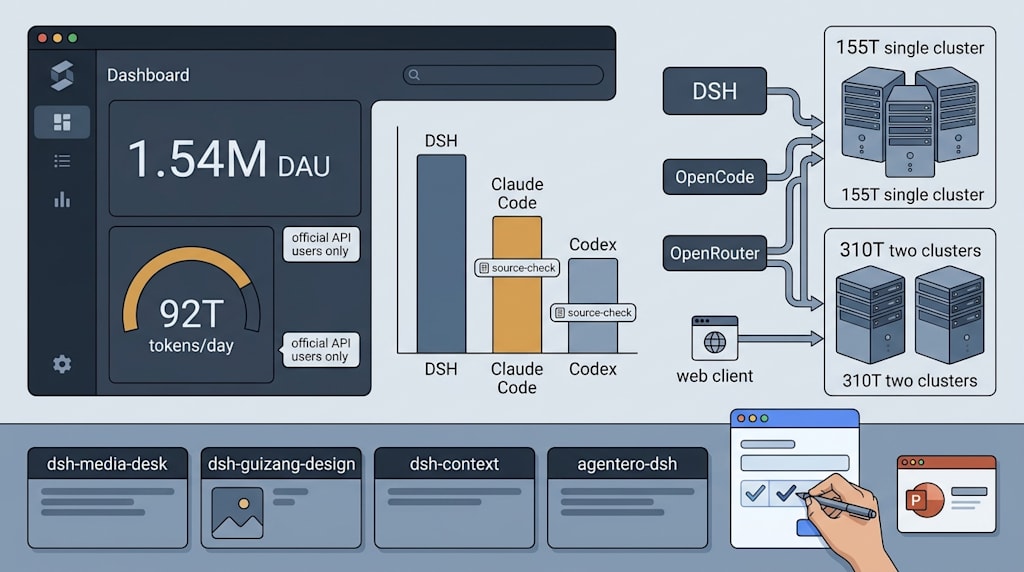
At 11:40 on a Tuesday night, a self-media operator named Mei was still at her desk, trying to finish a deck for a client who wanted "less AI flavor." She had been through three drafts. The first two read like a machine had written them: smooth, balanced, empty. Then she installed dsh-guizang-design, a plugin for DeepSeek Harness that ports the Guizang skill into a UI. She made one slide. The text came out shorter, blunter, with a number in the second sentence and a concrete example in the third. She saved it and went to bed.
She came back the next day. That is the unit the numbers are made of.
The disclosure
On November 4, DeepSeek Harness published a set of figures: 1.54 million daily active users, about 92 trillion tokens consumed per day. The company counted only users on its official API. That scope matters. It does not cover every way people reach DSH. It does not cover every DeepSeek model running somewhere else. Third-party channels, mirrors, and other access routes may sit outside the count.
Change the scope, and every comparison changes with it.
The growth line is easy to check. DSH v0.1 launched on August 13. The desktop version arrived on September 29. On September 30, DAU was about 271,000. By October 7, it was 429,000. By November 4, it was 1.54 million. Another report put the gain at 545% compared with the September 29 desktop launch. In about a month, DSH went from hundreds of thousands of daily users to the million level.
Mei is one of them. She does not appear in the 92 trillion token count as a person. She appears as a pattern of requests: a prompt, a revision, a second revision, a slide that finally works.
The comparison that gets shaky
The tempting comparison is Claude Code at about 14 million monthly active users and 9 million weekly active users. That would put DSH in the same league. The comparison is shaky.
Claude Code's activity numbers move depending on the source. Feedly AI put Claude Code at about 11.3 million monthly active users and 6.8 million weekly active users in September 2026. Another count put weekly active developer users at about 4.2 million. Different sources, different sampling, different numbers. What holds: Claude Code's weekly active scale is in the millions, not a firm number near 10 million.
Codex has grown faster. A 36Kr report in August 2026 said OpenAI Codex passed 20 million weekly active users. In the same period, Claude Code's four-week growth rate slowed to 5.2%. On weekly active users, Codex is clearly ahead of Claude Code.
DSH's 1.54 million is a daily number. Even a rough conversion to weekly active users leaves a clear gap between DSH and Codex's 20 million weekly users, and a gap between DSH and Claude Code's millions of weekly users. DSH is moving quickly toward Claude Code's early scale on daily users. Its absolute user base is still catching up. "Same league" is too generous. The sentence that says DSH is still behind Codex and Claude Code is closer to the facts.
Growth speed is one story. Absolute scale is another. The 1.54 million daily users supports the first story. It does not finish the second one.
What 92 trillion tokens measure
The 92 trillion daily tokens say more about how hard people use DSH than the 1.54 million daily users do. People are not just opening the tool. They are burning inference capacity.
The comparison making the rounds puts OpenCode at about 30 trillion tokens per day across all models, with OpenRouter close behind. The same comparison says DeepSeek models make up the bulk of both. That needs a scope check.
OpenCode's "30 trillion" is likely an old number or a narrow one. In June 2026, OpenCode processed about 7 trillion tokens per day. In August 2026, a report said OpenCode's daily token use jumped from about 3 trillion to 18 trillion after DeepSeek V4 Flash launched. OpenCode has claimed capacity for 100 trillion tokens per day. Capacity is not consumption. Using "30 trillion" as OpenCode's regular daily consumption overstates it.
On OpenRouter, DeepSeek V4.1 Flash runs at roughly 5 trillion to 8 trillion tokens per day. In that narrow sense, "OpenRouter is about the same" can hold.
So 92 trillion tokens is a useful gauge of how deeply DSH users work. It is not a license to claim DSH has eaten OpenCode plus OpenRouter. Numbers from different sources and different scopes do not add cleanly.
Mei's 92 trillion is not a market share. It is a stack of slides, scripts, and covers that people needed to finish before they could go to bed.
Two clusters, one premise
DeepSeek has said a single cluster handles 155 trillion tokens of inference requests per day. The number comes from the technical report for DeepInfer, DeepSeek's open-source inference framework. It can be checked.
A public-data estimate: DSH at 92 trillion, OpenCode at a more realistic 18 trillion, DeepSeek models on OpenRouter at 5 trillion to 8 trillion, plus the web client and other channels. The total lands around 115 trillion to 120 trillion. One cluster at 155 trillion can theoretically cover that. Two clusters at 310 trillion leave plenty of room.
The estimate rests on a premise: every channel's inference requests run on DeepSeek's own clusters using DeepInfer. DeepSeek has not said that all 92 trillion DSH tokens run on its own clusters. "Two clusters can probably serve every channel" is a reasonable inference, not an official fact. Treat it as an estimate.
The plugin community is where the numbers become workflows
The plugin community gets less attention than DAU and tokens. It does not answer "how big is DSH?" It answers "what do people do with DSH?"
The official recommendations include dsh-media-desk, a self-media workbench that pulls inspiration, scripts, covers, and storyboards into one place; dsh-guizang-design, which ports the Guizang skill to DSH with a UI and works for PPTs, graphic cards, and stripping AI flavor; dsh-context, a context insight plugin; and agentero-dsh, a paper-reading plugin.
Mei used dsh-guizang-design for a PPT. That kind of report carries more weight than any phrase about a plugin scene on the rise. A plugin matters when it enters a real workflow: one PPT slide, one paper, one script. That is what brings someone back the next day. DAU and tokens measure volume. Plugins measure the width of use cases.
There is also a practical entry point at the end of the official post. Clicking "Read Original" opens a Feishu form. Fill it out, and if the official team picks your plugin, you can get support: free tokens, featured exposure, technical exchange. At least one plugin author has received a 1,000 yuan voucher, enough to run DeepSeek-Flash for a while. The bar is lower than it looks.
The last number is not a number
DSH's 1.54 million daily users and 92 trillion tokens break into four checkable numbers: daily users on the official API; a climb from 271,000 to 1.54 million in about a month; 92 trillion tokens of usage depth; and 155 trillion tokens of single-cluster inference capacity.
In comparison, Claude Code and Codex weekly user numbers need source labels. DSH is growing fast, and its absolute scale is still catching up. In token comparison, OpenCode's "30 trillion" needs to be split into old scope, capacity, and actual consumption. The cluster estimate needs the premise that every channel runs on DeepSeek's own clusters. The plugin community pulls the question from "how big is DSH?" to "what is DSH for?"
The last number is not a number. Someone opens the Feishu form and fills in a plugin name, a use case, and a screenshot. Someone opens the desktop client, finishes one PPT slide with dsh-guizang-design, and comes back the next day. The 1.54 million daily users is made of those actions.
Mei finished her deck at 12:10 on Wednesday morning. She sent it to the client and closed her laptop. The slide she made with the plugin took four minutes. The two drafts before it took two hours. She will open the client again tomorrow, because the plugin is now part of how she works. That is the number the press release cannot count.
About the Creator
Jin
Writer of reamstories
https://reamstories.com/jin
Enjoyed the story? Support the Creator.
Subscribe for free to receive all their stories in your feed. You could also become a paid subscriber, letting them know you appreciate their work.
Comments
There are no comments for this story
Be the first to respond and start the conversation.