
O-Ring Seals Market Set to Surpass USD 21 Billion by 2034 as Industrial Automation and Aerospace Demand Accelerate
Rising investments in manufacturing, automotive production, energy infrastructure, and aerospace engineering are creating new growth opportunities for the global O-ring seals industry.

Industrial equipment often relies on components that receive little attention from the public but are essential to keeping machinery operational. Among these critical components are O-ring seals, simple yet highly effective sealing devices used in countless applications across industries. From automotive engines and aircraft systems to medical devices and energy infrastructure, O-ring seals play a crucial role in preventing leaks, improving safety, and enhancing operational efficiency.
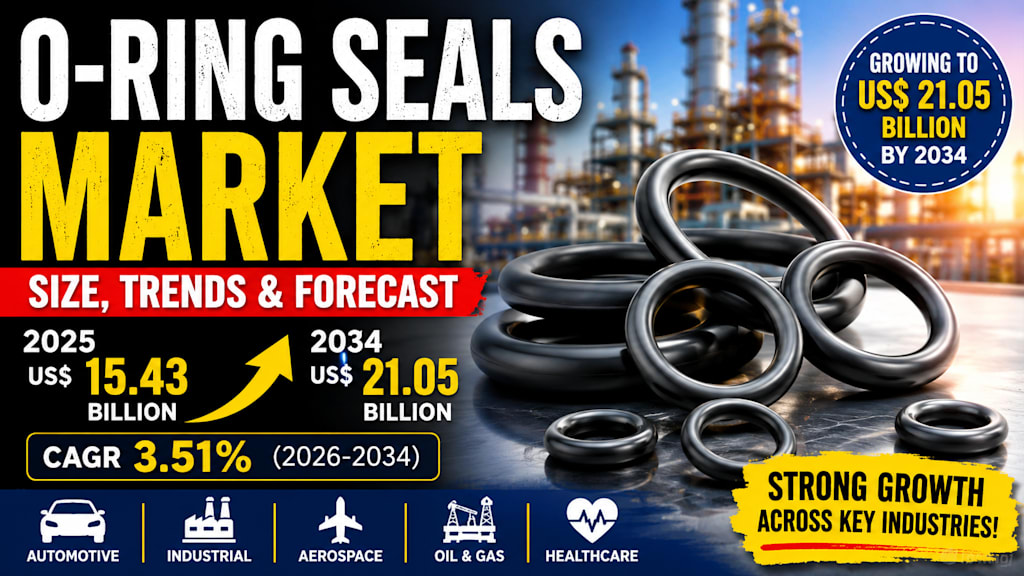
According to Renub Research, the global O-ring seals market is projected to increase from US$ 15.43 Billion in 2025 to US$ 21.05 Billion by 2034, expanding at a CAGR of 3.51% during the forecast period from 2026 to 2034. This steady growth reflects increasing industrialization, expanding infrastructure projects, and rising demand from sectors requiring reliable sealing solutions.
As industries continue to modernize and automate operations, the demand for durable and high-performance sealing systems is expected to rise significantly.
Understanding the Importance of O-Ring Seals
O-ring seals are circular mechanical gaskets designed to prevent the leakage of liquids and gases between two mating surfaces. Manufactured from materials such as nitrile rubber, silicone, fluorocarbons, EPDM, and other elastomers, these seals provide a simple yet highly effective solution for maintaining pressure and preventing contamination.
Their popularity stems from several advantages:
Cost-effective design
Easy installation
High durability
Resistance to temperature fluctuations
Ability to operate under varying pressure conditions
Compatibility with numerous industrial fluids and gases
Because of these characteristics, O-ring seals have become indispensable in industries where reliability and safety are non-negotiable.
Automotive Industry Remains a Major Growth Engine
The automotive sector represents one of the largest consumers of O-ring seals worldwide. Modern vehicles contain hundreds of sealing points that require dependable performance under challenging conditions.
O-ring seals are commonly used in:
Engines
Fuel systems
Hydraulic systems
Braking systems
Air conditioning units
Electric vehicle battery systems
As global vehicle production continues to expand, especially with the growing adoption of electric vehicles (EVs), manufacturers are increasingly seeking advanced sealing materials capable of withstanding higher temperatures and more demanding operating conditions.
Electric vehicles create additional opportunities because battery systems require robust protection against moisture, dust, and contaminants. Consequently, O-ring manufacturers are investing heavily in material innovation to meet evolving automotive requirements.
Industrial Manufacturing Expansion Drives Demand
The growth of industrial manufacturing activities worldwide has significantly increased the need for reliable sealing solutions.
Factories rely on O-ring seals to maintain the efficiency of:
Pumps
Compressors
Hydraulic systems
Pneumatic systems
Heavy industrial machinery
Process equipment
As governments and private organizations continue investing in industrial infrastructure, demand for machinery and equipment grows alongside the requirement for dependable sealing technologies.
Industrial automation trends are particularly influential. Automated manufacturing environments depend on precision equipment that cannot tolerate leakage or operational disruptions. O-ring seals help minimize maintenance costs while maximizing equipment uptime, making them indispensable components in modern production facilities.
Aerospace Sector Creates High-Value Opportunities
The aerospace industry represents one of the most demanding applications for O-ring seal manufacturers.
Aircraft systems operate under extreme conditions involving:
High temperatures
Significant pressure variations
Exposure to fuels and hydraulic fluids
Continuous vibration and mechanical stress
O-ring seals are extensively used in aircraft engines, landing gear systems, hydraulic circuits, and fuel management systems.
With global passenger traffic steadily increasing and airlines expanding their fleets, aerospace manufacturers continue to require advanced sealing technologies capable of meeting strict safety standards.
The industry’s focus on lightweight materials and fuel efficiency is also encouraging the development of next-generation sealing solutions that deliver superior performance while reducing weight.
Oil and Gas Industry Continues to Depend on Reliable Sealing Solutions
The oil and gas sector remains a cornerstone of demand for O-ring seals.
Operations in this industry often involve:
High-pressure drilling systems
Pipelines
Valves
Refineries
Offshore exploration platforms
Equipment failure in these environments can result in significant financial losses and safety risks. Therefore, operators prioritize high-quality sealing components capable of withstanding harsh chemicals, extreme temperatures, and challenging operating conditions.
As energy demand continues growing globally, exploration activities and infrastructure expansion are expected to support ongoing demand for industrial-grade O-ring seals.
Material Innovation Transforming Market Dynamics
One of the most important developments in the O-ring seals industry is the rapid advancement of material science.
Traditional sealing materials are being supplemented by advanced elastomers offering:
Greater chemical resistance
Improved heat tolerance
Enhanced wear resistance
Longer operational lifespan
Better environmental performance
These innovations enable manufacturers to serve increasingly demanding applications across aerospace, automotive, healthcare, and energy industries.
Material improvements are also helping businesses reduce maintenance requirements and extend equipment life cycles, creating additional value for end users.
Synthetic Rubber O-Rings Lead Market Adoption
Synthetic rubber remains the dominant material category within the O-ring seals market.
Popular synthetic materials include:
Nitrile Rubber (NBR)
Silicone Rubber
Fluorocarbon (FKM)
EPDM
These materials offer exceptional flexibility and durability, making them suitable for both static and dynamic sealing applications.
Synthetic rubber O-rings perform effectively under harsh industrial conditions and provide strong resistance against chemicals, oils, and temperature extremes.
As industries increasingly demand high-performance sealing solutions, synthetic rubber products are expected to maintain their leadership position throughout the forecast period.
Healthcare Industry Emerging as a Significant Consumer
Healthcare applications are becoming increasingly important for O-ring seal manufacturers.
Medical devices requiring precision sealing include:
Syringes
Infusion pumps
Ventilators
Diagnostic instruments
Laboratory equipment
Medical-grade O-rings must meet strict safety and hygiene requirements while ensuring compatibility with sensitive fluids and sterilization processes.
The expansion of healthcare infrastructure worldwide, combined with growing investment in advanced medical technology, is creating new opportunities for manufacturers specializing in medical sealing solutions.
Energy Infrastructure Investments Support Growth
The energy sector remains one of the largest users of O-ring seals.
Applications span multiple segments including:
Oil and gas exploration
Power generation facilities
Renewable energy systems
Pipeline networks
Industrial energy storage systems
Growing investments in both conventional and renewable energy infrastructure are driving demand for durable sealing components capable of operating in challenging environments.
As countries pursue energy security and sustainability goals, O-ring seal suppliers are likely to benefit from expanding infrastructure development projects.
Key Challenges Facing the Industry
Despite positive growth prospects, the O-ring seals market faces several challenges.
Raw Material Price Volatility
Many sealing materials are derived from petrochemical products, making manufacturers vulnerable to fluctuations in crude oil prices.
Unexpected increases in raw material costs can impact:
Production expenses
Profit margins
Supply chain stability
Product pricing strategies
Supply Chain Disruptions
Global supply chains remain susceptible to transportation bottlenecks, geopolitical tensions, and labor shortages.
These disruptions can delay production schedules and create inventory management challenges for manufacturers.
Competition from Alternative Sealing Technologies
Advanced sealing solutions such as mechanical seals and specialized gasket systems continue to compete with traditional O-ring products in certain applications.
To remain competitive, manufacturers must continue investing in research and development aimed at improving durability, efficiency, and performance.
Regional Market Outlook
United States
The United States remains one of the most significant markets for O-ring seals due to strong demand from aerospace, automotive, manufacturing, and energy sectors.
The country's focus on technological innovation and industrial automation supports ongoing market expansion.
United Kingdom
The United Kingdom benefits from a robust aerospace industry and advanced manufacturing ecosystem.
Demand for high-performance sealing solutions continues to increase as industries prioritize equipment reliability and operational efficiency.
India
India is emerging as an attractive growth market due to rapid industrialization, expanding automotive production, infrastructure development, and increased manufacturing activity.
Government initiatives supporting domestic manufacturing are expected to strengthen demand for industrial components, including O-ring seals.
Saudi Arabia
Saudi Arabia's extensive oil and gas infrastructure makes it a major consumer of industrial sealing products.
Economic diversification efforts and industrial development initiatives are expected to create additional growth opportunities in the coming years.
10 Recent Developments from Leading Companies
1. Freudenberg Introduced New Polyurethane Material
Freudenberg launched polyurethane-based material 98 AU 30500, designed as a high-performance alternative to conventional PTFE sealing solutions.
2. Inkbit Unveiled TEPU 50A Elastomer
Inkbit introduced TEPU 50A, enabling advanced additive manufacturing applications and expanding material options for sealing products.
3. Broetje-Automation Advanced Aerospace Sealing Technologies
The company showcased innovative sealing technologies for aerospace applications at major international industry exhibitions.
4. Parker Hannifin Expanded High-Performance Sealing Portfolio
The company continues investing in advanced sealing technologies supporting aerospace and industrial applications.
5. NOK Corporation Increased Focus on EV Components
NOK has strengthened product development efforts aimed at electric vehicle sealing systems.
6. ElringKlinger Enhanced Sustainable Material Research
The company continues exploring environmentally friendly materials for future sealing solutions.
7. Hutchinson Advanced Smart Sealing Technologies
The company is investing in next-generation sealing systems capable of delivering higher efficiency.
8. AB SKF Expanded Industrial Reliability Solutions
SKF continues integrating sealing technologies with broader machinery reliability offerings.
9. Zhongding Group Increased Global Manufacturing Capacity
The company has expanded production capabilities to meet rising international demand.
10. Industry-Wide Focus on High-Temperature Elastomers
Leading manufacturers are accelerating research into elastomers capable of operating under increasingly extreme conditions.
Competitive Landscape
The global O-ring seals market remains moderately competitive, with established players emphasizing innovation, product quality, and strategic partnerships.
Major companies include:
AB SKF
NOK Corporation
Zhongding Group
ElringKlinger AG
Freudenberg & Co. KG
Hutchinson SA
Parker Hannifin Corporation
These organizations continue investing in advanced materials, manufacturing technologies, and global distribution networks to strengthen their market positions.
Final Thoughts
Although often overlooked, O-ring seals are among the most important components supporting modern industry. Their ability to prevent leaks, maintain pressure integrity, and enhance equipment reliability makes them indispensable across automotive, aerospace, healthcare, manufacturing, and energy sectors.
With the global O-ring seals market expected to grow from US$ 15.43 Billion in 2025 to US$ 21.05 Billion by 2034, the industry is positioned for steady expansion over the coming decade. Driven by industrial automation, electric vehicle adoption, aerospace growth, healthcare advancements, and energy infrastructure investments, demand for high-performance sealing solutions is likely to remain strong.
As manufacturers continue innovating through advanced materials and next-generation engineering solutions, O-ring seals will remain a critical technology powering industries worldwide.
About the Creator
Enjoyed the story? Support the Creator.
Subscribe for free to receive all their stories in your feed.
Comments
There are no comments for this story
Be the first to respond and start the conversation.