
North America Non-Lethal Weapons Market to Cross US$ 4.4 Billion by 2033 Amid Rising Demand for Safer Crowd Control Solutions
Growing Security Concerns, Police Modernization, and Advanced Defense Technologies Are Reshaping the Future of Non-Lethal Weapons Across North America

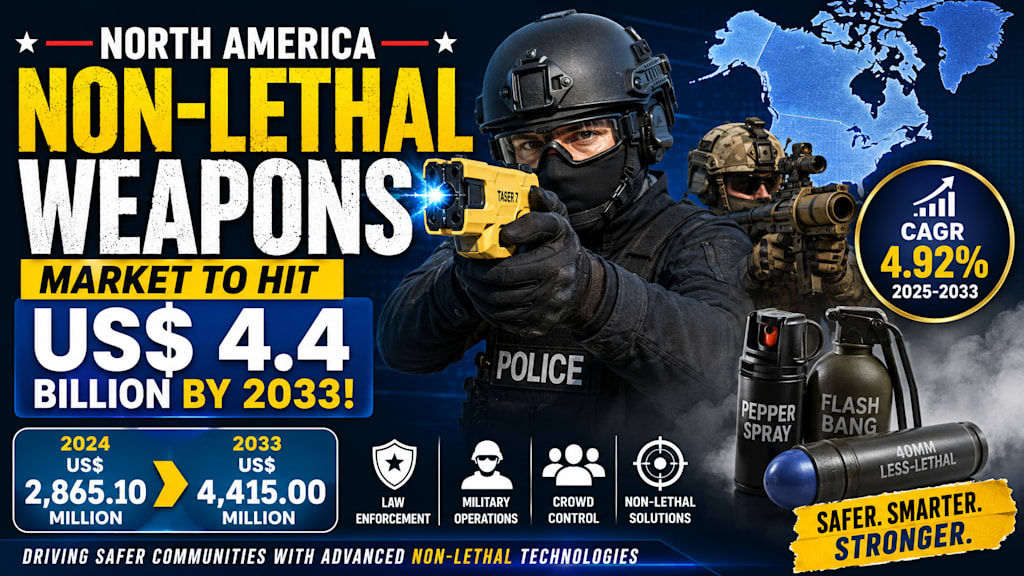
The North America non-lethal weapons market is entering a new era of transformation as governments, military agencies, and law enforcement departments increasingly prioritize safer methods of crowd management and public security. In a region where social unrest, public protests, and urban security challenges have intensified in recent years, non-lethal technologies are rapidly becoming an essential part of modern defense and policing strategies.
According to Renub Research, the North America Non-Lethal Weapons Market is projected to rise from US$ 2,865.10 million in 2024 to US$ 4,415.00 million by 2033, expanding at a CAGR of 4.92% during 2025–2033. The market’s steady growth reflects the increasing emphasis on de-escalation tactics, human rights compliance, and advanced security infrastructure across the United States and Canada.
Non-lethal weapons are specifically designed to incapacitate or deter individuals without causing permanent harm or fatalities. These systems are widely used by police departments, border security forces, military units, and private security agencies for riot control, peacekeeping missions, and tactical operations.
From Tasers and rubber bullets to tear gas and acoustic devices, the range of available non-lethal technologies continues to expand as manufacturers invest heavily in innovation and operational efficiency.
Rising Civil Unrest Is Fueling Demand
One of the biggest factors driving the non-lethal weapons market in North America is the growing frequency of civil demonstrations, protests, and social movements. Over the last decade, public gatherings related to political issues, economic inequality, racial justice, and labor concerns have become increasingly common.
Law enforcement agencies now face mounting pressure to maintain order while minimizing casualties and reducing the use of deadly force. As a result, police departments are increasingly relying on non-lethal options such as pepper spray, Tasers, rubber projectiles, and flash-bang grenades.
These technologies help authorities manage volatile situations more effectively while addressing public concerns regarding excessive force. Governments are also investing more resources into training programs to ensure officers use non-lethal tools responsibly and within legal frameworks.
The shift toward humane crowd control methods is expected to remain one of the strongest long-term growth drivers for the industry.
Technological Innovation Is Transforming the Industry
Technology is reshaping the future of non-lethal weapons in dramatic ways. Manufacturers are no longer focused solely on traditional crowd-control tools. Instead, they are developing highly advanced systems equipped with artificial intelligence, precision targeting, remote operation capabilities, and smart analytics.
Directed-energy weapons, acoustic deterrent systems, and AI-assisted targeting technologies are becoming increasingly sophisticated. These innovations improve operational accuracy while reducing unintended injuries during law enforcement and military operations.
North America, particularly the United States, remains a global hub for non-lethal defense innovation due to strong government support and high defense spending. Major defense contractors and security technology companies continue investing heavily in research and development.
The introduction of remotely operated non-lethal drones and enhanced electroshock devices is also creating new possibilities for border security and urban tactical operations.
As governments focus on modernization, demand for technologically advanced non-lethal systems is expected to accelerate further.
United States Continues to Lead the Market
The United States dominates the North American non-lethal weapons market due to its extensive investments in military modernization and law enforcement technologies.
Federal agencies, police departments, and the Department of Defense continue expanding their use of non-lethal systems to improve operational effectiveness while reducing civilian harm.
The U.S. Department of Defense allocated approximately US$ 486 million in its FY2024 budget for non-lethal weapons research and acquisition. Additionally, more than 75,000 military personnel received specialized training in non-lethal weapon systems, highlighting the growing strategic importance of these technologies.
American companies are also strengthening the country’s leadership position in global exports of non-lethal defense systems. These products are increasingly used by allied nations for riot control, border security, and peacekeeping operations.
The growing popularity of personal security devices has further expanded the market. In November 2024, Byrna Technologies announced that sales of its Byrna SD personal security launcher had exceeded 500,000 units. These portable CO2-powered launchers provide individuals with less-lethal self-defense alternatives and are becoming increasingly popular in the civilian market.
Canada Embraces Safer Law Enforcement Solutions
Canada is also witnessing growing adoption of non-lethal technologies, especially among police forces seeking safer and more community-oriented approaches to public security.
Canadian law enforcement agencies are increasingly deploying Tasers, pepper spray, and rubber bullets to handle public protests and high-risk incidents while minimizing fatalities and injuries.
The emphasis on de-escalation tactics and human rights protection is encouraging broader adoption of non-lethal systems across the country. In addition, technological advancements in acoustic and directed-energy systems are opening new opportunities for Canadian security agencies.
Although budget limitations and regulatory scrutiny continue to slow adoption in some provinces, Canada’s non-lethal weapons market is expected to experience stable long-term growth.
Ethical Concerns and Legal Challenges Remain
Despite strong growth potential, the non-lethal weapons market faces several important challenges.
One of the most significant concerns is the ethical debate surrounding misuse and excessive force. Although these weapons are designed to reduce fatalities, incidents involving improper deployment can still result in severe injuries or public backlash.
Civil rights organizations continue calling for greater accountability, transparency, and stricter regulation regarding the use of non-lethal force. In response, many law enforcement agencies are implementing enhanced training procedures and introducing tracking systems to monitor weapon usage.
Legal and regulatory complexities also create barriers for manufacturers and security agencies. Non-lethal weapons are subject to strict domestic regulations and international human rights standards, especially when used in civilian settings.
These compliance requirements can delay procurement processes and increase operational costs.
High Costs Affect Smaller Agencies
Advanced non-lethal systems often involve significant costs related to research, development, maintenance, and training. Technologies such as directed-energy weapons and AI-enabled platforms require major financial investments that smaller law enforcement departments may struggle to afford.
As a result, adoption rates are generally higher among large urban agencies and federal organizations with larger budgets.
Lengthy procurement procedures and bureaucratic approval systems further complicate the market environment. Despite these financial challenges, experts believe the long-term benefits of safer enforcement practices will continue driving investments in non-lethal technologies.
Expanding Applications Beyond Law Enforcement
While police and military agencies remain the primary users of non-lethal weapons, the market is also expanding into private security and civilian self-defense applications.
Personal security products such as pepper-ball launchers, stun devices, and portable defense systems are gaining popularity among consumers seeking alternatives to traditional firearms.
The increasing focus on public safety and self-protection is creating new business opportunities for manufacturers in the commercial sector.
Additionally, non-lethal technologies are being integrated into border security operations, correctional facilities, and peacekeeping missions worldwide.
This broader range of applications is helping diversify revenue streams for leading companies in the market.
Competitive Landscape Intensifies
The North American non-lethal weapons industry is highly competitive, with major defense contractors and specialized security technology firms competing for government contracts and innovation leadership.
Key players operating in the market include:
Byrna Technologies Inc.
General Dynamics Corporation
Moog Inc.
Raytheon Technologies Corporation
Rheinmetall AG
Textron Inc.
Combined Systems Inc.
These companies are focusing heavily on product innovation, strategic partnerships, and advanced defense technologies to strengthen their market positions.
Research and development remain central to competition as agencies demand more effective, accurate, and legally compliant solutions.
10 Recent Developments in the Non-Lethal Weapons Industry
1. Byrna Technologies Expanded Civilian Market Reach
In November 2024, Byrna Technologies announced sales exceeding 500,000 units for its Byrna SD personal security launcher.
2. Guard Dog Security Introduced “Fireball”
In March 2023, Guard Dog Security launched the Fireball non-lethal launcher capable of firing pepper balls up to 60 feet.
3. U.S. Defense Budget Increased Non-Lethal Funding
The U.S. Department of Defense allocated US$ 486 million for non-lethal weapons research and procurement in FY2024.
4. AI-Based Targeting Systems Gained Attention
Manufacturers increasingly integrated AI-enabled targeting technologies into advanced crowd-control systems.
5. Expansion of Directed-Energy Weapon Programs
Defense contractors expanded development programs focused on directed-energy non-lethal technologies.
6. Growth in Non-Lethal Drone Technologies
Remote-controlled non-lethal drones began attracting significant military and law enforcement interest.
7. Police Agencies Enhanced Officer Training
Thousands of officers across North America received updated training on de-escalation and non-lethal weapon deployment.
8. Increased Demand for Electroshock Devices
Modern Taser systems continued gaining popularity due to improved accuracy and reduced injury risks.
9. Canada Strengthened Community Policing Strategies
Canadian law enforcement agencies increased adoption of less-lethal solutions as part of broader community policing reforms.
10. Rising Investments in Smart Crowd-Control Solutions
Companies accelerated investments in acoustic deterrent systems and intelligent crowd-management platforms.
Future Outlook
The future of the North America non-lethal weapons market looks increasingly promising as governments and security agencies continue shifting toward safer enforcement methods.
Growing public demand for accountability, combined with advances in defense technology, is reshaping the security landscape across the region. While regulatory and ethical concerns remain important challenges, the market’s long-term fundamentals remain strong.
As urbanization, geopolitical tensions, and social unrest continue influencing public safety strategies, non-lethal technologies are expected to play an even larger role in military operations, law enforcement activities, and civilian security solutions.
The combination of innovation, modernization, and rising awareness around humane crowd control is likely to keep the market on a steady growth path through 2033.
Final Thoughts
The North America non-lethal weapons market is no longer just a niche segment within the defense industry. It has become a critical component of modern public safety and security operations.
Governments, military organizations, and police agencies are increasingly recognizing the importance of balancing operational effectiveness with human rights considerations. This evolving mindset is fueling demand for advanced non-lethal technologies that can help reduce fatalities while maintaining order and security.
With strong investments in innovation, expanding civilian applications, and growing adoption across law enforcement and defense sectors, the industry is positioned for sustained long-term growth in the years ahead.
About the Creator
Enjoyed the story? Support the Creator.
Subscribe for free to receive all their stories in your feed.
Comments
There are no comments for this story
Be the first to respond and start the conversation.