
North America Digital Marketing Software Market to Reach US$ 87.39 Billion by 2033 as AI-Powered Campaigns Reshape Customer Engagement
Rising E-Commerce Activity, Mobile Commerce, and AI-Driven Automation Fuel Massive Growth Across the United States, Canada, and Mexico

The North American digital economy is entering a new era, and at the center of this transformation stands the rapidly expanding market for digital marketing software. Businesses across industries are increasingly shifting their focus toward personalized customer experiences, data-driven advertising, and omnichannel engagement strategies. As companies race to strengthen their online visibility and maximize return on investment, digital marketing software has become a mission-critical business tool.
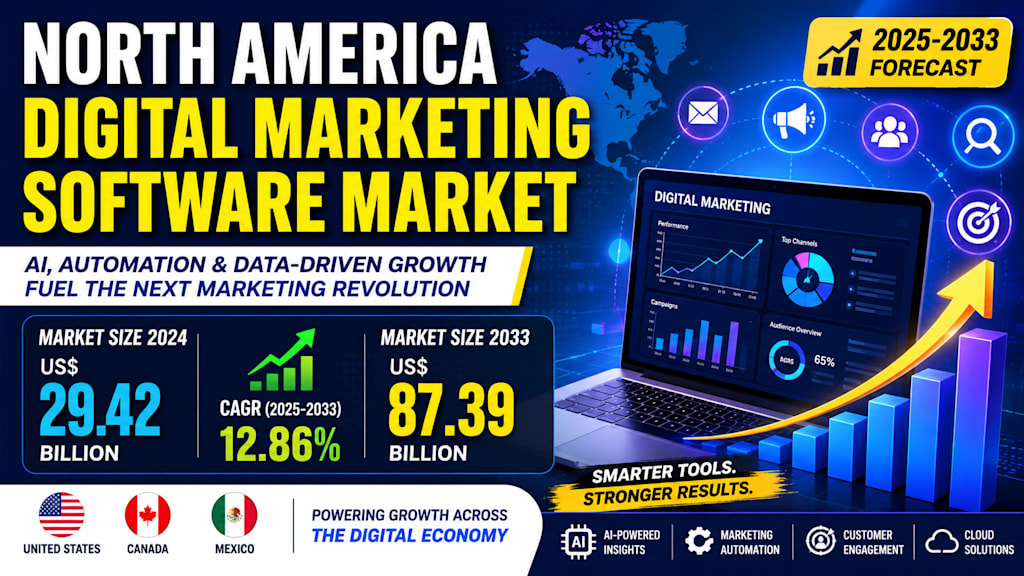
According to the North America Digital Marketing Software Market is projected to grow from US$ 29.42 billion in 2024 to US$ 87.39 billion by 2033, expanding at a CAGR of 12.86% between 2025 and 2033. The remarkable growth reflects the accelerating need for businesses to track marketing performance, understand consumer behavior, and optimize campaigns across digital channels.
The rapid adoption of digital technologies, combined with increasing internet penetration and booming e-commerce activity, is fundamentally reshaping the marketing landscape across North America. From small businesses to multinational enterprises, organizations are now investing heavily in automation platforms, CRM software, social media management tools, and advanced analytics solutions to stay competitive in a highly digital marketplace.
Digital Platforms Become the New Growth Engine
Digital marketing software is no longer considered optional for businesses operating in North America. Instead, it has become a core component of modern business strategy. Companies are increasingly relying on integrated marketing solutions that combine email marketing, social media management, campaign automation, content creation, and customer analytics into unified platforms.
The continued expansion of internet usage worldwide is also fueling this market momentum. As noted in the report, approximately 5.5 billion people were actively using the internet in 2024, representing a global internet penetration rate of 68%. This widespread connectivity is creating unprecedented opportunities for businesses to engage consumers online.
North American enterprises are responding by prioritizing software tools that deliver real-time analytics, improve customer targeting, and automate repetitive marketing tasks. Digital marketing platforms now help businesses manage complex customer journeys across websites, social media, mobile applications, email campaigns, and search engines.
The increasing focus on personalization is another major driver behind the software boom. Modern consumers expect brands to deliver tailored experiences, personalized recommendations, and relevant advertisements. Digital marketing software powered by artificial intelligence and machine learning enables businesses to analyze massive datasets and create highly customized campaigns that improve customer engagement and conversion rates.
E-Commerce Boom Continues to Accelerate Software Demand
The explosive growth of e-commerce remains one of the strongest contributors to the digital marketing software market in North America. Consumers are increasingly shopping online for everything from groceries and electronics to healthcare products and entertainment subscriptions.
As online competition intensifies, businesses are turning to digital marketing software to optimize customer acquisition and retention strategies. These platforms help organizations automate customer segmentation, personalize communications, and improve sales funnel management.
E-commerce companies are also integrating marketing software with social media advertising, email campaigns, and search engine optimization initiatives to create seamless customer experiences. Businesses now recognize that data-driven marketing is essential for maintaining competitive advantage in the online retail ecosystem.
Cloud-based marketing solutions are especially gaining popularity because they provide scalability, flexibility, and lower infrastructure costs. Companies can deploy marketing campaigns faster while accessing customer insights from centralized dashboards.
Mobile and Voice Commerce Open New Opportunities
Another major factor transforming the North America digital marketing software market is the rapid rise of mobile commerce and voice-enabled technologies. Consumers increasingly rely on smartphones, tablets, and smart speakers to interact with brands, make purchases, and search for products.
This shift has forced businesses to redesign marketing strategies around mobile-first experiences. Responsive websites, mobile applications, app-based advertising, and voice-search optimization are becoming essential components of modern marketing campaigns.
Voice assistants such as Amazon Alexa and Google Assistant are also changing how consumers discover products and services. Businesses are now optimizing content for conversational search queries and voice-based interactions, creating new demand for intelligent digital marketing tools.
Marketing software providers are responding by introducing advanced solutions capable of supporting mobile analytics, voice-search optimization, and AI-powered personalization. These innovations are helping companies improve customer engagement while driving higher sales conversions.
Artificial Intelligence Revolutionizes Marketing Operations
Artificial intelligence is rapidly becoming the backbone of digital marketing software innovation. AI-powered platforms allow businesses to automate tasks, predict customer behavior, and create highly targeted campaigns with improved efficiency.
Machine learning algorithms can analyze enormous volumes of consumer data to identify purchasing trends, browsing habits, and customer preferences. Marketers can then use these insights to deliver personalized recommendations and optimized advertising campaigns.
AI also enhances operational efficiency by automating repetitive tasks such as email scheduling, customer service interactions, social media posting, and lead nurturing. Businesses can save time, reduce operational costs, and focus on strategic growth initiatives.
Predictive analytics capabilities are particularly valuable for businesses seeking to anticipate market trends and adjust marketing strategies in real time. As competition intensifies across industries, AI-driven marketing platforms are becoming indispensable tools for organizations aiming to maximize return on marketing investments.
Data Privacy Regulations Present Challenges
Despite the strong growth outlook, the market also faces several important challenges. Data privacy regulations remain one of the biggest concerns for businesses and software providers alike.
Laws such as the California Consumer Privacy Act (CCPA) and the General Data Protection Regulation (GDPR) require businesses to obtain clear customer consent before collecting and using personal information. Companies must also ensure secure data storage and maintain transparency regarding data usage practices.
Failure to comply with these regulations can result in heavy financial penalties and reputational damage. As a result, digital marketing software providers are increasingly integrating advanced privacy management and compliance features into their platforms.
Businesses are also facing growing challenges related to fragmented customer data. Consumers interact with brands across multiple touchpoints including websites, apps, social media platforms, and email campaigns. Consolidating this information into a unified customer profile remains a difficult task for many organizations.
Without integrated data systems, businesses may struggle to deliver personalized experiences and accurately measure campaign performance. This has created rising demand for software solutions capable of centralizing customer information and improving cross-channel analytics.
United States Leads Regional Market Expansion
The United States remains the dominant force within the North America digital marketing software market. Businesses across industries are investing aggressively in marketing automation, customer analytics, and omnichannel engagement platforms.
The rapid growth of e-commerce, cloud computing, and mobile internet usage continues to strengthen market demand. Companies in sectors such as retail, healthcare, finance, entertainment, and education are adopting digital marketing software to improve customer acquisition and retention.
American businesses are particularly focused on leveraging AI-powered marketing technologies to gain deeper customer insights and enhance campaign performance. Integrated software platforms that combine CRM, analytics, automation, and advertising tools are becoming increasingly popular among enterprises seeking scalable marketing solutions.
Canada Witnesses Strong Digital Transformation
Canada is also experiencing significant growth in digital marketing software adoption. Businesses are prioritizing digital engagement strategies as consumers increasingly rely on online channels for shopping, communication, and entertainment.
The country's expanding media and entertainment industry is contributing to software demand, particularly in online content creation, television production, and streaming services. Companies are investing in digital marketing tools to strengthen audience engagement and optimize advertising performance.
Social media adoption and mobile device usage are further supporting market expansion. Canadian organizations are embracing data-driven marketing initiatives to improve targeting accuracy, customer retention, and campaign efficiency.
Mexico Emerges as a High-Growth Opportunity
Mexico is rapidly becoming one of the most promising markets for digital marketing software in North America. Growing internet accessibility, expanding e-commerce activity, and increased digital transformation initiatives are driving software adoption across the country.
Mexico's thriving manufacturing sector, especially in electronics and automotive industries, is also creating demand for digital marketing solutions. Businesses are increasingly seeking tools that improve brand visibility, automate marketing operations, and strengthen customer engagement.
As more Mexican consumers engage with digital platforms and online shopping experiences, businesses are accelerating investments in software solutions that support content management, social media analytics, and personalized advertising campaigns.
Competitive Landscape Intensifies
The North America digital marketing software market is highly competitive, with major technology companies continuously innovating to strengthen their market positions. Industry leaders are focusing on artificial intelligence integration, automation capabilities, cloud deployment, and advanced analytics to attract enterprise customers.
Key companies operating in the market include Adobe, Microsoft, Oracle, Salesforce, IBM, HubSpot, Teradata, and Hewlett Packard Enterprise.
These companies are increasingly expanding their product portfolios through partnerships, acquisitions, and AI-driven innovation strategies.
Recent Developments in Leading Companies
1. Adobe
Adobe expanded its generative AI capabilities across its marketing cloud solutions, enabling businesses to create AI-powered personalized customer experiences and automated content generation tools.
2. Salesforce
Salesforce strengthened its AI-powered Einstein platform to improve predictive analytics, customer engagement automation, and real-time marketing personalization.
3. Microsoft
Microsoft integrated advanced AI functionalities into Dynamics 365 Marketing, enhancing customer journey orchestration and campaign automation capabilities.
4. Oracle
Oracle enhanced its Oracle Advertising and Customer Experience platform with advanced data analytics and cross-channel customer engagement solutions.
5. HubSpot
HubSpot introduced new AI-driven marketing automation tools designed to help small and medium-sized businesses improve lead nurturing and campaign performance.
6. IBM
IBM expanded Watson AI integration within its digital marketing ecosystem to improve customer insights, conversational AI, and campaign optimization.
7. Hewlett Packard Enterprise
HPE accelerated cloud-native marketing infrastructure solutions aimed at improving data security, scalability, and marketing analytics performance.
8. Teradata
Teradata strengthened its AI-driven analytics capabilities to support real-time customer data processing and personalized marketing strategies.
9. SAP
SAP expanded its customer experience portfolio with advanced omnichannel marketing and commerce integration capabilities.
10. Mailchimp
Mailchimp introduced enhanced automation and predictive segmentation tools to improve personalized email marketing and customer targeting.
Final Thoughts
The North America Digital Marketing Software Market is entering a transformative decade driven by artificial intelligence, automation, mobile commerce, and data-driven customer engagement. Businesses across the region are rapidly modernizing their marketing infrastructure to meet evolving consumer expectations and remain competitive in increasingly digital economies.
As organizations continue prioritizing personalized customer experiences and measurable marketing outcomes, demand for intelligent digital marketing solutions will continue rising sharply. Companies capable of delivering integrated, AI-powered, privacy-compliant, and scalable marketing platforms are expected to dominate the next phase of industry growth.
With the market forecasted to surpass US$ 87 billion by 2033, digital marketing software is poised to become one of the most influential technology sectors shaping the future of business communication, commerce, and customer engagement.
About the Creator
Enjoyed the story? Support the Creator.
Subscribe for free to receive all their stories in your feed.
Comments
There are no comments for this story
Be the first to respond and start the conversation.