
North America Automotive Robotics Market Outlook 2025–2033: Automation, AI, and Smart Manufacturing Accelerate Industry Growth
Renub Research forecasts the North America Automotive Robotics Market to grow from US$ 3.05 billion in 2024 to US$ 7.09 billion by 2033, driven by rising automation demand, Industry 4.0 adoption, AI-powered manufacturing systems, and increasing production of electric and smart vehicles.

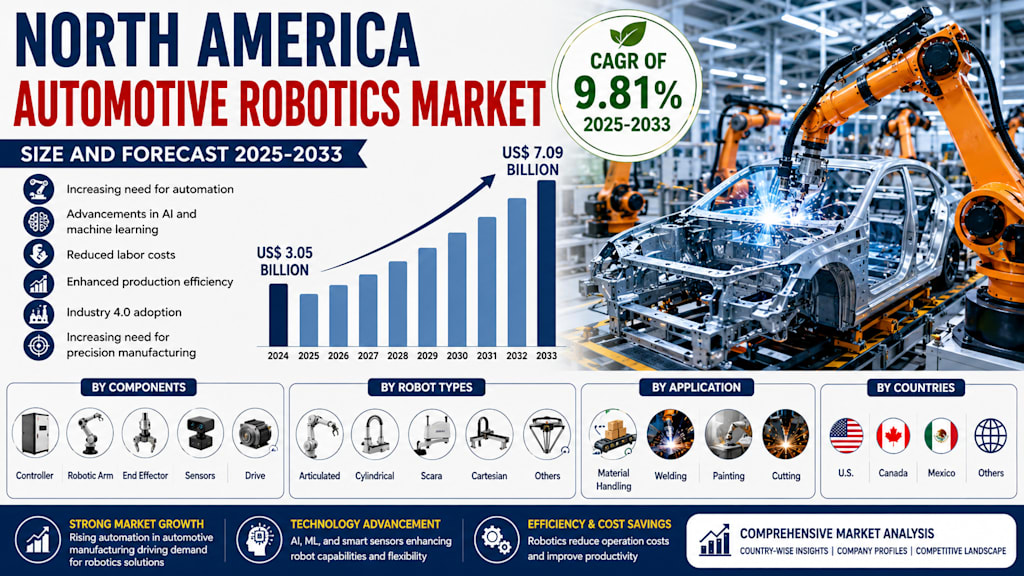
North America Automotive Robotics Market Enters a New Era of Smart Manufacturing
The North America automotive robotics market is experiencing rapid transformation as automakers increasingly adopt intelligent automation technologies to improve production efficiency, reduce costs, and meet the growing complexity of modern vehicle manufacturing. Robotics has become a central component of advanced automotive production systems, enabling manufacturers to achieve higher precision, flexibility, and operational consistency.
Automotive robots are now widely used across manufacturing facilities for welding, painting, material handling, assembly, cutting, inspection, and quality control tasks. These robotic systems help reduce human error, improve worker safety, and increase production speed while supporting the transition toward smart factories and Industry 4.0 manufacturing environments.
According to Renub Research, the North America Automotive Robotics Market is expected to reach US$ 7.09 billion by 2033 from US$ 3.05 billion in 2024, growing at a CAGR of 9.81% during 2025–2033. The report highlights increasing automation demand, technological advancements in AI and machine learning, reduced labor costs, enhanced production efficiency, Industry 4.0 adoption, and the need for precision manufacturing as the primary growth drivers.
As automotive manufacturers continue shifting toward electric vehicles (EVs), autonomous driving systems, and customized production processes, robotics is becoming more critical than ever before.
Automation Demand Continues Driving Market Expansion
One of the strongest drivers behind the North America automotive robotics market is the growing demand for automation across vehicle manufacturing facilities.
Automotive manufacturers are under increasing pressure to improve productivity while maintaining strict quality standards and controlling operational costs. Robotics allows manufacturers to automate repetitive and labor-intensive tasks with greater consistency and speed than traditional manual processes.
Automation also helps reduce manufacturing defects and minimize production downtime. High-speed robotic systems can operate continuously with exceptional accuracy, allowing manufacturers to scale production efficiently while improving product quality.
The report highlights ABB’s December 2023 agreement with Volvo Cars as a major example of automation growth within the sector. ABB agreed to supply 1,300 industrial robots to support Volvo’s next-generation electric vehicle manufacturing operations. These robots are capable of performing tasks such as spot welding, flow drilling, dispensing, and riveting.
This development reflects the increasing reliance on robotics to meet evolving automotive manufacturing requirements, especially in the fast-growing electric vehicle segment.
Industry 4.0 Accelerates Robotics Integration
Industry 4.0 adoption is significantly accelerating robotics deployment across North American automotive factories. Smart manufacturing systems built around connected technologies, automation, and data-driven operations are becoming increasingly common within the automotive industry.
Industry 4.0 focuses heavily on machine connectivity, intelligent monitoring, predictive maintenance, real-time analytics, and autonomous production systems. Automotive robots are central to this transformation because they can communicate with other factory systems while adapting to changing production requirements.
Connected robotic systems improve operational efficiency by enabling manufacturers to monitor production performance in real time and identify potential issues before disruptions occur.
The integration of robotics with cloud computing, industrial IoT platforms, and smart factory infrastructure is helping manufacturers create highly flexible and efficient production environments capable of supporting complex vehicle assembly operations.
As automakers continue modernizing production facilities, Industry 4.0 technologies are expected to remain one of the strongest long-term growth drivers for the robotics market.
Artificial Intelligence and Machine Learning Improve Robot Capabilities
Advancements in artificial intelligence (AI), machine learning, machine vision, and sensor technologies are dramatically enhancing the capabilities of automotive robots.
Modern robotic systems are no longer limited to performing simple repetitive tasks. AI-powered robots can now analyze data, recognize patterns, adapt to production changes, and improve operational efficiency over time.
Machine learning algorithms enable robots to optimize movement patterns, reduce errors, and improve task accuracy. Advanced sensor integration also allows robots to operate more safely alongside human workers while performing increasingly sophisticated manufacturing activities.
The report notes that technological advancements are making industrial robots smarter, more flexible, and more efficient, particularly for supporting electric and autonomous vehicle manufacturing.
ABB’s participation in Automate 2023 in Detroit further demonstrated the growing importance of intelligent robotics solutions. The company showcased collaborative robots, autonomous mobile robots (AMRs), industrial robotics systems, and machine automation technologies designed to address evolving manufacturing requirements.
As AI and robotics technologies continue advancing, manufacturers are expected to adopt increasingly intelligent and adaptive production systems.
Electric Vehicle Manufacturing Creates Major Growth Opportunities
The rapid growth of electric vehicle production is creating significant opportunities for the North America automotive robotics market.
Electric vehicles require highly specialized manufacturing processes involving battery assembly, precision welding, advanced material handling, and complex component integration. Robotics plays a critical role in ensuring the accuracy and efficiency required for EV production.
Battery pack installation, chassis welding, adhesive application, and electronic system integration all require high-precision robotic operations. As EV production volumes continue increasing, demand for sophisticated automation systems is expected to rise substantially.
Automotive manufacturers are investing heavily in robotic technologies capable of supporting flexible production lines that can adapt to changing EV designs and evolving consumer demand.
The transition toward electric mobility is therefore becoming one of the most important long-term growth catalysts for the automotive robotics industry across North America.
Safety Improvements Encourage Robotics Adoption
Workplace safety improvements are another major factor driving the expansion of automotive robotics.
Manufacturing environments often involve hazardous tasks such as welding, cutting, heavy lifting, painting, and exposure to extreme temperatures. Robotics helps minimize workplace risks by reducing direct human involvement in dangerous production activities.
Collaborative robots, or cobots, are becoming increasingly popular because they can safely operate alongside human workers without requiring large protective barriers. These systems are designed with advanced sensors and safety technologies that detect nearby movement and prevent accidents.
The report highlights Kawasaki Robotics’ launch of the CL Series intelligent cobots at IMTS Chicago in September 2024 as an important example of safety-focused innovation. These collaborative robots feature advanced safety sensors and are designed specifically for shared automotive manufacturing workspaces.
As workplace safety regulations become stricter, manufacturers are expected to continue increasing investments in collaborative robotics technologies.
High Initial Investment Remains a Key Challenge
Despite strong growth prospects, the North America automotive robotics market continues facing several operational challenges.
One of the biggest barriers is the high initial investment required to deploy robotic systems within manufacturing facilities. Industrial robots, automation software, machine vision systems, and integration infrastructure require significant capital expenditure.
In addition to purchasing equipment, manufacturers must invest in installation, programming, workforce training, maintenance, and facility modifications. These costs can be especially difficult for small and mid-sized automotive suppliers.
The report notes that although robotics offers long-term productivity and efficiency benefits, high upfront investment costs often delay adoption among many companies.
Access to financing, government support programs, and long-term operational planning will therefore remain important factors influencing robotics adoption rates.
Regulatory and Compliance Requirements Increase Complexity
Regulatory and safety compliance also present major challenges within the automotive robotics industry.
Manufacturers must comply with complex regional, national, and international regulations governing robotic operations, workplace safety, and human-machine interactions. Compliance standards such as OSHA and ISO regulations require ongoing monitoring, documentation, testing, and operational adjustments.
According to the report, maintaining regulatory compliance can increase operational costs and create delays in robotics implementation projects.
Failure to meet regulatory requirements may result in financial penalties, production disruptions, or facility shutdowns, making compliance management a critical aspect of robotics deployment strategies.
United States Leads North American Robotics Adoption
The United States remains the largest automotive robotics market in North America due to strong manufacturing activity, rapid technological adoption, and increasing electric vehicle production.
American automakers are aggressively investing in automation technologies to improve production efficiency and remain globally competitive. Robotics is increasingly being integrated across assembly lines, welding stations, material handling operations, and quality inspection systems.
The report highlights ABB’s US$ 20 million investment announced in March 2023 to expand its Auburn Hills robotics facility in Michigan. The expanded automated manufacturing plant is designed to support advanced robotics production while creating new employment opportunities.
The United States continues benefiting from strong private investment, technological innovation, and rising demand for intelligent manufacturing systems.
Canada’s Automotive Robotics Industry Continues Expanding
Canada’s automotive robotics market is also experiencing steady growth as manufacturers increasingly adopt advanced automation technologies to improve production capabilities.
Canadian automotive facilities are integrating robotics systems to support precision manufacturing, quality improvement, and operational efficiency. The shift toward electric and smart vehicle production is further increasing demand for advanced robotic solutions.
AI integration, machine learning technologies, and sensor advancements are helping Canadian manufacturers improve flexibility and efficiency within production environments.
Although high investment costs and skilled labor shortages remain challenges, robotics continues playing a critical role in shaping the future of Canada’s automotive manufacturing industry.
Mexico Emerges as a Major Automotive Robotics Growth Market
Mexico’s automotive manufacturing sector is becoming an increasingly important market for robotics adoption.
The country’s growing role as a global automotive production hub is driving demand for automation systems capable of improving productivity, quality, and operational safety.
Robotics is widely used within Mexican manufacturing facilities for welding, painting, assembly, and material handling operations. The rapid expansion of electric vehicle production is also increasing demand for advanced robotic solutions capable of handling complex manufacturing tasks.
The report notes that robotics remains essential for supporting Mexico’s growing automotive manufacturing ecosystem despite challenges such as skilled labor shortages and integration complexity.
Competitive Landscape Reflects Strong Technology Investment
The North America automotive robotics market includes several major industrial automation and robotics companies investing heavily in advanced manufacturing technologies.
Companies covered in the Renub Research report include ABB Ltd, Rockwell Automation Inc., Yaskawa Electric Corp, Fanuc Corporation, Harmonic Drive Systems Inc., Nachi-Fujikoshi Corp, Universal Robots, and Comau S.p.A.
These companies are focusing on AI integration, collaborative robotics, machine vision systems, autonomous mobile robots, and flexible manufacturing solutions designed to support next-generation automotive production.
Recent Developments by Leading Companies
- ABB partnered with Volvo Cars to supply 1,300 industrial robots for next-generation electric vehicle production.
- ABB showcased advanced robotics, collaborative robots, and automation technologies during Automate 2023 in Detroit.
- ABB invested US$ 20 million to expand its Auburn Hills robotics manufacturing facility in Michigan.
- Kawasaki Robotics introduced CL Series intelligent cobots designed for collaborative automotive manufacturing environments.
- Automotive manufacturers increased investment in AI-powered robotics for precision assembly and EV battery integration.
- Collaborative robots gained stronger adoption due to improved safety features and flexible production capabilities.
- Manufacturers accelerated Industry 4.0 adoption through connected robotic production systems.
- Electric vehicle production growth increased demand for advanced welding and material handling robots.
- Robotics companies expanded machine vision and sensor integration technologies for automotive quality control.
- Smart factory modernization projects across North America continued driving robotics deployment.
Future Outlook for the North America Automotive Robotics Market Remains Highly Positive
The future of the North America automotive robotics market appears extremely promising as automation, AI integration, and smart manufacturing continue reshaping the automotive industry.
Growing electric vehicle production, rising demand for manufacturing efficiency, stricter safety standards, and Industry 4.0 adoption are expected to support continued market expansion over the next decade.
Advancements in collaborative robotics, machine learning, autonomous systems, and predictive analytics will likely create even greater opportunities for automation across automotive manufacturing operations.
Although high investment costs and regulatory complexity remain important challenges, the long-term advantages of robotics continue driving widespread industry adoption.
As automotive manufacturers increasingly prioritize precision, flexibility, productivity, and sustainability, robotics is expected to remain a core pillar of North America’s automotive manufacturing future through 2033.
About the Creator
Enjoyed the story? Support the Creator.
Subscribe for free to receive all their stories in your feed.
Comments
There are no comments for this story
Be the first to respond and start the conversation.