
Non-Lethal Weapons Market Expands as Governments Prioritize Public Safety and Responsible Policing
Growing demand for crowd control solutions, advancements in security technologies, and increased focus on human rights are driving the evolution of non-lethal weapons worldwide.

In an era where public safety and human rights are equally important priorities, governments and security agencies around the world are increasingly turning to non-lethal weapons as an alternative to traditional force. Whether managing large public gatherings, responding to civil unrest, protecting critical infrastructure, or conducting law enforcement operations, security personnel are under growing pressure to maintain order while minimizing the risk of serious injury or loss of life.
This shift in security strategy has elevated the importance of non-lethal weapons, a category of tools designed to temporarily incapacitate, deter, or control individuals without causing permanent harm. From tasers and pepper sprays to rubber bullets and advanced electroshock devices, non-lethal weapons are becoming essential components of modern policing and security operations.
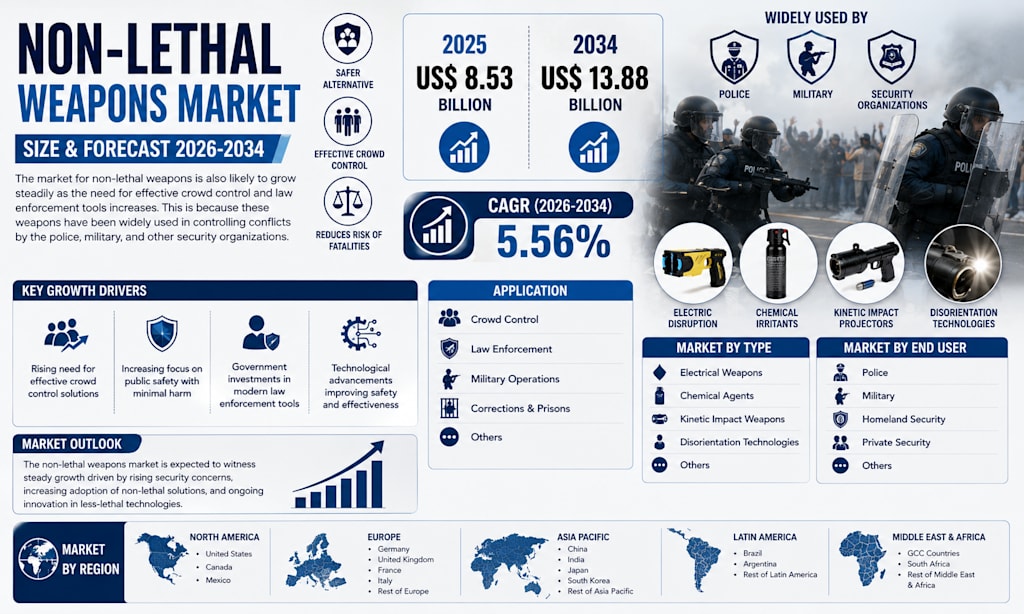
As governments seek more balanced approaches to public safety, the market for these technologies is experiencing steady growth. According to Renub Research, the global non-lethal weapons market is expected to increase from US$ 8.53 billion in 2025 to US$ 13.88 billion by 2034, expanding at a compound annual growth rate (CAGR) of 5.56% during the forecast period from 2026 to 2034. This growth reflects the increasing importance of security solutions that combine operational effectiveness with reduced risk of fatal outcomes.
Understanding the Role of Non-Lethal Weapons
Non-lethal weapons, often referred to as less-lethal weapons, are designed to help law enforcement officers, military personnel, and security agencies control potentially dangerous situations without resorting to lethal force. Unlike conventional firearms, these tools aim to temporarily incapacitate individuals while reducing the likelihood of permanent injury or death.
Common examples include tasers, tear gas, pepper spray, stun devices, rubber bullets, bean bag rounds, and other mechanical or electroshock systems. These tools provide security personnel with alternatives that can be used in situations where lethal weapons may be unnecessary or inappropriate.
The growing use of non-lethal weapons reflects broader changes in public expectations regarding policing and security operations. Communities increasingly expect authorities to prioritize de-escalation and proportional responses, creating strong demand for technologies that support these objectives.
As urban populations continue to grow and public events become larger and more frequent, the need for effective crowd management tools is becoming increasingly important.
Rising Demand for Crowd Control and Public Safety
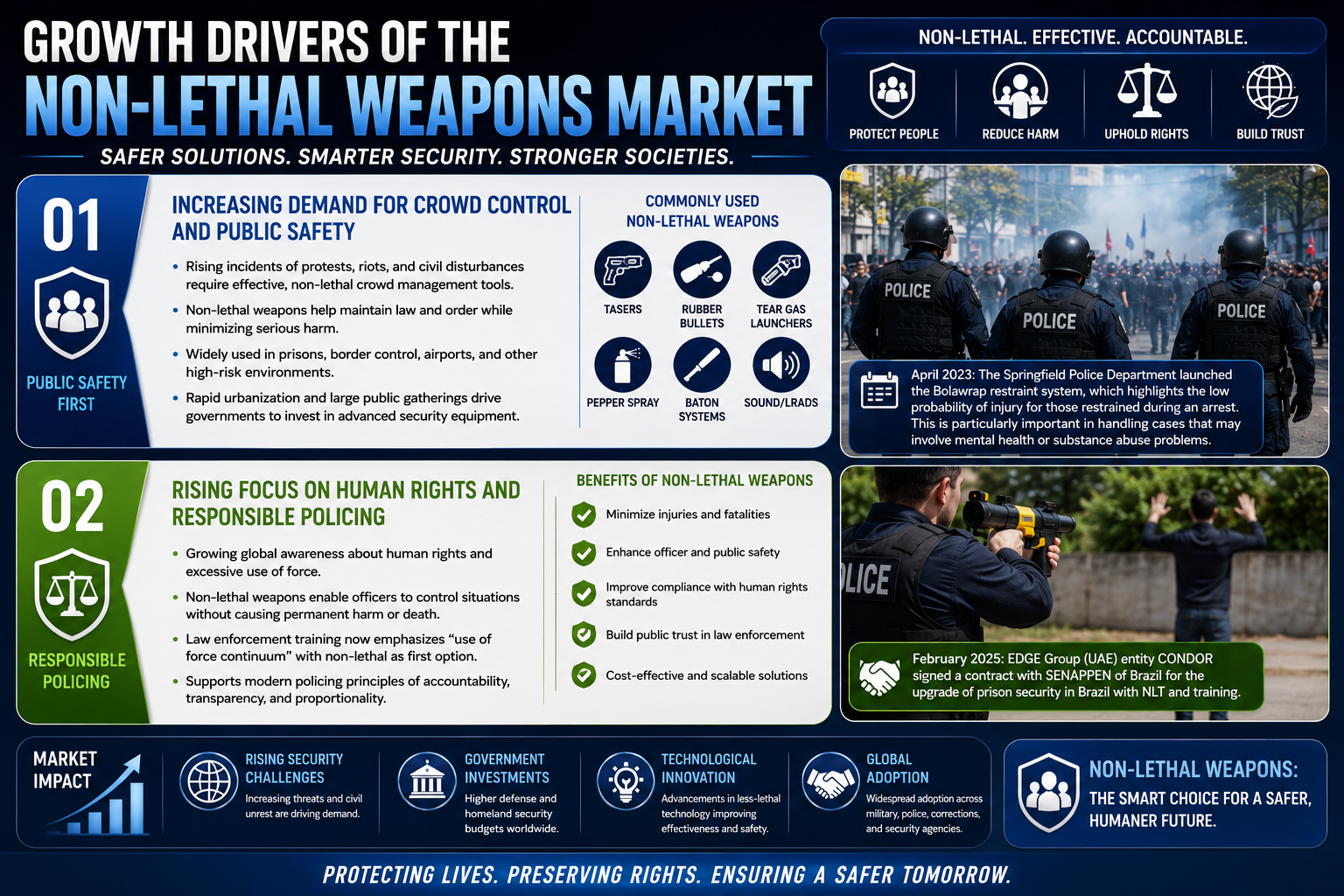
One of the strongest factors driving market growth is the increasing need for effective crowd control and public safety solutions.
Law enforcement agencies regularly face situations involving demonstrations, protests, sporting events, political gatherings, and civil disturbances. In these circumstances, authorities must maintain order while minimizing harm to both participants and bystanders.
Non-lethal weapons provide practical solutions that allow security personnel to manage potentially volatile situations without immediately escalating to lethal force. Tools such as tear gas, pepper spray, rubber projectiles, and electronic control devices are widely used because they offer temporary incapacitation while reducing the likelihood of fatal consequences.
Beyond public demonstrations, these technologies are increasingly utilized in correctional facilities, transportation hubs, border security operations, and airport environments. As governments continue investing in public safety infrastructure, demand for modern crowd control technologies is expected to remain strong.
The increasing frequency of large-scale public events and the growing complexity of urban security management are creating favorable conditions for continued market expansion.
Human Rights Concerns Are Influencing Security Policies
Another major driver of the non-lethal weapons market is the growing global focus on human rights and responsible policing practices.
Over the past decade, public discussions surrounding law enforcement accountability and use-of-force policies have intensified in many countries. Citizens, advocacy groups, and policymakers have called for greater transparency and safer approaches to conflict management.
Non-lethal weapons have emerged as an important component of these efforts because they provide alternatives that can help reduce fatalities and severe injuries during law enforcement operations. Many police departments now emphasize de-escalation strategies and encourage officers to consider less-lethal options whenever appropriate.
Training programs increasingly incorporate non-lethal tools as part of modern policing methodologies. Governments and security agencies recognize that reducing the use of deadly force can strengthen public trust and improve community relations.
As awareness of human rights issues continues to grow, demand for security technologies that align with responsible policing objectives is expected to increase further.
Technological Innovation Is Transforming the Market
Technological advancement is playing a critical role in the evolution of non-lethal weapons.
Manufacturers are investing heavily in research and development to improve the effectiveness, accuracy, safety, and reliability of their products. Modern systems are becoming more sophisticated, enabling security personnel to respond to threats with greater precision and reduced risk.
Advancements in electronic control devices, directed-energy technologies, acoustic deterrent systems, and integrated surveillance solutions are expanding the capabilities of non-lethal weapons. These innovations help minimize unintended consequences while improving operational performance.
New technologies also enhance portability, durability, and ease of use. Security personnel can now access more advanced equipment that integrates seamlessly with broader security and communication networks.
As innovation continues, manufacturers are expected to introduce increasingly sophisticated solutions that support both public safety and operational efficiency.
Growing Adoption of Taser and Electroshock Devices
Among the various product categories, taser guns and electroshock weapons have emerged as some of the most widely adopted non-lethal solutions.
These devices use controlled electrical impulses to temporarily disrupt muscle function, enabling officers to subdue potentially dangerous individuals without causing permanent injury. Their effectiveness has made them standard equipment for many law enforcement agencies worldwide.
Technological improvements have significantly enhanced the reliability and safety of modern electroshock devices. Advanced targeting systems, improved energy management, and enhanced training protocols have increased confidence in their operational use.
As security organizations continue seeking alternatives to lethal force, demand for tasers and related electroshock technologies is expected to remain strong.
Mechanical and Kinetic Weapons Continue to Play a Key Role
Mechanical and kinetic non-lethal weapons remain important tools within the broader security landscape.
Products such as rubber bullets, bean bag rounds, batons, and other impact-based devices are frequently used during crowd management, border security operations, and correctional facility incidents. These tools provide security personnel with flexible response options that can deter aggressive behavior while reducing the risk of fatal outcomes.
One of the primary advantages of mechanical non-lethal weapons is their simplicity. They are relatively easy to deploy, require limited technical infrastructure, and can be used effectively across a variety of operational environments.
As governments continue prioritizing safer approaches to conflict management, these technologies are expected to maintain a significant role in security operations worldwide.
Law Enforcement Remains the Largest End-User Segment
Law enforcement agencies represent the largest end-user segment within the non-lethal weapons market.
Police departments increasingly rely on less-lethal tools to manage arrests, public disturbances, and high-risk encounters. These technologies provide officers with additional response options that support modern policing objectives.
Training programs focused on responsible weapon use have become more common, helping officers understand when and how to deploy non-lethal equipment effectively. Many agencies view these tools as essential components of comprehensive public safety strategies.
As governments continue modernizing law enforcement operations, investment in non-lethal technologies is expected to increase across multiple regions.
Regional Markets Show Strong Growth Potential
United States
The United States remains one of the largest markets for non-lethal weapons. Extensive use by law enforcement agencies, correctional facilities, and security organizations continues to support demand. Ongoing efforts to promote safer policing practices are encouraging further adoption of advanced non-lethal technologies.
United Kingdom
The United Kingdom places strong emphasis on proportional force and public safety. Non-lethal tools are widely used by police forces to manage security situations while minimizing harm. Continued investment in public safety infrastructure is expected to support market growth.
India
India's growing urban population and frequent public gatherings create significant demand for crowd management solutions. Security agencies increasingly rely on tear gas, water cannons, rubber bullets, and other non-lethal tools to maintain order during large-scale events.
Saudi Arabia
Saudi Arabia is investing heavily in security modernization and public safety initiatives. The country's focus on protecting critical infrastructure and managing large public events is creating opportunities for non-lethal weapon manufacturers.
Challenges Facing the Industry
Despite its positive outlook, the non-lethal weapons market faces several challenges.
One of the primary concerns involves the potential misuse of these technologies. Although designed to minimize harm, improper deployment can still result in injuries or legal disputes. Public scrutiny surrounding law enforcement practices has increased pressure on agencies to ensure responsible use.
Regulatory differences between countries also create challenges for manufacturers. Approval requirements, usage restrictions, and ethical debates can vary significantly across regions, affecting product development and market access.
Addressing these concerns through improved training, clear operational guidelines, and ongoing innovation will be essential for maintaining public confidence and supporting long-term market growth.
Market Forecast: Steady Growth Through 2034
According to Renub Research, the global non-lethal weapons market is expected to grow from US$ 8.53 billion in 2025 to US$ 13.88 billion by 2034, reflecting a CAGR of 5.56% during the forecast period from 2026 to 2034. Growth will be supported by increasing demand for crowd control solutions, advances in security technology, expanding law enforcement modernization programs, and rising emphasis on responsible policing practices.
Final Thoughts
The non-lethal weapons market is becoming an increasingly important part of the global security landscape. As governments, law enforcement agencies, and security organizations seek effective ways to maintain public safety while reducing the risk of serious harm, demand for less-lethal technologies continues to grow.
With Renub Research forecasting market expansion from US$ 8.53 billion in 2025 to US$ 13.88 billion by 2034, the industry is positioned for steady development over the coming decade. Advances in technology, evolving security requirements, and greater emphasis on human rights are expected to shape the future of the market, making non-lethal weapons a critical component of modern public safety strategies worldwide.
About the Creator
Enjoyed the story? Support the Creator.
Subscribe for free to receive all their stories in your feed.
Comments
There are no comments for this story
Be the first to respond and start the conversation.