
Netherlands Watch Market Is Evolving as Fashion, Sustainability, and Digital Innovation Reshape Consumer Preferences
From minimalist quartz watches to luxury mechanical timepieces and fast-growing online retail channels, the Netherlands watch industry is steadily transforming alongside changing lifestyle trends and consumer expectations.

Today, they represent personal identity, fashion preferences, lifestyle choices, and even sustainability values. Across the country, consumers are increasingly purchasing watches that combine functionality, design, durability, and modern aesthetics.
As fashion awareness rises and digital retail continues expanding, the Netherlands watch market is experiencing steady growth supported by changing consumer preferences, technological innovation, and increasing demand for stylish accessories.
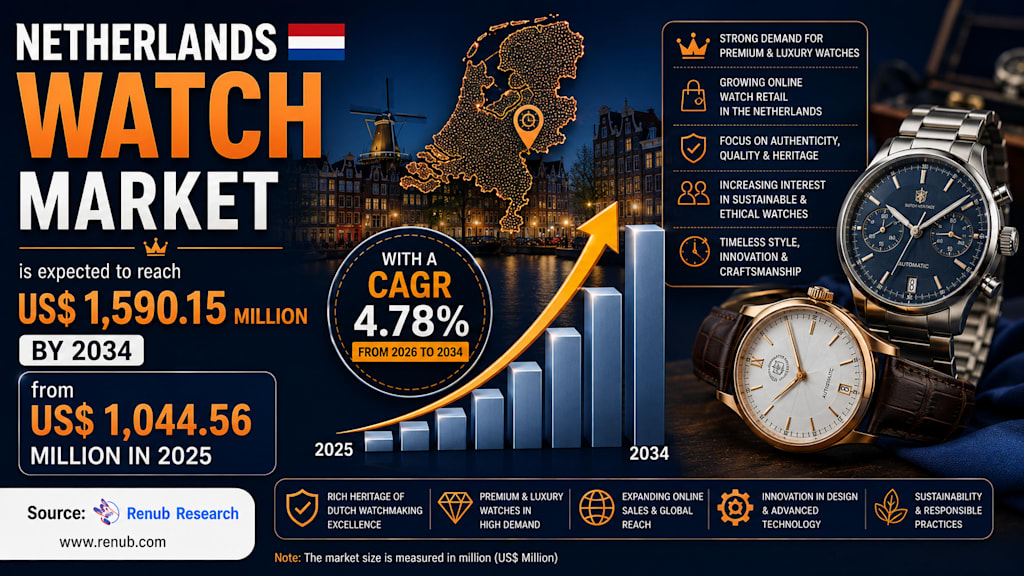
According to Renub Research, the Netherlands Watch Market is expected to grow from US$ 1,044.56 million in 2025 to US$ 1,590.15 million by 2034, expanding at a CAGR of 4.78% between 2026 and 2034. The market’s growth is being driven by rising fashion awareness, increasing demand for functional accessories, and expanding online retail channels that improve accessibility and consumer engagement.
Consumers in the Netherlands increasingly see watches as both practical and fashionable products.
While traditional timepieces continue maintaining strong appeal, growing interest in sustainability, minimalist designs, and multifunctional products is reshaping the industry landscape.
This transformation is encouraging brands to focus more heavily on innovation, digital engagement, and personalized customer experiences.
Fashion and Functional Accessories Are Driving Consumer Demand
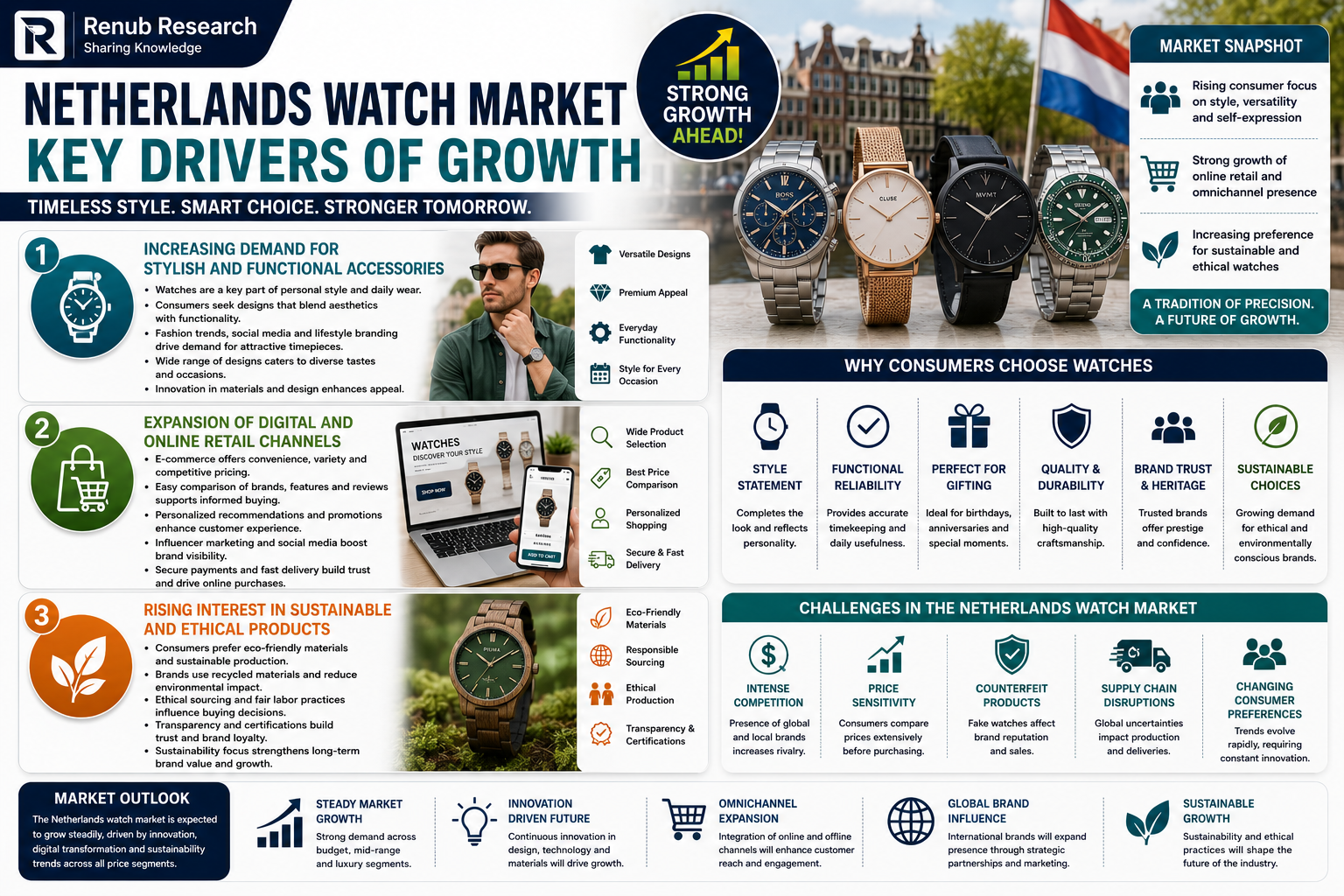
One of the strongest drivers behind the Netherlands watch market is the increasing demand for stylish and functional accessories.
Consumers today are more fashion-conscious than ever and often use watches to complement their personal style and everyday outfits.
Modern buyers increasingly seek products that combine:
- Elegant design
- Versatility
- Comfort
- Durability
- Practical functionality
Watches are no longer viewed only as utility products.
Instead, they are becoming lifestyle accessories worn across:
- Professional settings
- Casual occasions
- Social events
- Luxury environments
Social media platforms, fashion influencers, and digital lifestyle trends are significantly influencing purchasing behavior.
Consumers are constantly exposed to:
- Celebrity fashion trends
- Influencer collaborations
- Luxury branding campaigns
- Designer collections
which encourage stronger interest in premium and aesthetically appealing watches.
Manufacturers are responding by offering:
- Minimalist designs
- Contemporary aesthetics
- Bold fashion collections
- Limited-edition releases
- Customizable products
to meet evolving consumer expectations.
This growing focus on individuality and style continues supporting long-term market expansion.
Digital Retail Is Transforming the Market
The rapid growth of e-commerce is one of the most important developments reshaping the Netherlands watch industry.
Consumers increasingly prefer online shopping because it allows them to:
- Compare prices
- Explore multiple brands
- Read reviews
- Access international collections
- Make convenient purchases from home
Online platforms provide consumers with broader product accessibility while allowing brands to reach larger audiences more efficiently.
Digital retail also supports:
- Personalized shopping experiences
- Targeted promotions
- Influencer marketing campaigns
- Social media-driven engagement
The growth of secure payment systems and fast delivery services has further increased consumer confidence in purchasing watches online.
Brands are heavily investing in:
- Direct-to-consumer websites
- Digital advertising
- Influencer partnerships
- Social commerce strategies
to strengthen visibility and improve customer engagement.
At the same time, physical retail stores continue playing an important role, particularly for premium and luxury watch purchases where consumers value in-store experiences and product trials.
This combination of online convenience and traditional retail service is helping reshape the overall watch-buying experience across the Netherlands.
Sustainability Is Becoming a Key Consumer Priority
Environmental awareness is increasingly influencing purchasing decisions within the Netherlands watch market.
Consumers are becoming more conscious about the environmental impact of their purchases and increasingly prefer brands that emphasize:
- Sustainable materials
- Ethical sourcing
- Eco-friendly packaging
- Responsible manufacturing
This trend is especially strong among younger consumers who prioritize sustainability alongside product quality and design.
Watch manufacturers are responding by introducing products made from:
- Recycled materials
- Sustainable metals
- Eco-conscious packaging
- Vegan-friendly straps
Transparency in production practices and ethical certifications are also becoming increasingly important factors influencing consumer trust.
Brands capable of aligning with sustainability values are gaining stronger competitive advantages in the market.
This growing emphasis on environmental responsibility is not only shaping product development but also redefining long-term brand positioning across the industry.
Quartz Watches Continue Dominating Everyday Demand
Quartz watches remain one of the most popular categories within the Netherlands watch market.
Consumers widely prefer quartz watches because they offer:
- High accuracy
- Low maintenance
- Affordable pricing
- Reliable performance
Quartz models are especially popular for daily wear due to their practicality and convenience.
Manufacturers continue focusing on combining quartz functionality with modern aesthetics to appeal to fashion-conscious consumers.
Minimalist and contemporary designs remain particularly popular in the Netherlands, reflecting broader European fashion trends emphasizing simplicity and elegance.
The availability of quartz watches across multiple price ranges further strengthens market accessibility.
Both online platforms and physical retail stores continue supporting strong distribution throughout the country.
Mechanical Watches Continue Attracting Luxury Buyers
While quartz watches dominate mainstream demand, mechanical watches maintain strong appeal among enthusiasts, collectors, and luxury consumers.
Mechanical timepieces are often associated with:
- Heritage craftsmanship
- Precision engineering
- Exclusivity
- Long-term value
Consumers purchasing mechanical watches frequently value the artistry and technical complexity behind traditional watchmaking.
Luxury mechanical watches are often viewed as:
- Status symbols
- Investment pieces
- Collector’s items
Manufacturers focus heavily on:
- Premium materials
- Limited editions
- Sophisticated craftsmanship
- Distinctive designs
to differentiate their products in the premium segment.
Although the mechanical segment serves a smaller audience compared to quartz watches, it continues experiencing stable growth due to strong brand loyalty and enduring consumer interest in traditional craftsmanship.
Women’s Watches Segment Is Expanding Rapidly
The women’s watches market in the Netherlands is experiencing notable growth as consumers increasingly seek stylish and versatile accessories.
Women buyers prioritize factors such as:
- Elegance
- Comfort
- Lightweight designs
- Fashion compatibility
- Customization options
Manufacturers are responding with a wide variety of products ranging from minimalist designs to decorative luxury pieces featuring:
- Metallic finishes
- Gemstone accents
- Fashion-forward straps
- Contemporary aesthetics
Social media and fashion influencers continue playing major roles in shaping women’s purchasing behavior.
The growing emphasis on self-expression and personal style is expected to further strengthen demand across this segment.
Non-Luxury Watches Continue Supporting Mass Demand
The non-luxury watches segment remains essential to the Netherlands watch market due to its affordability and accessibility.
These watches cater to a broad consumer base seeking:
- Everyday practicality
- Budget-friendly options
- Functional timepieces
The segment includes products across multiple styles and price ranges designed for daily wear.
Price sensitivity plays a major role within this category, encouraging manufacturers to focus on:
- Competitive pricing
- Cost-efficient production
- Practical features
- Modern aesthetics
Retail distribution through supermarkets, department stores, online platforms, and convenience retailers ensures broad market accessibility.
Despite growing competition from premium products, non-luxury watches continue maintaining strong demand due to their affordability and convenience.
Online Watch Sales Are Growing Rapidly
The online watches market is one of the fastest-growing segments in the Netherlands.
Consumers increasingly prefer digital shopping channels because they offer:
- Convenience
- Product variety
- Transparent pricing
- Easy comparison tools
- Customer reviews
Online channels also allow brands to deliver highly personalized experiences through:
- AI-driven recommendations
- Digital campaigns
- Social media integration
- Direct customer communication
The rise of direct-to-consumer models is further strengthening market growth by allowing brands to establish stronger customer relationships while reducing retail dependency.
As internet penetration and mobile commerce continue expanding, online watch sales are expected to remain a major long-term growth engine for the industry.
Competition Remains Intense Across the Industry
Despite positive market growth, competition within the Netherlands watch industry remains extremely intense.
The market includes:
- Global luxury brands
- Mid-range manufacturers
- Fashion labels
- Affordable private-label products
This crowded competitive landscape creates strong pricing pressure and makes differentiation increasingly difficult.
Consumers have access to countless product alternatives across various price categories.
As a result, companies must continuously invest in:
- Product innovation
- Branding strategies
- Marketing campaigns
- Customer experience improvements
- Digital engagement
to maintain relevance and customer loyalty.
Balancing affordability, design quality, and technological innovation remains one of the industry’s biggest challenges.
Technological Disruption Is Changing Consumer Expectations
The growing popularity of multifunctional digital devices and wearable technology is reshaping consumer expectations within the watch market.
Consumers increasingly seek products that offer:
- Connectivity
- Smart functionality
- Enhanced convenience
- Modern digital features
This shift creates pressure on traditional watch manufacturers to innovate while preserving aesthetic and craftsmanship value.
Companies must balance:
- Traditional watchmaking heritage
- Modern technological integration
- Fashion appeal
- Competitive pricing
to remain relevant in a rapidly evolving market environment.
Key Market Segments
By Type
- Quartz Watches
- Electronic Watches
- Mechanical Watches
By Gender
- Men
- Women
- Unisex
By Price Range
- Luxury
- Non-Luxury
By Distribution Channel
- Hypermarket/Supermarket
- Convenience Stores
- Online
Major Cities
- Amsterdam
- Rotterdam
- The Hague
- Utrecht
- Eindhoven
- Groningen
- Tilburg
- Almere
- Breda
- Nijmegen
Major Companies Operating in the Market
Leading companies in the Netherlands watch market include:
- Seiko Holdings Corporation
- Casio Computer Co. Ltd
- Timex Group
- Rolex SA
Compagnie Financière Richemont S.A
- The Swatch Group Ltd
- Citizen Watch Co. Ltd.
- Fossil Group Inc.
- Google LLC (Fitbit Inc.)
These companies continue investing heavily in innovation, digital retail expansion, sustainable manufacturing, and premium product development.
Final Thoughts
The Netherlands watch market is steadily evolving as fashion trends, sustainability awareness, digital retail growth, and technological innovation reshape consumer behavior.
Watches are increasingly viewed as lifestyle accessories that combine functionality, style, individuality, and modern convenience.
Consumers continue seeking products that reflect both personal identity and evolving cultural values.
According to Renub Research, the Netherlands watch market is projected to grow from US$ 1,044.56 million in 2025 to US$ 1,590.15 million by 2034, highlighting strong long-term growth potential supported by digital commerce, premiumization, and changing fashion preferences.
About the Creator
Enjoyed the story? Support the Creator.
Subscribe for free to receive all their stories in your feed.
Comments
There are no comments for this story
Be the first to respond and start the conversation.