
My First Encounter with the Internet
And Why It Felt Like I Was Taking My First Steps on the Moon

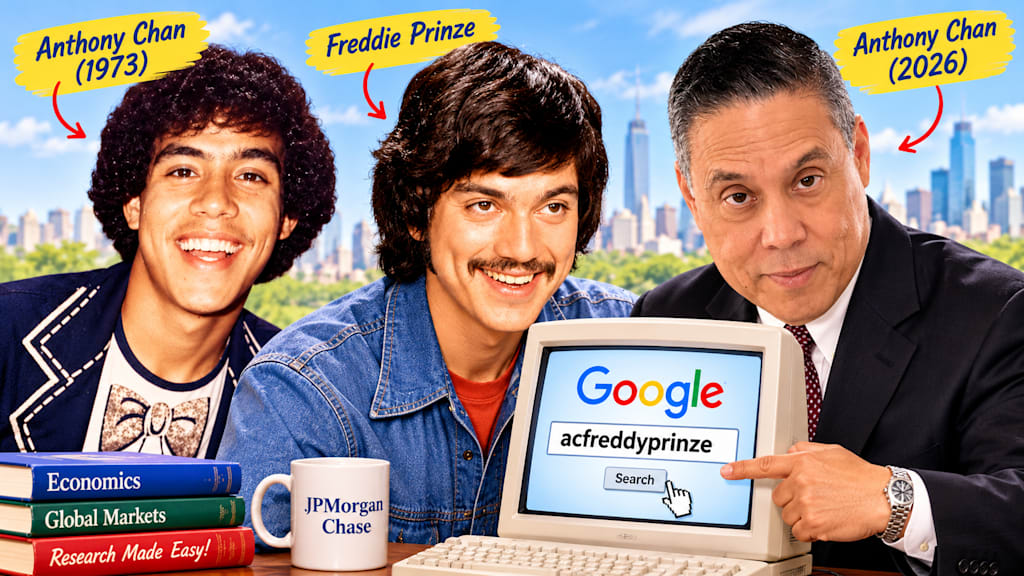
In 1998, I experienced something that would permanently revolutionize how I worked, researched, and communicated. I discovered Google and, for the first time in my life, could search for information without visiting a library, shuffling through hundreds of index cards, or staring at a microfiche machine until my eyes felt like they were about to fall out.
Today, we take the internet for granted. We ask a question, and within seconds, thousands of answers stare back at us. But in 1998, this was nothing short of a technological miracle. At least, that was how it felt to me. I was the Global Chief Economist at a predecessor company that eventually merged with JPMorgan Chase, and I thought I had just discovered the eighth wonder of the world.
To appreciate why this experience was so extraordinary, you need to understand where I had come from. When I began writing my doctoral dissertation in economics, I did not have the luxury of a computer. I had an electric typewriter. Yes, an actual typewriter! Every page required careful preparation, and making corrections was an exercise in patience. If I made a mistake, I could use correction tape or fluid, but there was no magical delete button to rescue me. Rewriting a paragraph could mean retyping an entire page. I became very familiar with the sound of keys striking paper, and I suspect my apartment neighbors became equally familiar with it.
Eventually, while working as an intern at the Federal Reserve in Washington, DC, I graduated to something considerably more sophisticated: a Wang word processor. For those who remember Wang, it was practically the Rolls-Royce of office technology. I could now edit my dissertation without starting from scratch every time I changed my mind. I thought I had reached the pinnacle of technology. Little did I know the real revolution was still waiting for all of us!
Of course, writing a dissertation or preparing an economic article required much more than typing. Research was an entirely different adventure. If I needed historical economic data, an academic study, or a reference to support an argument, I often had to visit a physical library. I would begin with the card catalog, searching through drawers of index cards to find the books or journals I needed. Sometimes the information was available only on microfiche, which meant loading a tiny film into a machine and scrolling through page after page.
Finding the right information could take hours. Sometimes I found exactly what I wanted. Other times, after all that effort, I discovered the material was irrelevant. There was no search bar, no convenient hyperlink, and certainly no artificial intelligence waiting to summarize the information for me. My research strategy was simple: keep looking, keep turning pages, and hope I hadn't wasted an entire afternoon.
Then came 1998.
I began using Google to research my articles, and my professional life changed almost overnight. Suddenly, I could sit at my personal computer and search for information that once would have required a trip to a library. I could look up economic statistics, find background information, locate articles, and confirm facts without leaving my office.
I remember thinking to myself, "Are you kidding me? I can actually do this from here?"
The process was not particularly fast. Computers were considerably less powerful, internet connections were slow, and sometimes I had to wait what seemed like an eternity for a page to load. You could type in a search, click a result, and then have enough time to make a cup of coffee before the information appeared.
Sometimes I wondered whether the computer was searching the entire internet or just taking a well-deserved lunch break. But I didn't care; it worked!
For the first time, I could independently look up and confirm information almost immediately. As an economist responsible for writing articles and explaining complex economic developments to clients, this was immensely important. Research became more efficient, information more accessible, and I could spend more time thinking about what the information meant rather than spending hours trying to locate it.
It was as though someone had given me the keys to an enormous library containing virtually everything I could want to know, except that I didn't have to put on a coat, travel anywhere, or worry about whether it was still open. I honestly felt as though I had just taken my first steps walking on the moon. It was that revolutionary to me.
And then there was another first: my email address.
When I set up my first email account, I chose the address acfreddyprinze. There was a reason for this rather unusual choice. When I was in high school, people constantly told me I strongly resembled the late Freddie Prinze, the comedian and actor who starred in the popular television sitcom Chico and the Man.
Apparently, the resemblance was convincing enough that I adopted it as part of my new digital identity. Looking back, I have to laugh. There I was, a Global Chief Economist at one of the world's largest financial institutions, researching economic developments and preparing articles for sophisticated clients, while introducing myself to the emerging digital world with the personal email address acfreddyprinze.
I suppose everyone needs a little personal branding. Some people choose their initials, others choose their professional titles, and I apparently decided that being mistaken for a television comedian was the way to go.
I wonder what my friends thought when they realized that personal email address. Perhaps they assumed I had a secret second career in Hollywood. Unfortunately, no one ever offered me a television contract, so I remained an economist.
What made this experience particularly memorable was that I had lived through an extraordinary progression in technology within a relatively short period. I went from an electric typewriter to a Wang word processor, and then to a personal computer connected to a worldwide information network. Each step seemed almost unimaginable compared with the one before it.
At the time, I had no idea how far this technology would eventually take us. Google would become an indispensable part of everyday life, email would replace much of traditional correspondence, and the internet would fundamentally transform how businesses, governments, financial markets, and individuals communicated.
And, of course, nobody could have imagined that one day we would ask artificial intelligence to help us even more by analyzing economic data and answering questions that once required hours of research.
I sometimes wonder what the younger version of me, sitting in front of that electric typewriter, would have thought if someone had told him that someday he could access an extraordinary amount of the world's information on a small computer or a personal mobile device!
He probably would have asked whether the machine could also correct spelling errors, rewrite entire paragraphs, and eliminate the need for correction fluid. Actually, that last point alone might have been enough to convince him.
My first encounter with Google in 1998 was more than just discovering a new way to conduct research. I didn't know it then, but I was witnessing the start of a transformation that would eventually change nearly every aspect of my professional and personal life.
And to think, it all started with a search engine, a slow computer, and an email address that made me sound like I was auditioning for a Hollywood sitcom.
Not bad for a guy who started with an electric typewriter!
About the Creator
Anthony Chan
Chan Economics LLC, Public Speaker
Chief Global Economist & Public Speaker JPM Chase ('94-'19).
Senior Economist Barclays ('91-'94)
Economist, NY Federal Reserve ('89-'91)
Econ. Prof. (Univ. of Dayton, '86-'89)
Ph.D. Economics
Enjoyed the story? Support the Creator.
Subscribe for free to receive all their stories in your feed. You could also become a paid subscriber, letting them know you appreciate their work.
Comments
There are no comments for this story
Be the first to respond and start the conversation.