
Modified Starch Is Quietly Transforming Modern Industries from Food Production to Pharmaceuticals
Rising Demand for Processed Foods, Clean-Label Ingredients, and Industrial Applications Is Driving Growth in the Global Modified Starch Market

While consumers rarely notice it on product labels, modified starch has become one of the most important ingredients supporting modern food production and numerous industrial processes. From improving the texture of sauces and soups to strengthening paper products and enhancing pharmaceutical formulations, modified starch plays a critical role across multiple sectors of the global economy.
As demand for convenience foods, functional ingredients, and sustainable industrial materials continues to rise, manufacturers are increasingly turning to modified starch for its versatility, efficiency, and performance benefits. Technological innovations are further expanding its applications, making it a key ingredient in the future of food processing and industrial manufacturing.
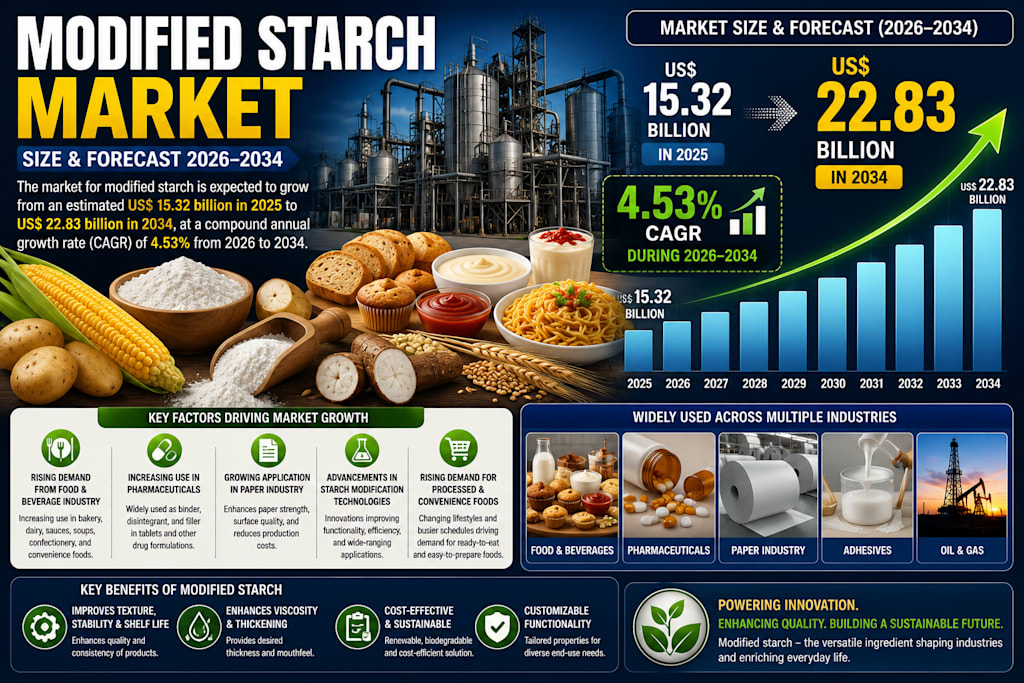
According to Renub Research, the Modified Starch Market is projected to grow from US$ 15.32 billion in 2025 to US$ 22.83 billion by 2034, registering a compound annual growth rate (CAGR) of 4.53% between 2026 and 2034. Growing demand from food and beverage manufacturers, expanding pharmaceutical applications, increasing industrial usage, and ongoing product innovation are driving market expansion worldwide.
As industries continue seeking high-performance, plant-based, and sustainable ingredients, modified starch is becoming increasingly valuable across a broad range of applications.
Understanding Modified Starch and Its Importance
Modified starch is a form of starch that has been physically, chemically, or enzymatically altered to improve its functional properties.
It is commonly derived from natural raw materials such as corn, potatoes, wheat, and cassava.
The modification process enhances characteristics including:
- Thickening ability
- Stability under heat
- Freeze-thaw resistance
- Acid tolerance
- Texture improvement
- Shelf-life extension
- Emulsification performance
These enhanced properties make modified starch suitable for applications where conventional starch may not perform effectively.
Today, modified starch is widely used in food production, pharmaceuticals, paper manufacturing, textiles, adhesives, and many other industries.
Its versatility has made it one of the most important functional ingredients in modern manufacturing.
Food and Beverage Industry Remains the Largest Growth Driver
The food and beverage sector continues to be the largest consumer of modified starch globally.
Manufacturers use modified starch as a thickener, stabilizer, emulsifier, binder, and texture enhancer in a wide range of products.
Common applications include:
- Soups
- Sauces
- Dressings
- Dairy products
- Bakery items
- Frozen foods
- Ready-to-eat meals
- Snacks
- Confectionery products
As consumer lifestyles become increasingly busy, demand for convenience foods continues to rise.
These products often require ingredients capable of maintaining texture, consistency, and stability throughout production, transportation, and storage.
Modified starch helps manufacturers meet these requirements while ensuring product quality.
The growing popularity of processed and packaged foods is expected to remain one of the strongest drivers of market growth.
Industry Consolidation Is Strengthening Market Development
The modified starch sector continues witnessing strategic acquisitions and partnerships designed to expand product portfolios and strengthen innovation capabilities.
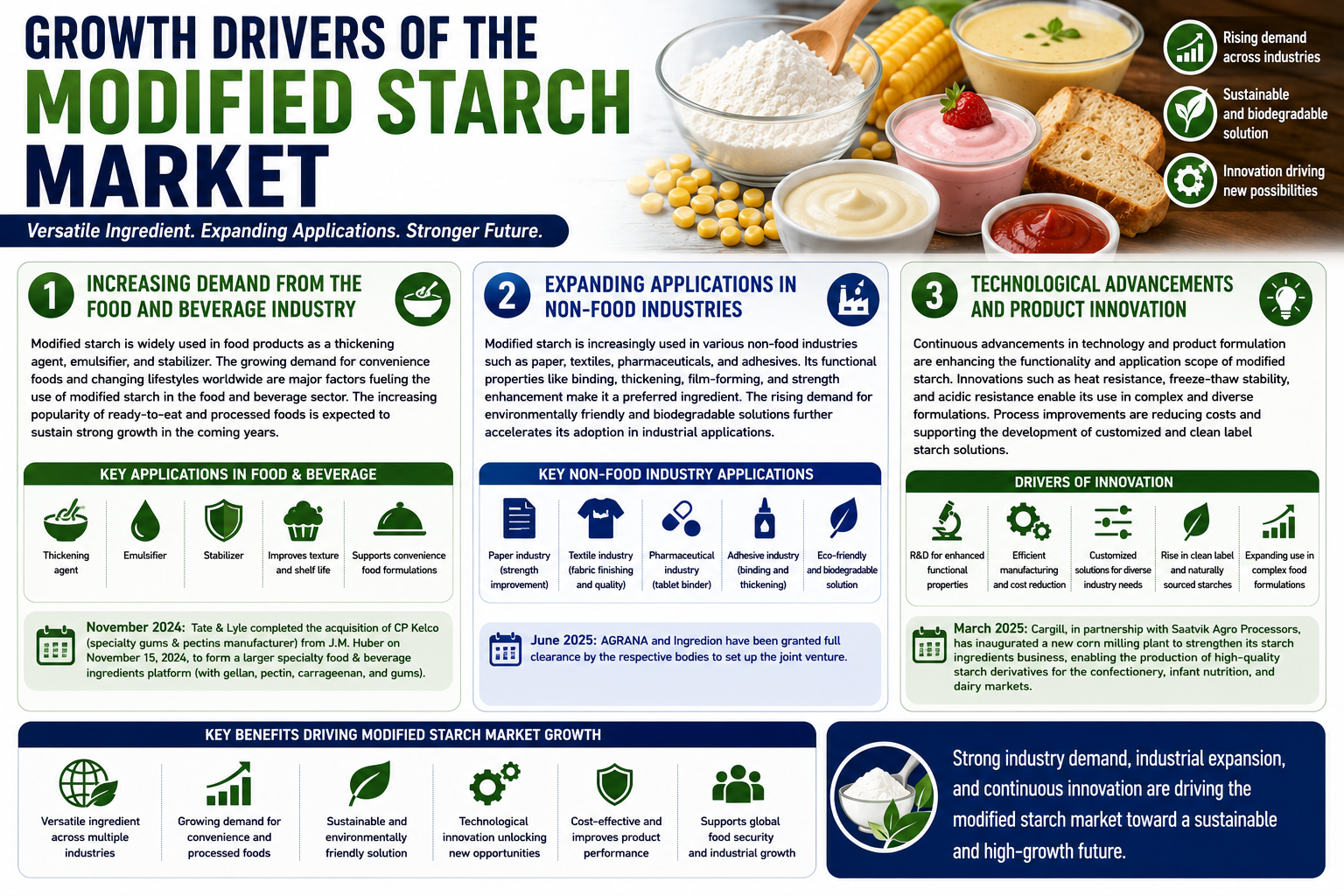
A notable development occurred in November 2024 when Tate & Lyle completed its acquisition of CP Kelco, a major producer of specialty gums and pectins.
The transaction expanded Tate & Lyle's capabilities in specialty food ingredients and created a broader platform for food and beverage solutions.
Such consolidation efforts enable companies to better address evolving customer demands while accelerating product development and global market reach.
As competition intensifies, strategic partnerships and acquisitions are expected to remain important growth strategies.
Non-Food Applications Are Expanding Rapidly
While food processing dominates demand, non-food industries are becoming increasingly important consumers of modified starch.
Paper Manufacturing
In the paper industry, modified starch improves paper strength, printability, surface quality, and production efficiency.
The growing demand for sustainable packaging materials continues supporting starch consumption within this sector.
Textile Industry
Modified starch serves as a sizing agent that enhances fabric quality and improves weaving efficiency.
Its biodegradable nature makes it attractive for environmentally conscious textile production.
Adhesive Manufacturing
Modified starch provides excellent binding and thickening properties, making it useful in adhesives used across packaging, construction, and industrial applications.
Pharmaceutical Industry
Pharmaceutical manufacturers rely on modified starch as a binder, filler, and disintegrant in tablet formulations.
These expanding applications are significantly broadening market opportunities.
Sustainability Trends Are Supporting Adoption
Sustainability has become a major factor influencing industrial purchasing decisions.
Many industries are actively replacing synthetic and petroleum-based materials with renewable alternatives.
Modified starch offers several sustainability advantages:
- Renewable sourcing
- Biodegradability
- Reduced environmental impact
- Compatibility with circular economy initiatives
As environmental regulations become stricter and corporate sustainability goals become more ambitious, demand for plant-based ingredients continues increasing.
Modified starch aligns closely with these objectives, helping manufacturers reduce environmental footprints while maintaining performance standards.
This trend is expected to remain a major growth catalyst throughout the forecast period.
Technological Innovation Is Improving Product Performance
Research and development efforts continue generating new opportunities within the modified starch market.
Manufacturers are investing heavily in technologies that improve starch functionality and broaden application possibilities.
Modern starch innovations focus on:
- Improved heat resistance
- Enhanced freeze-thaw stability
- Better acid tolerance
- Increased processing efficiency
- Customized functionality for specific industries
These advances allow modified starch to perform effectively in increasingly complex formulations.
March 2025 marked an important development when Cargill, in collaboration with Saatvik Agro Processors, inaugurated a new corn milling facility designed to support production of high-quality starch derivatives for dairy, confectionery, and infant nutrition markets.
Such investments demonstrate the industry's commitment to innovation and capacity expansion.
Corn-Based Modified Starch Dominates the Market
Corn remains the most widely used raw material for modified starch production.
Its abundant availability, affordability, and desirable functional properties make it highly attractive for manufacturers.
Corn-based modified starch is commonly used in:
- Soups
- Sauces
- Bakery products
- Dairy products
- Paper manufacturing
- Textile processing
- Adhesive production
Strong agricultural production in major corn-growing regions further supports market stability.
As demand for modified starch continues expanding, corn is expected to remain the industry's dominant feedstock.
Cassava-Based Modified Starch Gains Momentum
Cassava, also known as tapioca, is becoming increasingly important within the modified starch market.
Cassava-derived starch offers several advantages:
- Gluten-free properties
- Neutral flavor profile
- Excellent thickening capabilities
- Smooth texture formation
- Natural origin
These characteristics make cassava starch particularly attractive for clean-label and allergen-free food products.
Beyond food applications, cassava starch is also used in packaging, textiles, and paper manufacturing.
As demand for natural ingredients grows, cassava-based modified starch is expected to experience strong expansion.
Cationic Modified Starch Supports Industrial Growth
Cationic modified starch represents an important segment serving industrial markets.
Its positive electrical charge allows it to bind effectively with negatively charged materials, particularly in paper manufacturing.
Benefits include:
- Improved paper strength
- Better printability
- Enhanced retention properties
- Improved production efficiency
The textile industry also utilizes cationic starch as a sizing agent to improve fabric quality.
As demand for sustainable industrial materials increases, cationic starch is expected to maintain strong growth momentum.
Pharmaceutical Applications Continue Expanding
The pharmaceutical industry represents one of the fastest-growing end-use sectors for modified starch.
Modified starch plays a critical role as an excipient in drug manufacturing.
Functions include:
- Tablet binding
- Drug disintegration
- Filler applications
- Controlled drug release
The growth of global healthcare systems, increasing pharmaceutical production, and advancements in drug delivery technologies continue supporting demand.
Plant-based and biocompatible excipients are also gaining popularity among pharmaceutical manufacturers.
As healthcare demand increases worldwide, pharmaceutical applications are expected to contribute significantly to market expansion.
Regional Markets Driving Growth
United States
The United States remains one of the largest modified starch markets globally due to strong demand from food processing, pharmaceuticals, and industrial sectors.
The country's abundant corn production and advanced food manufacturing infrastructure provide significant competitive advantages.
United Kingdom
The UK market benefits from growing demand for convenience foods, clean-label products, and specialty ingredients.
In May 2025, Danish starch producer KMC entered a new distribution agreement with Daymer Ingredients to expand access to specialty starch products across the British food industry.
India
India's modified starch market is expanding rapidly due to growth in food processing, pharmaceuticals, textiles, and paper industries.
Urbanization and changing consumer lifestyles continue driving demand for processed food products.
Saudi Arabia
Saudi Arabia is witnessing increasing demand for modified starch in both food manufacturing and industrial applications as economic diversification efforts continue.
Challenges Facing the Market
Raw Material Price Volatility
One of the industry's biggest challenges is fluctuating prices for agricultural feedstocks such as corn, wheat, potatoes, and cassava.
Weather conditions, crop yields, and competition from other industries can significantly impact supply and production costs.
Clean-Label and Regulatory Pressures
Consumers increasingly seek minimally processed and natural ingredients.
Some modified starch products face scrutiny because of perceptions surrounding processing methods.
Additionally, regulatory compliance requirements can increase costs and extend product development timelines.
Final Thoughts
Modified starch has become one of the most versatile and valuable ingredients in modern manufacturing, supporting applications ranging from food processing to pharmaceuticals and industrial production.
According to Renub Research, the Modified Starch Market is expected to grow from US$ 15.32 billion in 2025 to US$ 22.83 billion by 2034, reflecting rising demand for functional ingredients, sustainable materials, and advanced industrial solutions.
As innovation continues improving product performance and industries increasingly prioritize sustainability, modified starch will remain an essential component of the global manufacturing ecosystem.
The future of modified starch extends far beyond food—it is helping shape a more efficient, sustainable, and technologically advanced industrial world.
About the Creator
Enjoyed the story? Support the Creator.
Subscribe for free to receive all their stories in your feed.
Comments
There are no comments for this story
Be the first to respond and start the conversation.