
Mobile Application Market to Reach US$ 740.25 Billion by 2033 as AI, 5G, and Digital Commerce Transform the Mobile Economy
The mobile app revolution is entering a new phase, driven by artificial intelligence, immersive experiences, mobile payments, and the ever-growing global smartphone user base.

The smartphone has evolved from a communication device into a powerful digital ecosystem that influences how people work, shop, learn, entertain themselves, and manage their daily lives. At the center of this transformation lies the mobile application industry, one of the most dynamic sectors in the global digital economy.
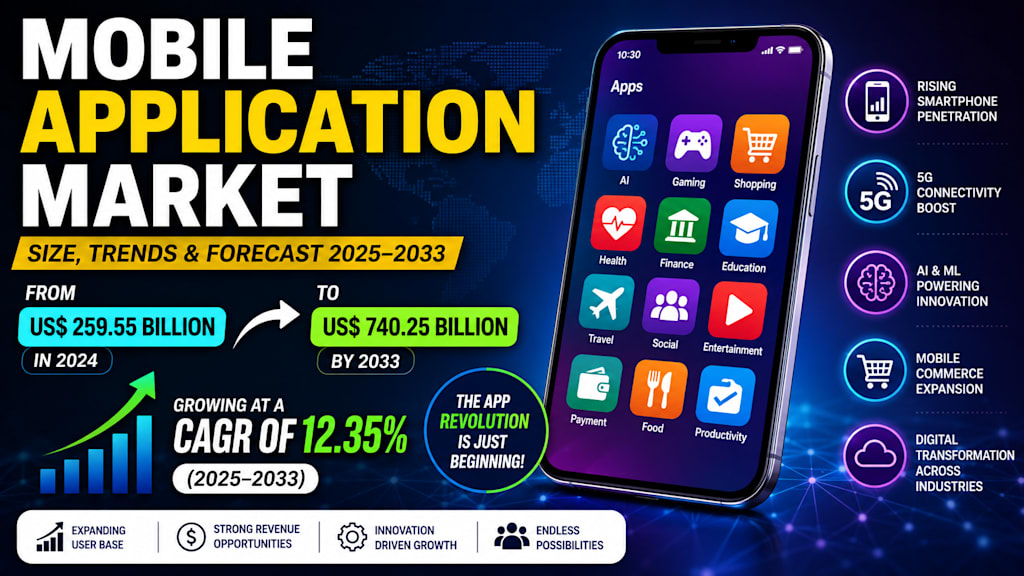
According to recent market analysis, the global Mobile Application Market is projected to grow from US$ 259.55 Billion in 2024 to US$ 740.25 Billion by 2033, expanding at a CAGR of 12.35% during the forecast period from 2025 to 2033. This remarkable growth reflects the increasing importance of mobile applications in both consumer and enterprise environments.
From social networking and gaming to healthcare, education, finance, and retail, mobile applications have become essential tools for billions of users worldwide. As emerging technologies continue to reshape digital experiences, the mobile app market is poised for another decade of innovation and expansion.
Understanding the Mobile Application Ecosystem
A mobile application is software specifically designed to run on smartphones, tablets, and other portable devices. These applications provide users with access to various services, including communication, navigation, productivity, entertainment, shopping, healthcare, and financial management.
Mobile applications generally fall into three categories:
Native Applications
Web-Based Applications
Hybrid Applications
Native applications are built for specific operating systems such as Android or iOS, offering superior performance and functionality. Hybrid applications combine elements of both native and web technologies, enabling broader compatibility while reducing development costs.
Today, consumers expect seamless digital experiences, and mobile applications serve as the primary gateway connecting users with brands, businesses, and services.
Smartphone Adoption Continues to Fuel Market Growth
One of the strongest drivers behind the mobile application industry's expansion is the widespread adoption of smartphones.
Over the last decade, smartphone affordability has improved significantly, particularly in emerging economies. Millions of first-time internet users now access online services primarily through mobile devices.
This trend has transformed smartphones into essential tools for communication, entertainment, banking, shopping, and education.
As internet connectivity improves and device prices continue to fall, more users are downloading and engaging with applications daily. The growing digital population creates a larger addressable market for developers and businesses seeking to reach consumers through mobile platforms.
The increasing reliance on mobile devices has also encouraged organizations to prioritize mobile-first strategies, ensuring that customers can access services conveniently through dedicated applications.
5G Connectivity Is Unlocking New Possibilities
The global rollout of 5G networks is creating significant opportunities for mobile application developers.
Compared with previous wireless technologies, 5G offers:
Faster download speeds
Lower latency
Improved network reliability
Greater device connectivity
These advantages enable developers to build more sophisticated applications featuring real-time interactions, cloud gaming, augmented reality (AR), virtual reality (VR), and advanced streaming capabilities.
Consumers increasingly demand instant access to content and services. 5G helps meet these expectations by delivering smoother user experiences and supporting data-intensive applications.
As 5G coverage expands globally, app developers are expected to introduce innovative features that were previously limited by network constraints.
Artificial Intelligence Is Reshaping Mobile Experiences
Artificial Intelligence (AI) has become one of the most influential technologies in modern app development.
AI-powered applications can analyze user behavior, personalize recommendations, automate processes, and improve customer engagement.
Some common AI applications include:
Smart chatbots
Voice assistants
Predictive analytics
Personalized content recommendations
Fraud detection systems
Image recognition tools
Streaming platforms, retail applications, financial services apps, and productivity tools increasingly leverage AI to create more relevant user experiences.
Machine learning algorithms continuously learn from user interactions, enabling applications to become smarter over time. This capability not only improves user satisfaction but also enhances retention and monetization opportunities.
Mobile Commerce Is Transforming Consumer Behavior
Mobile commerce has become a critical growth pillar for the application market.
Consumers now prefer shopping through mobile applications because of convenience, personalized recommendations, and simplified payment processes.
Retailers are investing heavily in app-based commerce experiences that offer:
One-click purchasing
Personalized promotions
Loyalty rewards
Mobile payment integration
Real-time order tracking
The rapid adoption of digital wallets and contactless payment technologies has further accelerated mobile commerce growth.
As businesses continue shifting toward digital-first sales strategies, mobile applications will remain essential tools for customer acquisition and retention.
In-App Purchases Drive Revenue Growth
The freemium business model has transformed how mobile applications generate revenue.
Rather than charging users upfront, many developers offer free downloads while monetizing through:
In-app purchases
Subscription services
Premium content
Virtual goods
Advertising
Gaming applications have been particularly successful in leveraging this model. However, subscription-based monetization has also gained popularity across fitness, education, entertainment, and productivity categories.
Consumers are increasingly willing to pay for enhanced experiences, exclusive content, and personalized features.
This shift has created sustainable revenue streams for developers while encouraging continuous innovation and feature development.
Enterprise Mobility Is Expanding the Market
The mobile application market is no longer driven solely by consumers.
Businesses across industries are embracing enterprise mobility solutions to improve productivity, collaboration, and operational efficiency.
Organizations now rely on mobile applications for:
Remote workforce management
Customer relationship management
Team collaboration
Data access
Workflow automation
As hybrid and remote work models continue evolving, demand for enterprise mobile applications is expected to increase substantially.
Companies recognize that mobile technology enables employees to remain productive regardless of location, creating new opportunities for software developers and technology providers.
Gaming and Entertainment Remain Dominant Segments
Gaming remains one of the largest and most profitable segments within the mobile application industry.
Mobile gaming attracts users across all age groups and demographics, supported by:
Improved smartphone hardware
Faster internet connectivity
Social gaming experiences
Cloud gaming innovations
Similarly, entertainment applications continue to experience strong demand.
Streaming platforms, short-video applications, music services, and content-sharing networks have become integral parts of daily digital consumption.
The combination of gaming and entertainment accounts for a significant portion of app downloads, user engagement, and overall revenue generation.
Regional Growth Trends
United States
The United States remains one of the world's largest mobile application markets.
High smartphone penetration, advanced digital infrastructure, and strong technology investments support continuous innovation.
The country is witnessing significant growth in AI-powered applications, augmented reality experiences, mobile commerce platforms, and subscription-based services.
Germany
Germany represents one of Europe's most mature mobile app markets.
Consumers increasingly seek secure, personalized, and efficient digital experiences. Popular categories include finance, social networking, gaming, and e-commerce applications.
The growing popularity of integrated digital ecosystems is encouraging further investment in app innovation.
India
India continues to emerge as one of the fastest-growing mobile application markets globally.
Several factors contribute to this growth:
Affordable internet access
Expanding smartphone ownership
Young population demographics
Government digital initiatives
Rising digital payment adoption
The emergence of regional-language applications is further expanding accessibility and driving user engagement across diverse populations.
Saudi Arabia
Saudi Arabia's mobile application market is experiencing rapid growth due to digital transformation initiatives and strong government support.
Demand for fintech, healthcare, e-commerce, and public service applications continues to rise as consumers increasingly embrace digital lifestyles.
Challenges Facing the Industry
Despite impressive growth prospects, the mobile application industry faces several challenges.
Intense Market Competition
Millions of applications compete for visibility in app marketplaces.
Developers must invest heavily in:
User experience optimization
Marketing campaigns
Brand development
Feature innovation
Without differentiation, even high-quality applications may struggle to attract users.
Data Privacy and Security Concerns
As applications collect increasing amounts of user data, privacy and security have become major concerns.
Developers must comply with evolving regulations while implementing robust cybersecurity measures.
Failure to protect user information can damage brand reputation and reduce customer trust.
Maintaining secure digital environments remains a top priority across the industry.
10 Recent Developments Shaping the Mobile Application Market
1. Google Expands AI-Powered YouTube Features
Google introduced AI-enhanced content creation tools for YouTube creators, helping automate creative workflows.
2. Apple's Freeform App Gains Adoption
Apple continues expanding collaborative digital workspace capabilities through its Freeform application.
3. Snap Enhances Augmented Reality Advertising
Snap launched sponsored AR filters, providing brands with new engagement opportunities.
4. AI Chatbots Become Mainstream
Mobile applications increasingly integrate intelligent virtual assistants for customer support and personalization.
5. Subscription-Based Apps Continue Growing
Developers are focusing more on recurring revenue models rather than one-time purchases.
6. Mobile Health Applications Expand
Healthcare providers are adopting mobile platforms for consultations, monitoring, and wellness management.
7. Fintech Innovation Accelerates
Digital banking and payment applications continue experiencing rapid user growth worldwide.
8. Enterprise Mobility Investments Increase
Organizations are investing in mobile-first workplace productivity solutions.
9. Cloud Gaming Adoption Rises
Improved connectivity enables broader access to cloud-based gaming experiences.
10. Mountain Bike Training Goes Digital
Ninja MTB Performance introduced the Ninja MTB Studio Fitness and Skills App, combining fitness and skills training for cyclists.
Key Companies Leading the Market
Major industry participants include:
Apple Inc.
Google LLC
Microsoft Corporation
Adobe Inc.
Tencent Holdings Limited
Spotify Technology S.A.
Uber Technologies, Inc.
Snap Inc.
Lyft, Inc.
Meta Platforms, Inc.
These organizations continue investing in artificial intelligence, cloud technologies, user engagement strategies, and platform innovation to strengthen their competitive positions.
Final Thoughts
The global mobile application market stands at the heart of the digital economy. With smartphones becoming indispensable tools for everyday life, applications have evolved into essential gateways for communication, entertainment, commerce, education, healthcare, and business operations.
The market's projected rise from US$ 259.55 Billion in 2024 to US$ 740.25 Billion by 2033 highlights the enormous opportunities ahead. Emerging technologies such as artificial intelligence, machine learning, augmented reality, cloud computing, and 5G connectivity will continue reshaping user experiences and driving innovation.
While competition and security concerns remain significant challenges, the industry's long-term outlook remains exceptionally strong. Businesses, developers, and investors that embrace innovation and prioritize user-centric experiences will be best positioned to capitalize on the next phase of mobile application market growth.
About the Creator
Enjoyed the story? Support the Creator.
Subscribe for free to receive all their stories in your feed.
Comments
There are no comments for this story
Be the first to respond and start the conversation.