
Mixer Grinder Market Is Becoming the Heart of the Modern Smart Kitchen
Driven by urban lifestyles, home cooking trends, and multifunctional kitchen innovation, mixer grinders are evolving from basic appliances into essential everyday kitchen companions.

The modern kitchen is changing rapidly. Consumers today want appliances that are faster, smarter, more compact, and capable of handling multiple tasks with minimal effort. In this evolving kitchen ecosystem, the mixer grinder has emerged as one of the most practical and widely used appliances in homes around the world.
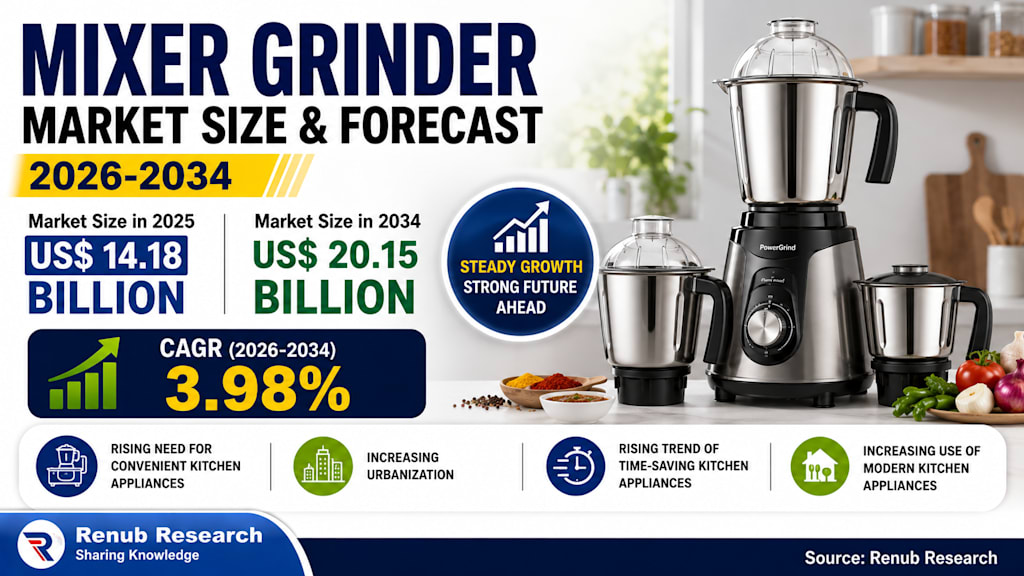
According to Renub Research, the global mixer grinder market is expected to grow from US$ 14.18 billion in 2025 to US$ 20.15 billion by 2034, registering a compound annual growth rate (CAGR) of 3.98% between 2026 and 2034.
The market’s growth reflects larger shifts in lifestyle, cooking habits, and consumer expectations. Urbanization, busy work schedules, rising interest in home cooking, and growing demand for convenient kitchen appliances are all contributing to the increasing popularity of mixer grinders. At the same time, manufacturers are transforming the category through innovation, improved motor technology, stylish designs, and multifunctional capabilities.
What was once considered a simple kitchen utility is now becoming a centerpiece of the modern kitchen experience.
Convenience is driving modern kitchen decisions
One of the biggest reasons behind the steady growth of the mixer grinder market is the growing importance of convenience in everyday life. Urban households are busier than ever before, and consumers increasingly prefer appliances that reduce cooking effort while saving time.
Mixer grinders perfectly fit this lifestyle shift. They simplify food preparation by handling multiple tasks such as grinding spices, blending smoothies, preparing batters, mixing sauces, and making chutneys. Instead of performing these tasks manually, users can complete them within minutes using a single appliance.
This level of convenience has made mixer grinders especially popular in homes where both adults are working professionals. As daily schedules become more demanding, consumers are looking for kitchen appliances that allow them to cook efficiently without compromising food quality.
Urbanization is strengthening this trend even further. As more people move into cities and adopt compact apartment lifestyles, demand for multifunctional and space-saving appliances is increasing rapidly. Mixer grinders offer exactly that combination of versatility and efficiency.
The modern consumer no longer wants multiple separate appliances taking up kitchen space. Instead, buyers increasingly prefer products capable of handling several functions within one compact system.
Home cooking trends are creating long-term demand
Another major factor supporting market growth is the renewed interest in home cooking. Around the world, more consumers are preparing meals at home due to health awareness, cost considerations, lifestyle preferences, and growing interest in personalized nutrition.
This trend has increased the importance of kitchen appliances that make food preparation faster and easier. Mixer grinders are especially useful because they support a wide variety of cooking styles and cuisines.
They are commonly used for preparing spice powders, sauces, smoothies, purees, chutneys, batters, soups, and marinades. In many Asian and Middle Eastern households, mixer grinders are essential for traditional cooking methods that require fine grinding of spices and ingredients.
As culinary experimentation becomes more common, consumers are investing in appliances that help them prepare restaurant-style meals at home. This shift is turning mixer grinders from basic utility products into important tools for creative cooking.
The rise of healthy eating trends is also contributing to market demand. Consumers increasingly prepare fresh juices, smoothies, and homemade food items rather than relying entirely on processed alternatives. Mixer grinders and related products such as blenders and juicers are benefiting directly from this lifestyle movement.
Technology is transforming the category
Like many other home appliance markets, the mixer grinder industry is being reshaped by technological innovation. Manufacturers are investing heavily in improving performance, safety, efficiency, and user experience.
Modern mixer grinders now include more powerful motors capable of handling difficult grinding tasks quickly and efficiently. Improved blade systems help deliver smoother blending and finer grinding results, while noise-reduction technologies are making appliances more comfortable to use in residential environments.
Safety has also become a major focus area. Many newer models include automatic shut-off systems, overload protection, digital controls, and enhanced jar-locking mechanisms designed to improve user confidence and appliance durability.
Design innovation is equally important. Today’s consumers care not only about functionality but also about appearance. Mixer grinders are increasingly being designed with sleek finishes, compact structures, stylish color combinations, and easy-to-clean components.
Manufacturers understand that kitchen appliances are now part of the broader lifestyle and interior design experience. Consumers want products that look modern while also delivering practical performance.
Continuous innovation is helping brands differentiate themselves in an increasingly competitive market.
Multifunctional appliances are winning consumer attention
One of the most important shifts in consumer behavior is the growing preference for multifunctional appliances. Buyers increasingly want products capable of performing multiple kitchen tasks efficiently.
Mixer grinders benefit strongly from this trend because they already combine several core functions in one appliance. They can mix, blend, grind, puree, and process food ingredients using different jar configurations and blade attachments.
This versatility gives them an advantage in modern kitchens where space optimization matters. Consumers living in apartments or compact homes often prefer one appliance capable of handling multiple preparation tasks rather than purchasing separate products for each function.
At the same time, the market is seeing growth in related categories such as jar blenders, electric juicers, and food processors. These segments reflect broader consumer demand for convenient and health-oriented kitchen solutions.
Jar blenders, for example, are becoming increasingly popular among consumers focused on smoothies, protein shakes, soups, and healthy beverages. Electric juicers are also witnessing strong demand as consumers prioritize fresh fruit and vegetable consumption.
Together, these trends show how the modern kitchen appliance industry is becoming increasingly connected to wellness, efficiency, and lifestyle personalization.
Online shopping is changing how consumers buy appliances
The rise of e-commerce is significantly reshaping the mixer grinder market. Online retail platforms have made it easier for consumers to compare brands, features, prices, and customer reviews before making purchasing decisions.
This accessibility is especially important in developing regions where physical appliance availability may vary by location. Online marketplaces allow consumers in urban and rural areas alike to access a wider range of products.
Discounts, promotional campaigns, and home delivery services are also encouraging more consumers to purchase kitchen appliances online. Detailed product information and customer reviews help buyers make informed decisions without visiting physical stores.
At the same time, exclusive brand stores and multi-brand retail outlets continue to play an important role. Many consumers still prefer seeing appliances physically before purchasing, especially when evaluating build quality, motor performance, and design.
Manufacturers are increasingly adopting omnichannel strategies that combine online accessibility with physical retail presence. This approach allows brands to improve visibility while reaching consumers across different shopping preferences.
India remains one of the strongest mixer grinder markets globally
India is one of the most important and fastest-growing markets for mixer grinders due to the appliance’s deep integration into everyday cooking habits.
Mixer grinders are considered essential household products in many Indian homes. They are widely used for grinding spices, preparing chutneys, blending ingredients, and making batter for traditional dishes. Because Indian cuisine often requires extensive spice preparation, mixer grinders have become deeply connected to daily cooking routines.
Urbanization and rising disposable incomes are further accelerating demand. As more consumers adopt modern lifestyles and move into urban areas, the demand for efficient kitchen appliances continues to grow.
The expansion of online retail has also improved product accessibility across the country, including smaller cities and semi-urban regions. This broader reach is helping manufacturers tap into a larger customer base.
Innovation remains particularly important in India’s market. Companies are introducing appliances with stronger motors, better safety systems, quieter operation, and advanced grinding technologies designed specifically for regional cooking needs.
Because of its combination of high-volume demand and strong cultural relevance, India is expected to remain one of the key drivers of global market growth.
The United States market is evolving through multicultural cooking trends
The United States mixer grinder market is growing gradually as consumers increasingly embrace diverse global cuisines and multifunctional kitchen appliances.
While food processors and blenders remain widely used in American kitchens, mixer grinders are becoming more popular because of their ability to handle fine grinding tasks required in Asian, Middle Eastern, and international cooking styles.
The increasing popularity of homemade meals and culinary experimentation is also contributing to demand. Consumers are seeking appliances that simplify food preparation while supporting a broader variety of recipes.
Online retail growth has significantly improved product availability across the United States. As awareness increases and international cuisines become more mainstream, the market is expected to continue expanding steadily.
The United Kingdom market reflects changing culinary preferences
The United Kingdom is witnessing gradual growth in the mixer grinder market as multicultural cuisine and home cooking trends continue to influence consumer behavior.
Consumers are increasingly interested in preparing dishes that require spice grinding, blending, and batter preparation. The growing diversity of food culture in the country is encouraging adoption of appliances capable of supporting more complex cooking styles.
Retailers are also offering a broader range of mixer grinders with varying capacities and functions, making the products more accessible to different household types.
As modern kitchen appliance adoption increases and cooking trends continue evolving, the UK market is expected to expand further.
Saudi Arabia is embracing modern kitchen lifestyles
Saudi Arabia’s mixer grinder market is also witnessing growth as consumers increasingly adopt modern cooking appliances that improve convenience and efficiency.
Mixer grinders are becoming common in households preparing both traditional and international dishes. Home cooking trends, changing lifestyles, and rising interest in modern kitchen solutions are all contributing to increased adoption.
Retail expansion and improved appliance availability are helping support market development. Manufacturers are also introducing products with more powerful motors and durable jar systems to meet local cooking preferences.
As urbanization and consumer modernization continue in the region, demand for kitchen appliances like mixer grinders is expected to rise steadily.
Competition and pricing pressures remain major challenges
Despite steady growth, the mixer grinder market faces important challenges. One of the biggest is competition from alternative kitchen appliances such as food processors, blenders, and multifunction kitchen machines.
Many of these products offer overlapping functionality, forcing mixer grinder manufacturers to continuously improve product differentiation through innovation and design.
Price sensitivity is another major issue, particularly in developing markets. Consumers often compare multiple brands and prioritize affordability when purchasing household appliances.
This creates pressure on manufacturers to maintain product quality while remaining competitively priced. Intense competition can reduce profit margins and make brand differentiation more difficult.
To remain successful, companies must balance innovation, affordability, durability, and performance while responding to rapidly changing consumer expectations.
Final Thoughts
The mixer grinder market is evolving far beyond its traditional identity as a basic kitchen appliance. Today, it represents convenience, multifunctionality, modern cooking culture, and smart kitchen living.
According to Renub Research, the market is projected to grow from US$ 14.18 billion in 2025 to US$ 20.15 billion by 2034, reflecting the continued global demand for efficient and versatile food preparation appliances.
Urban lifestyles, home cooking trends, healthy eating habits, and digital retail expansion are all helping reshape the industry. At the same time, innovation in motor performance, safety systems, compact design, and smart functionality is making mixer grinders more appealing than ever before.
For consumers, the mixer grinder has become more than just a tool for grinding spices. It is now a daily companion in modern cooking routines.
About the Creator
Enjoyed the story? Support the Creator.
Subscribe for free to receive all their stories in your feed.
Comments
There are no comments for this story
Be the first to respond and start the conversation.