
Microwave Ovens Are Becoming Smarter, Faster, and More Essential in American Kitchens
Convenience, Smart Technology, and Changing Food Habits Are Fueling Growth in the United States Microwave Oven Market

The American kitchen has undergone a remarkable transformation over the past few decades. Once centered around traditional cooking methods, modern kitchens now feature a wide range of advanced appliances designed to save time, improve convenience, and enhance everyday living. Among these appliances, the microwave oven remains one of the most indispensable tools in households across the country.
From reheating leftovers and defrosting frozen foods to preparing complete meals in minutes, microwave ovens have become a cornerstone of modern food preparation. As consumers increasingly seek efficient cooking solutions that fit their busy lifestyles, manufacturers are responding with innovative products featuring smart technology, energy-saving capabilities, and multifunctional cooking options.
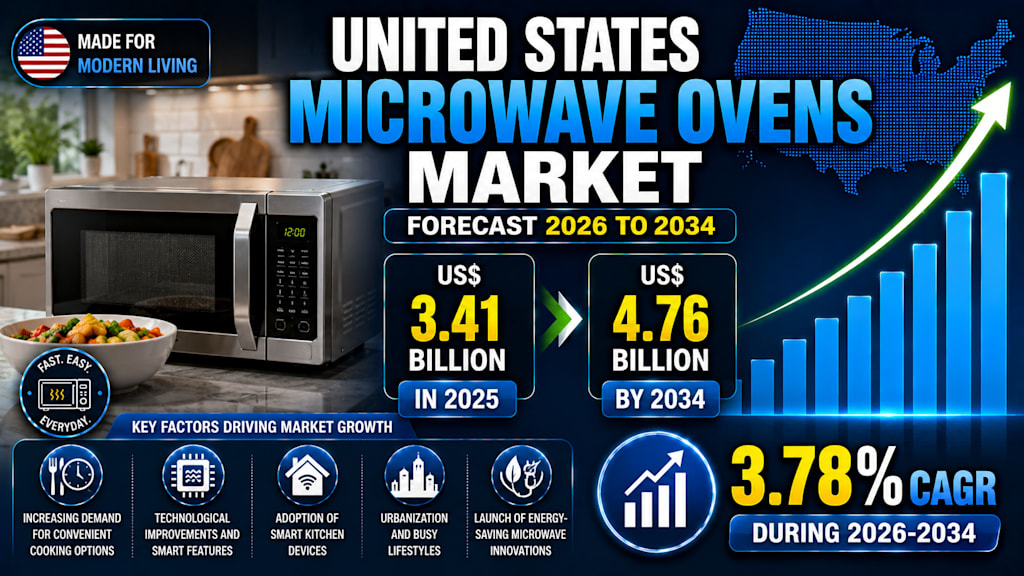
According to Renub Research, the United States Microwave Oven Market is projected to grow from US$ 3.41 billion in 2025 to US$ 4.76 billion by 2034, registering a compound annual growth rate (CAGR) of 3.78% from 2026 to 2034. Rising demand for convenient cooking solutions, technological advancements, smart kitchen integration, and urbanization are among the primary factors driving market growth.
As Americans continue embracing connected lifestyles and modern kitchen innovations, microwave ovens are evolving into intelligent appliances that offer far more than simple reheating capabilities.
The Microwave Oven Has Become a Household Necessity
Few kitchen appliances have achieved the widespread adoption enjoyed by microwave ovens.
Today, microwave ovens are found in the vast majority of American homes and have become essential tools for preparing meals quickly and efficiently. Their popularity stems from their ability to significantly reduce cooking times while providing convenient solutions for busy households.
Microwave technology works by generating electromagnetic waves that cause water molecules within food to vibrate rapidly, producing heat that cooks or warms the food.
This process allows consumers to prepare meals, defrost ingredients, and reheat leftovers in a fraction of the time required by conventional cooking methods.
As modern lifestyles continue accelerating, the practical benefits offered by microwave ovens remain highly attractive to consumers.
Convenience Continues to Drive Consumer Demand
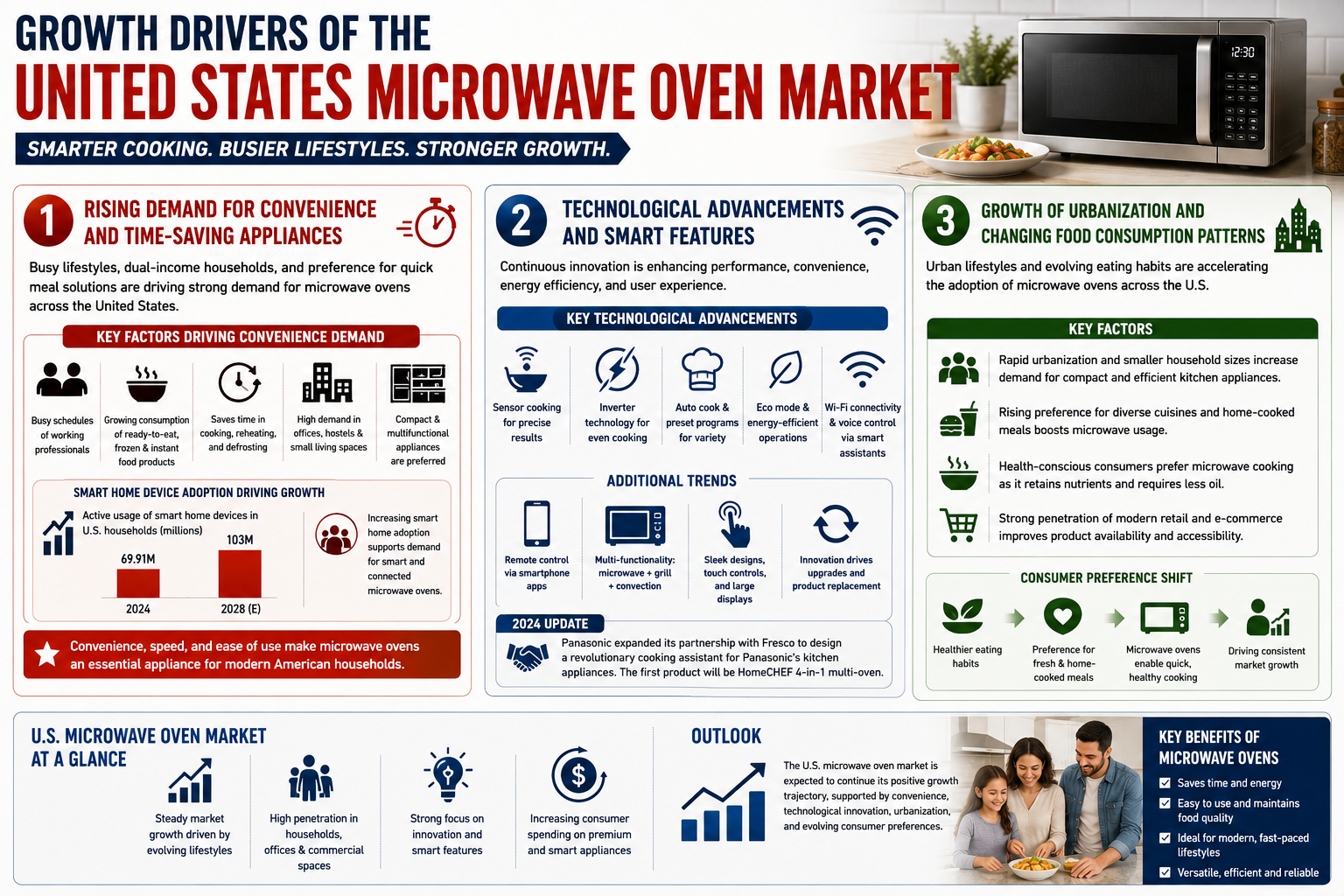
One of the most significant factors supporting growth in the microwave oven market is the increasing demand for convenience.
American consumers are leading increasingly busy lives. Working professionals, dual-income households, students, and urban residents often have limited time available for meal preparation.
Microwave ovens provide an efficient solution by enabling quick cooking and reheating without sacrificing convenience.
The popularity of frozen foods, ready-to-eat meals, and meal kits has further strengthened demand for microwave ovens.
Many of these products are specifically designed for microwave preparation, making the appliance a critical component of modern food consumption patterns.
The demand for convenience extends beyond homes. Offices, dormitories, small apartments, and shared living spaces also rely heavily on microwave ovens because of their compact size and ease of use.
As time-saving solutions remain a priority for consumers, microwave ovens are expected to maintain strong demand across multiple demographic groups.
Smart Technology Is Transforming Kitchen Appliances
Technology is reshaping the microwave oven industry in ways that were unimaginable just a decade ago.
Manufacturers are introducing products equipped with advanced features designed to improve user experience, cooking accuracy, and energy efficiency.
Modern microwave ovens frequently include technologies such as sensor cooking, inverter systems, automatic cooking programs, touch controls, and eco modes.
These innovations help ensure more consistent cooking results while reducing energy consumption.
The rise of smart home technology has introduced an entirely new category of connected microwave ovens.
Many models now feature Wi-Fi connectivity, smartphone integration, and voice-control capabilities compatible with virtual assistants.
Consumers can monitor cooking progress, adjust settings remotely, and receive notifications through connected devices.
This integration aligns with broader smart home trends that emphasize convenience, automation, and connected living.
As the number of smart homes continues growing across the United States, demand for intelligent kitchen appliances is expected to increase significantly.
Smart Home Adoption Is Creating New Opportunities
The growth of smart home ecosystems is providing a substantial boost to the microwave oven market.
Millions of American households already use connected devices such as smart speakers, thermostats, lighting systems, and security products.
Kitchen appliances are increasingly becoming part of this ecosystem.
Smart microwave ovens offer remote operation, recipe integration, personalized cooking programs, and enhanced energy management capabilities.
Consumers appreciate the convenience of controlling appliances through mobile applications or voice commands.
The increasing popularity of connected living environments is encouraging manufacturers to invest heavily in smart appliance innovation.
Future microwave ovens may incorporate artificial intelligence capable of automatically adjusting cooking settings based on food type, weight, and user preferences.
As smart homes become more common, microwave ovens will continue evolving into sophisticated digital cooking assistants.
Urbanization and Compact Living Support Market Growth
Urbanization is another important factor influencing microwave oven demand.
Large metropolitan areas such as New York, Los Angeles, Chicago, Houston, and San Francisco continue attracting residents seeking employment opportunities and modern lifestyles.
Urban living often involves smaller apartments and limited kitchen space.
Microwave ovens are particularly well suited to these environments because they provide powerful cooking capabilities while occupying minimal space.
Compact designs, multifunctionality, and ease of installation make microwave ovens attractive options for city dwellers.
The growing number of single-person households and students living independently further supports demand for space-efficient appliances.
As urban populations continue growing, microwave ovens are expected to remain essential components of compact modern kitchens.
Changing Food Habits Are Reshaping Consumer Preferences
Food consumption patterns in the United States continue evolving rapidly.
Consumers increasingly rely on frozen meals, convenience foods, meal delivery services, and ready-to-eat products.
Microwave ovens complement these trends by providing quick and efficient preparation methods.
At the same time, social media, online recipes, and international cuisine trends are encouraging consumers to experiment with new cooking techniques.
Manufacturers have responded by introducing microwave ovens capable of grilling, baking, roasting, steaming, and convection cooking.
These multifunctional appliances offer greater versatility than traditional microwave ovens, making them more attractive to modern consumers.
As food habits continue evolving, microwave ovens are adapting to meet increasingly diverse cooking needs.
Household Applications Continue to Dominate
The household segment remains the largest contributor to the United States microwave oven market.
Microwave ovens have become standard appliances in American homes due to their affordability, convenience, and versatility.
Consumers use microwave ovens daily for reheating leftovers, preparing frozen foods, cooking vegetables, and supporting a wide variety of meal preparation tasks.
Technological improvements continue encouraging replacement purchases as consumers upgrade older models with newer, feature-rich alternatives.
Smart microwave ovens are becoming particularly popular among younger and technology-oriented consumers.
Given the appliance's central role in everyday meal preparation, household demand is expected to remain strong throughout the forecast period.
Commercial Applications Are Expanding Rapidly
Beyond residential kitchens, microwave ovens play a critical role in commercial foodservice operations.
Restaurants, hotels, cafés, catering businesses, convenience stores, and cloud kitchens rely on commercial microwave ovens to improve efficiency and speed.
Commercial units are designed for heavy-duty operation and typically offer higher power output, faster cooking times, and enhanced durability.
The expansion of quick-service restaurants and food delivery services has further increased demand for commercial microwave equipment.
Businesses value microwave ovens because they enable rapid food preparation while maintaining consistency and productivity.
As the foodservice industry continues expanding, commercial applications will remain an important source of market growth.
Built-In Microwave Ovens Are Becoming Increasingly Popular
Consumer preferences are shifting toward premium kitchen designs that combine functionality and aesthetics.
Built-in microwave ovens have become particularly popular because they integrate seamlessly into cabinetry, creating a clean and modern appearance.
These appliances are especially common in newly constructed homes and renovation projects.
Homeowners appreciate their space-saving benefits and ability to contribute to a cohesive kitchen design.
Built-in models often feature advanced technologies and premium finishes that appeal to higher-income consumers.
As home remodeling activity continues across the United States, demand for built-in microwave ovens is expected to increase steadily.
Online Retail Is Transforming Consumer Purchasing Behavior
E-commerce has become a major distribution channel for microwave ovens.
Consumers increasingly prefer online shopping because it provides access to a wider selection of products, detailed specifications, customer reviews, and competitive pricing.
The convenience of home delivery and flexible return policies further supports online sales growth.
The COVID-19 pandemic accelerated adoption of digital shopping behaviors, and many of these habits have persisted.
Manufacturers and retailers continue expanding their online presence to reach consumers more effectively.
As digital commerce continues evolving, online channels are expected to play an increasingly important role in microwave oven distribution.
Challenges Facing the Market
Despite positive growth prospects, several challenges could affect market performance.
Health Perceptions and Consumer Concerns
Some consumers continue expressing concerns about microwave cooking, despite scientific evidence supporting its safety.
Growing interest in organic foods, fresh ingredients, and traditional cooking methods has encouraged some consumers to explore alternative appliances.
Manufacturers must continue educating consumers about microwave technology while developing products that support healthier cooking preferences.
Market Saturation and Competition
Microwave oven ownership is already widespread across the United States.
As a result, much of the market depends on replacement purchases rather than first-time buyers.
Competition among manufacturers remains intense, with brands competing on price, technology, design, and functionality.
Alternative appliances such as air fryers, toaster ovens, and multi-cookers also contribute to competitive pressures.
Regional Markets Continue to Thrive
California
California remains one of the largest microwave oven markets due to its large population, technological leadership, and strong demand for smart home products.
Texas
Rapid population growth, urbanization, and strong economic activity are supporting continued microwave oven demand across Texas.
New York
Space constraints and fast-paced urban lifestyles make microwave ovens particularly valuable in New York's residential and commercial markets.
Washington
Washington's technology-oriented consumers continue driving demand for advanced microwave ovens equipped with smart features and energy-efficient technologies.
Final Thoughts
Microwave ovens have evolved far beyond their original purpose of reheating food. Today, they represent an important intersection of convenience, technology, energy efficiency, and smart home innovation.
According to Renub Research, the United States Microwave Oven Market is expected to grow from US$ 3.41 billion in 2025 to US$ 4.76 billion by 2034, reflecting continued consumer demand for efficient cooking solutions and advanced kitchen technologies.
As smart homes become increasingly common and consumers continue prioritizing convenience, microwave ovens will remain central to modern kitchen design. The future of microwave cooking is no longer just about speed—it is about creating connected, intelligent, and versatile culinary experiences that fit seamlessly into everyday life.
About the Creator
Enjoyed the story? Support the Creator.
Subscribe for free to receive all their stories in your feed.
Comments
There are no comments for this story
Be the first to respond and start the conversation.