
Mexico’s Microgrid Revolution: How Decentralized Energy Is Transforming the Nation’s Power Future
As energy reliability concerns rise and renewable adoption accelerates, Mexico’s microgrid market is emerging as a critical solution for sustainable, resilient, and decentralized electricity generation.

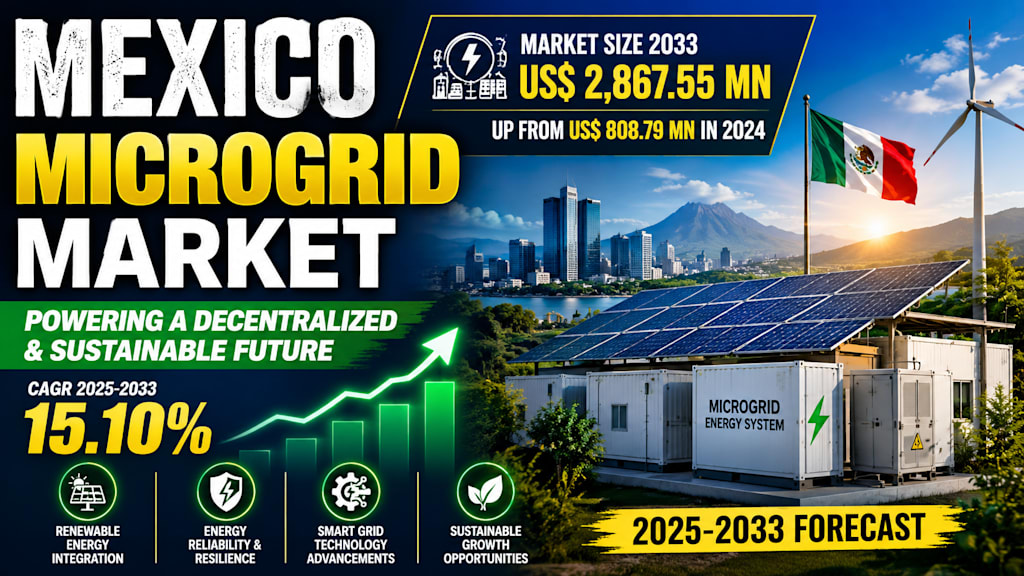
Mexico Microgrid Market Set for Remarkable Growth Through 2033
Mexico is entering a new era of energy transformation. As the country faces increasing electricity demand, aging infrastructure, climate-related disruptions, and ambitious sustainability goals, microgrids are rapidly becoming a cornerstone of its future power strategy.
According to Renub Research, the Mexico Microgrid Market is projected to grow from US$ 808.79 million in 2024 to US$ 2,867.55 million by 2033, expanding at a robust CAGR of 15.10% during 2025–2033. This impressive growth reflects the country's increasing focus on energy resilience, renewable integration, and decentralized power generation.
Microgrids are no longer viewed as niche energy systems. Today, they are becoming essential infrastructure for industries, commercial facilities, educational institutions, utilities, and remote communities seeking reliable and sustainable electricity solutions.
As Mexico advances toward a cleaner energy future, microgrids are positioned to play a transformative role in reshaping how electricity is generated, distributed, and consumed.
Understanding Microgrids and Their Importance
A microgrid is a localized energy network capable of operating independently or in coordination with the main power grid. These systems typically combine multiple energy sources such as solar panels, wind turbines, diesel generators, fuel cells, and battery storage technologies.
Unlike traditional centralized grids, microgrids offer localized control over electricity generation and consumption. They can continue supplying power even when the main grid experiences outages, making them highly valuable for critical infrastructure and remote locations.
The advantages of microgrids include:
Improved energy reliability
Reduced transmission losses
Enhanced renewable energy integration
Greater resilience during natural disasters
Lower operational costs over time
Increased energy independence
These benefits have positioned microgrids as a vital component of modern energy systems worldwide, and Mexico is increasingly embracing their potential.
Rising Energy Demand Is Driving Market Expansion
Mexico's growing population, expanding industrial base, and economic development have significantly increased electricity consumption across the country.
Meeting this rising demand solely through traditional centralized infrastructure presents major challenges. Expanding transmission networks requires substantial investments, lengthy development timelines, and ongoing maintenance costs.
Microgrids offer an alternative approach by generating electricity closer to where it is consumed. This decentralized model reduces pressure on national infrastructure while improving efficiency and reliability.
Government agencies, private businesses, and local communities are increasingly recognizing that microgrids can provide scalable and cost-effective solutions to address the country's evolving energy requirements.
Industrial and Commercial Sectors Are Seeking Energy Security
One of the strongest drivers behind Mexico's microgrid market growth is the growing need for uninterrupted power supply among industrial and commercial users.
Manufacturing facilities, mining operations, logistics centers, hospitals, and data centers depend heavily on continuous electricity availability. Even brief power interruptions can result in substantial financial losses, operational disruptions, and productivity declines.
Mexico experienced significant energy challenges in 2024 when peak electricity demand approached available generation capacity. Multiple regions experienced power disruptions, highlighting vulnerabilities within the national grid.
As a result, many organizations are investing in microgrid solutions that provide:
Backup power capabilities
Enhanced operational continuity
Reduced downtime risks
Better energy management
Long-term cost optimization
Businesses increasingly view microgrids as strategic assets rather than optional investments.
Renewable Energy Integration Is Accelerating Adoption
Mexico possesses exceptional renewable energy resources, particularly solar and wind power potential.
The country enjoys high solar irradiation levels across many regions, making solar photovoltaic systems highly effective. Meanwhile, favorable wind conditions in several states provide additional opportunities for clean electricity generation.
Microgrids have emerged as an ideal platform for integrating these renewable resources.
Hybrid microgrids that combine solar panels, wind turbines, and battery storage systems allow users to maximize renewable energy utilization while maintaining reliable power supply.
The Mexican government's energy transition initiatives and sustainability commitments are encouraging further deployment of renewable-powered microgrids. These systems support national goals by reducing dependence on fossil fuels and lowering greenhouse gas emissions.
As renewable technologies continue becoming more affordable, adoption rates are expected to accelerate further.
Rural Electrification Remains a Key Opportunity
Many remote regions throughout Mexico continue facing challenges related to reliable electricity access.
Extending traditional grid infrastructure to geographically isolated communities is often expensive and technically difficult. In many cases, microgrids provide a more practical alternative.
Renewable-powered microgrids can deliver clean and affordable electricity to rural populations without requiring extensive transmission infrastructure.
Benefits for remote communities include:
Improved healthcare services
Enhanced educational opportunities
Support for local businesses
Increased economic development
Better quality of life
As Mexico continues pursuing inclusive development strategies, rural microgrid projects are expected to receive increasing attention and investment.
Technological Innovations Are Strengthening Market Potential
Rapid advancements in energy technologies are significantly improving the economics and performance of microgrids.
Several innovations are contributing to market growth:
Advanced Energy Storage
Modern battery systems allow excess renewable energy to be stored and used when generation levels decline.
Lithium-ion batteries have become increasingly efficient, reliable, and affordable, helping overcome one of the primary limitations associated with renewable energy sources.
Smart Grid Technologies
Advanced monitoring systems, sensors, and automated controls enable real-time management of energy flows.
These technologies improve:
System efficiency
Load balancing
Demand forecasting
Fault detection
Operational reliability
Hybrid Energy Systems
Modern microgrids increasingly combine multiple generation technologies to create highly resilient energy ecosystems.
Hybrid configurations ensure continuous electricity availability even when individual energy sources experience fluctuations.
These technological developments are making microgrids more attractive across a broad range of applications.
Sustainability Goals Are Supporting Market Development
Environmental sustainability has become a major priority for governments, businesses, and consumers alike.
Organizations across Mexico are under increasing pressure to reduce carbon emissions and improve environmental performance.
Microgrids support these objectives by enabling greater use of renewable energy resources and reducing reliance on conventional fossil fuel generation.
Many companies are incorporating microgrids into broader sustainability strategies designed to:
Meet ESG commitments
Achieve carbon reduction targets
Improve environmental performance
Enhance corporate reputation
As sustainability considerations continue influencing investment decisions, demand for clean energy microgrids is expected to strengthen.
Key Challenges Facing the Industry
Despite strong growth prospects, several obstacles could influence market expansion.
High Initial Investment Costs
Developing a microgrid requires significant upfront capital investment.
Major cost components include:
Solar photovoltaic systems
Battery storage units
Control systems
Power electronics
Engineering and installation services
For smaller organizations and rural communities, securing adequate financing remains a challenge. Limited access to affordable funding can delay or prevent project implementation.
Regulatory Uncertainty
Policy consistency remains another important concern.
Investors generally prefer stable regulatory environments that provide long-term clarity regarding incentives, permitting processes, and energy market participation.
Any uncertainty surrounding energy regulations may affect investment decisions and project timelines. Continued policy support will be important for sustaining market momentum.
Market Segmentation Highlights
The Mexico Microgrid Market serves diverse applications and industries.
By Power Source
CHP
Natural Gas
Solar PV
Diesel
Fuel Cell
Others
Among these, Solar PV-based systems are expected to gain substantial momentum due to Mexico's abundant solar resources and declining technology costs.
By Application
Education
Government
Commercial
Utility
Defense
Others
Commercial and utility sectors are anticipated to remain major adopters due to their growing need for energy reliability and operational resilience.
By Connectivity
Grid Connected
Off Grid
Both categories will play important roles as organizations seek flexible energy solutions tailored to specific operational requirements.
By Grid Type
AC Microgrid
DC Microgrid
Hybrid
Hybrid microgrids are expected to attract increasing attention due to their versatility and ability to integrate multiple energy technologies effectively.
10 Recent Developments from Leading Microgrid Companies
1. ABB
ABB continues expanding its digital energy management portfolio, enhancing automation and microgrid optimization capabilities for industrial customers.
2. Siemens AG
Siemens has accelerated investments in smart infrastructure technologies designed to improve distributed energy system performance and resilience.
3. General Electric
GE continues developing advanced grid modernization solutions that support renewable integration and decentralized power networks.
4. Eaton Corporation
Eaton has strengthened its microgrid control technologies, helping customers improve energy efficiency and operational continuity.
5. Exelon Corporation
Exelon remains focused on grid modernization initiatives and distributed energy resource management strategies.
6. Honeywell International Inc.
Honeywell has expanded intelligent energy management platforms that improve monitoring and optimization of microgrid assets.
7. Schneider Electric SE
Schneider Electric continues introducing advanced EcoStruxure-based solutions for renewable-powered microgrid deployments.
8. Hitachi Energy Ltd.
Hitachi Energy is investing heavily in digital grid technologies that support flexible and sustainable energy systems.
9. ABB and Battery Integration Expansion
ABB has increasingly emphasized battery energy storage integration to enhance microgrid flexibility and reliability.
10. Siemens and Renewable Microgrids
Siemens continues supporting renewable microgrid projects worldwide through advanced automation and energy management technologies.
Final Thoughts
Mexico's microgrid market stands at the intersection of energy security, sustainability, and technological innovation. As industries seek greater resilience, communities demand reliable electricity, and policymakers pursue cleaner energy systems, microgrids are emerging as a critical solution.
With the market expected to climb from US$ 808.79 million in 2024 to US$ 2.87 billion by 2033, the sector presents significant opportunities for technology providers, investors, utilities, and renewable energy developers.
While challenges related to financing and regulation remain, ongoing technological advancements, renewable energy adoption, and increasing demand for energy independence are likely to keep the market on a strong growth trajectory.
For Mexico, microgrids are more than just an energy technology—they represent a pathway toward a cleaner, smarter, and more resilient power future.
About the Creator
Enjoyed the story? Support the Creator.
Subscribe for free to receive all their stories in your feed.
Comments
There are no comments for this story
Be the first to respond and start the conversation.