
Medical Ceramics Market Is Reshaping the Future of Implants and Regenerative Healthcare
Advanced biomaterials, 3D printing innovation, and growing demand for orthopedic and dental implants are accelerating the global medical ceramics industry.

Modern healthcare is increasingly relying on advanced biomaterials that can safely interact with the human body while delivering durability, strength, and long-term performance. Among the most important of these materials are medical ceramics — specialized biomaterials that are becoming essential in orthopedic implants, dental restorations, prosthetics, regenerative medicine, and surgical technologies.
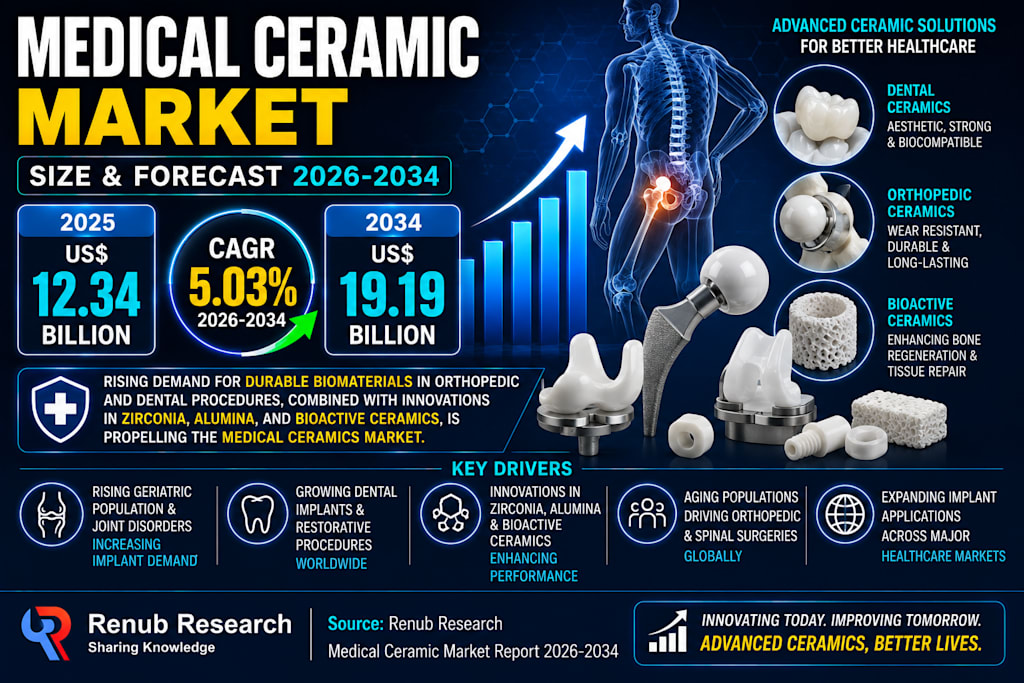
According to Renub Research, the Medical Ceramics Market is projected to grow from US$ 12.34 billion in 2025 to US$ 19.19 billion by 2034, expanding at a CAGR of 5.03% from 2026 to 2034. Market growth is being driven by increasing demand for orthopedic and dental implants, rising surgical volumes, innovations in zirconia and alumina ceramics, and expanding applications in regenerative healthcare.
As populations age and healthcare systems increasingly prioritize long-term implant performance and tissue compatibility, medical ceramics are becoming one of the foundational materials of modern restorative medicine.
Medical ceramics are becoming essential in advanced healthcare
Medical ceramics are highly engineered biomaterials designed specifically for healthcare applications. These materials are valued for their exceptional biocompatibility, corrosion resistance, durability, and ability to integrate safely with human tissues.
Medical ceramics are broadly categorized into bioinert, bioactive, and biodegradable ceramics, each serving different clinical functions. Common examples include zirconia, alumina, hydroxyapatite, and bioactive glass.
These materials are widely used in orthopedic implants, dental restorations, bone grafts, pacemaker components, prosthetics, and surgical instruments. Their non-reactive nature makes them highly suitable for long-term implantation inside the human body.
Advancements in ceramic processing technologies are also improving strength, wear resistance, and aesthetic quality, helping expand medical ceramics into increasingly complex therapeutic applications.
Orthopedic and dental implants are driving market demand
One of the strongest growth drivers for the medical ceramics market is the rising global demand for orthopedic and dental implants. Aging populations worldwide are experiencing higher rates of osteoarthritis, bone degeneration, tooth loss, and musculoskeletal disorders, increasing the need for durable implant materials.
Medical ceramics such as zirconia and alumina are increasingly preferred for hip replacements, knee implants, spinal devices, and dental crowns because they offer excellent strength, low wear rates, and superior tissue compatibility.
In dentistry, patient preference for natural-looking restorations is also accelerating ceramic adoption. Ceramic crowns, bridges, and implants closely resemble natural teeth while offering strong durability and stain resistance.
Minimally invasive surgical techniques and improvements in implant procedures are further increasing success rates, encouraging broader adoption of ceramic-based implants across healthcare systems.
Compared to many traditional metal implants, ceramics offer longer-lasting performance and improved aesthetics, making them increasingly attractive to both clinicians and patients.
Material science innovation is transforming the industry
Technological advancements in ceramic material science are significantly expanding the capabilities of medical ceramics. Manufacturers are developing advanced ceramics with enhanced mechanical strength, improved aesthetics, and superior biocompatibility.
Innovations such as toughened zirconia, porous ceramic scaffolds, and bioactive materials are creating new opportunities in orthopedics, regenerative medicine, and implantable medical devices.
One of the most important breakthroughs is the integration of additive manufacturing and 3D printing into ceramic production. 3D printing allows manufacturers to create highly customized implants tailored to a patient’s anatomy, improving surgical precision and clinical outcomes.
Advanced sintering technologies, nanotechnology applications, and precision machining are also helping reduce manufacturing defects while improving product consistency and reliability.
These innovations are enabling ceramics to be used in increasingly demanding applications, including load-bearing implants and advanced regenerative medicine systems.
Regenerative medicine is creating new opportunities
The growing field of regenerative medicine is becoming another major growth engine for the medical ceramics market. Bioactive ceramics such as hydroxyapatite and bioactive glass are playing increasingly important roles in tissue engineering, bone regeneration, and scaffold-based healing technologies.
These materials support osteoconduction and osteointegration, meaning they help the body naturally regenerate damaged bone and tissue.
The increasing prevalence of trauma injuries, sports injuries, osteoporosis, and degenerative bone conditions is accelerating demand for advanced bone graft substitutes made from ceramic materials.
Medical ceramics are also becoming important components in stem-cell therapies and next-generation scaffold engineering because they support cell attachment, growth, and tissue differentiation.
As research in regenerative healthcare continues expanding, ceramics are expected to play an even larger role in advanced biomedical applications.
High manufacturing costs remain a challenge
Despite their many advantages, medical ceramics remain expensive to manufacture. Advanced ceramics require highly specialized production processes involving high-temperature sintering, precision engineering, advanced quality control systems, and skilled labor.
These complex manufacturing requirements increase production costs and result in relatively expensive implants and prosthetic solutions.
Smaller healthcare providers and cost-sensitive regions may struggle to adopt premium ceramic-based technologies due to affordability concerns.
The cost of raw materials, research, and customization also contributes to financial pressure within the industry. These barriers may slow adoption in developing economies where healthcare budgets remain limited.
Brittleness continues to present engineering challenges
Although medical ceramics offer exceptional strength and durability, brittleness remains one of the industry’s biggest technical challenges. Under excessive impact or stress, ceramic implants may fracture, particularly in load-bearing orthopedic applications.
This risk can make some surgeons cautious about using ceramic implants in certain procedures where metal alternatives may provide greater flexibility.
Manufacturing defects and improper implant placement can further increase the risk of structural failure.
Material scientists continue working to improve ceramic toughness through advanced engineering techniques, but ensuring long-term mechanical reliability remains critical for broader adoption across complex surgical applications.
The United States remains a leading market
The United States medical ceramics market benefits from high healthcare spending, advanced surgical capabilities, and strong demand for orthopedic and dental procedures.
The country’s sophisticated medical device ecosystem and leading research institutions support continuous innovation in ceramic technologies and implant development.
Growing rates of joint disorders, cosmetic dental procedures, and chronic diseases continue driving adoption of ceramic implants and restorative solutions across the United States.
Advancements in personalized medicine and 3D-printed implants are also helping expand clinical applications for medical ceramics nationwide.
Germany combines engineering precision with biomaterial innovation
Germany remains one of Europe’s most influential medical ceramics markets due to its strong healthcare infrastructure and advanced engineering expertise.
The country’s aging population is increasing demand for orthopedic implants and dental restorations, while German research institutions continue advancing zirconia implants, regenerative medicine, and bioactive ceramic technologies.
Germany’s reputation for high-quality manufacturing and advanced biomaterial research helps maintain its leadership position in the global market.
China is rapidly expanding production and adoption
China’s medical ceramics market is growing rapidly due to healthcare modernization, urbanization, and rising demand for orthopedic and dental procedures.
The country is increasingly becoming a major manufacturing hub for medical ceramics, supported by investments in biomaterial research and advanced ceramic processing technologies.
Growing awareness of aesthetic dentistry and expanding healthcare access are also contributing to stronger demand for ceramic implants and restorative materials across the Chinese healthcare system.
Saudi Arabia is modernizing healthcare infrastructure
Saudi Arabia’s medical ceramics market is expanding as the country invests heavily in healthcare modernization and advanced medical technologies.
Increasing orthopedic disorders, dental conditions, and trauma injuries are driving demand for ceramic implants and prosthetic solutions.
The rise of private healthcare facilities, medical tourism, and international medical partnerships is also supporting broader adoption of advanced ceramic-based medical technologies throughout the region.
Recent innovations highlight rapid market evolution
Recent developments within the industry demonstrate how quickly medical ceramics technology is advancing.
In October 2024, KYOCERA Fineceramics Medical announced plans for a new production facility in Stuttgart focused on manufacturing medical-grade ceramic components for implants, including ceramic hip prosthesis ball heads.
In September 2024, Austrian 3D-printing specialist Lithoz launched the CeraFab System S320, an advanced ceramic 3D printer designed for medical implants and industrial applications.
These developments highlight the growing integration of advanced manufacturing technologies within the medical ceramics sector.
Competition among major players is intensifying
The global medical ceramics market includes several major companies competing across biomaterials, implant manufacturing, and advanced ceramic processing technologies. Key companies highlighted in the report include CeramTec, Kyocera Corporation, Morgan Advanced Materials, 3M, DSM, NGK Spark Plug, DePuySynthes, Zimmer Biomet, Straumann, and BioMérieux.
Competition is expected to intensify further as regenerative medicine, personalized implants, and advanced biomaterial applications continue expanding globally.
Final thoughts
The medical ceramics market is becoming increasingly important in the future of restorative and regenerative healthcare. According to Renub Research, the market’s projected growth from US$ 12.34 billion in 2025 to US$ 19.19 billion by 2034 reflects rising demand for durable, biocompatible, and high-performance medical materials.
Advancements in zirconia, alumina, bioactive ceramics, and 3D printing are enabling more personalized, reliable, and long-lasting implant solutions across orthopedics, dentistry, and regenerative medicine.
Although manufacturing costs and material brittleness remain important challenges, medical ceramics are expected to remain central to the next generation of implantable healthcare technologies and tissue-engineering innovations.
About the Creator
Enjoyed the story? Support the Creator.
Subscribe for free to receive all their stories in your feed.
Comments
There are no comments for this story
Be the first to respond and start the conversation.