
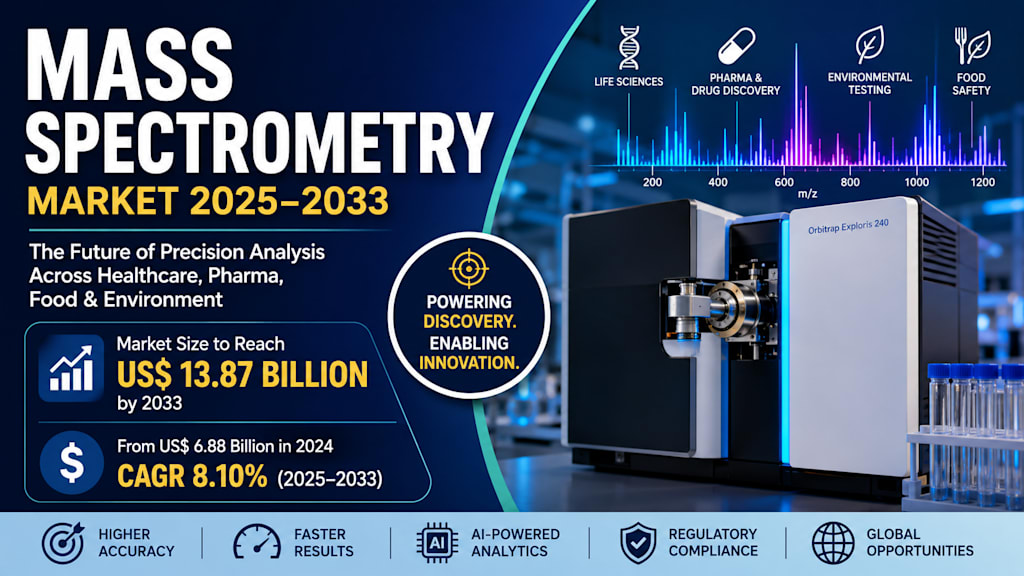
Mass Spectrometry Market to Reach US$ 13.87 Billion by 2033 as Advanced Analytics Transform Healthcare, Pharmaceuticals, and Environmental Testing
Growing demand for precision diagnostics, drug discovery, proteomics research, and regulatory compliance is accelerating adoption of mass spectrometry technologies worldwide.

The Science Powering Modern Discovery
In today's data-driven scientific landscape, the ability to identify and analyze molecules with extraordinary precision has become essential. Whether researchers are developing life-saving drugs, investigating environmental contaminants, or advancing personalized medicine, accurate molecular analysis is at the heart of innovation. One technology that continues to play a pivotal role across these applications is mass spectrometry.
Mass spectrometry has evolved from a specialized laboratory technique into one of the most important analytical technologies used across pharmaceuticals, biotechnology, clinical diagnostics, food safety, environmental monitoring, and academic research. Its ability to identify compounds, determine molecular structures, and measure trace substances with remarkable accuracy makes it indispensable for modern scientific investigation.
According to Renub Research, the global Mass Spectrometry Market is projected to increase from US$ 6.88 billion in 2024 to US$ 13.87 billion by 2033, expanding at a CAGR of 8.10% during 2025–2033. This growth reflects the increasing need for advanced analytical solutions capable of delivering precise, rapid, and reliable results across multiple industries.
Understanding the Importance of Mass Spectrometry
Mass spectrometry is an analytical technique that identifies and quantifies molecules by measuring their mass-to-charge ratio. During analysis, chemical compounds are ionized to create charged particles, which are then separated and detected according to their mass characteristics.
The resulting data provides valuable information about molecular composition, structure, and concentration. Scientists can use this information to identify unknown substances, analyze complex biological samples, detect contaminants, and verify product quality.
The technology's versatility has enabled its widespread adoption across diverse industries. In pharmaceuticals, it supports drug discovery and quality control. In healthcare, it assists in disease diagnosis and biomarker identification. Environmental laboratories use it to detect pollutants, while food manufacturers rely on it to ensure product safety and compliance.
As scientific research becomes increasingly sophisticated, demand for highly sensitive analytical tools continues to rise, creating significant opportunities for the mass spectrometry industry.
Rising Demand from the Pharmaceutical Industry
One of the strongest growth drivers for the mass spectrometry market is the expanding pharmaceutical and biotechnology sector.
Drug discovery has become increasingly complex, requiring researchers to identify molecular interactions, evaluate drug metabolism, and assess therapeutic effectiveness with unprecedented precision. Mass spectrometry enables scientists to perform these tasks efficiently and accurately.
Pharmaceutical companies rely heavily on mass spectrometry throughout the drug development lifecycle. From early-stage research and candidate screening to clinical trials and manufacturing quality control, the technology helps accelerate development timelines while ensuring regulatory compliance.
As pharmaceutical companies continue investing heavily in innovative therapies, including biologics, gene therapies, and personalized medicines, the need for advanced analytical technologies is expected to increase substantially.
Personalized Medicine Creates New Opportunities
Healthcare is undergoing a major transformation toward personalized treatment approaches. Rather than relying on generalized therapies, healthcare providers increasingly seek treatments tailored to individual patient characteristics.
Mass spectrometry plays a crucial role in this transition by enabling detailed analysis of proteins, metabolites, and biomarkers associated with specific diseases and patient populations.
Researchers can identify unique biological signatures that help predict disease progression, treatment response, and potential risks. This capability supports more effective treatment strategies while reducing unnecessary interventions.
The growing focus on precision medicine is expected to remain a key catalyst for market expansion throughout the forecast period.
Technological Innovations Are Driving Market Expansion
Technological advancement continues to reshape the mass spectrometry landscape.
Modern instruments offer higher sensitivity, improved resolution, faster processing speeds, and enhanced accuracy compared to previous generations. These improvements allow scientists to analyze increasingly complex samples with greater confidence.
The integration of artificial intelligence, machine learning, and automation is further revolutionizing laboratory workflows. Automated systems can process large datasets more efficiently, reducing manual effort and accelerating scientific discovery.
Miniaturization is another important trend. Portable and compact mass spectrometers are making advanced analysis accessible in field applications, clinical settings, and smaller laboratories.
These innovations not only improve performance but also expand the technology's applicability across new industries and use cases.
Proteomics and Metabolomics Research Fuel Growth
The expanding fields of proteomics and metabolomics are creating substantial demand for mass spectrometry technologies.
Proteomics focuses on studying proteins and their functions within biological systems, while metabolomics examines small molecules involved in cellular processes. Both disciplines generate vast amounts of complex data that require sophisticated analytical tools.
Mass spectrometry serves as a foundational technology in these research areas due to its ability to identify and quantify thousands of biological compounds simultaneously.
Researchers investigating cancer, neurological disorders, cardiovascular diseases, and rare genetic conditions increasingly depend on mass spectrometry to uncover new biomarkers and therapeutic targets.
As life science research continues to expand globally, demand for advanced mass spectrometry platforms is expected to grow correspondingly.
Environmental Monitoring Becomes a Priority
Environmental sustainability has emerged as a major global concern, prompting governments and organizations to strengthen monitoring programs.
Mass spectrometry enables laboratories to detect pollutants, pesticides, heavy metals, and emerging contaminants at extremely low concentrations. This capability is essential for protecting public health and ensuring environmental compliance.
Water quality testing, air pollution analysis, and soil contamination studies increasingly rely on mass spectrometry technologies to provide accurate and reliable results.
As environmental regulations become more stringent worldwide, laboratories are investing in advanced analytical systems capable of meeting evolving compliance requirements.
Food Safety Applications Continue to Expand
Food safety remains a critical issue for consumers, manufacturers, and regulators alike.
Mass spectrometry helps identify contaminants, pesticide residues, toxins, additives, and adulterants within food products. Its exceptional sensitivity allows laboratories to detect harmful substances even at trace levels.
Globalization of food supply chains has increased the complexity of food safety management, creating greater demand for sophisticated testing technologies.
Governments worldwide continue implementing stricter food safety standards, encouraging broader adoption of mass spectrometry systems among food testing laboratories and regulatory agencies.
Regulatory Compliance Drives Industry Adoption
Regulatory requirements represent another major factor supporting market growth.
Industries such as pharmaceuticals, biotechnology, food production, and environmental testing operate under strict quality and safety regulations. Compliance often requires highly accurate analytical methods capable of producing reproducible and validated results.
Mass spectrometry provides the precision necessary to meet these requirements while supporting documentation, auditing, and quality assurance processes.
As regulatory frameworks continue evolving, organizations increasingly view advanced analytical technologies as strategic investments rather than optional tools.
Challenges Limiting Market Growth
Despite strong growth prospects, several challenges continue to affect market adoption.
The high cost of mass spectrometry instruments remains a significant barrier, particularly for smaller laboratories, academic institutions, and organizations operating in developing regions.
Beyond initial acquisition costs, users must also invest in maintenance, calibration, consumables, and specialized personnel training. These expenses can limit accessibility for budget-constrained organizations.
Additionally, regulatory validation requirements can slow technology implementation. Organizations must often complete extensive documentation and testing procedures before deploying new analytical methods.
Addressing these challenges will be critical for expanding adoption across emerging markets.
Regional Market Outlook
United States
The United States remains one of the world's most advanced and influential markets for mass spectrometry. Strong pharmaceutical research activity, significant healthcare investments, and robust biotechnology innovation continue driving adoption.
Government funding programs and world-class research institutions further strengthen the country's leadership position.
India
India's mass spectrometry market is experiencing steady growth, supported by expanding pharmaceutical manufacturing, biotechnology research, and healthcare modernization initiatives.
Increasing focus on food safety, environmental monitoring, and clinical diagnostics is creating additional opportunities for technology adoption.
United Kingdom
The United Kingdom benefits from a highly developed scientific research ecosystem and strong pharmaceutical industry presence. Demand continues to grow across clinical diagnostics, forensic science, and environmental analysis applications.
United Arab Emirates
The UAE is emerging as an important regional market due to investments in healthcare infrastructure, pharmaceutical research, and advanced laboratory capabilities. Growing emphasis on quality assurance and regulatory compliance supports continued market development.
Competitive Landscape
Competition within the global mass spectrometry market remains intense as leading manufacturers focus on innovation, automation, and expanding application capabilities.
Major industry participants include:
Agilent Technologies
Bruker Corporation
Danaher Corporation
Hitachi Ltd.
JEOL Ltd.
LECO Corporation
PerkinElmer Inc.
Thermo Fisher Scientific
These organizations continue investing in research and development to enhance performance, improve usability, and strengthen market positioning.
10 Recent Developments in the Mass Spectrometry Industry
1. Thermo Fisher Scientific Launches Stellar Mass Spectrometer
Thermo Fisher Scientific introduced the Stellar Mass Spectrometer platform designed to improve translational omics research through enhanced sensitivity and faster throughput.
2. SCIEX and Mass Analytica Collaborate on AI Quantitation
SCIEX partnered with Mass Analytica to introduce AI-powered quantitation software that streamlines complex data analysis workflows.
3. Growing AI Integration Across Analytical Platforms
Manufacturers are increasingly incorporating artificial intelligence and machine learning into mass spectrometry systems to improve efficiency and accuracy.
4. Expansion of Portable Mass Spectrometry Solutions
Several vendors are introducing compact instruments suitable for field analysis and point-of-need testing.
5. Increased Investment in Omics Research
Life science organizations worldwide continue expanding proteomics and metabolomics programs supported by advanced mass spectrometry technologies.
6. Enhanced Automation Features Introduced
Laboratory automation capabilities are reducing manual intervention and increasing throughput across analytical workflows.
7. Improved High-Resolution Instruments Enter Market
Manufacturers continue launching high-resolution systems capable of analyzing increasingly complex biological samples.
8. Clinical Diagnostic Applications Expand
Mass spectrometry adoption is increasing within hospital laboratories and clinical diagnostic settings.
9. Environmental Testing Demand Accelerates
Regulatory agencies worldwide are increasing monitoring requirements for pollutants and contaminants.
10. Food Safety Laboratories Upgrade Infrastructure
Food testing organizations continue investing in advanced analytical technologies to meet stricter compliance standards.
Final Thoughts
Mass spectrometry has become one of the most influential analytical technologies in modern science. From accelerating drug discovery and advancing personalized medicine to protecting food supplies and monitoring environmental quality, its impact spans countless industries.
As technological innovations continue improving instrument performance and accessibility, adoption is expected to accelerate across both established and emerging markets. While challenges related to cost and regulatory complexity remain, the long-term outlook for the industry remains exceptionally strong.
With the global market expected to reach US$ 13.87 billion by 2033, mass spectrometry is positioned to remain a cornerstone technology supporting scientific discovery, healthcare advancement, and industrial innovation for years to come.
About the Creator
Enjoyed the story? Support the Creator.
Subscribe for free to receive all their stories in your feed.
Comments
There are no comments for this story
Be the first to respond and start the conversation.