
Managed Services Market 2026-2034: Cybersecurity Risks and Cloud Complexity Accelerate Global IT Outsourcing Demand
As businesses modernize operations, migrate to the cloud, and battle rising cyber threats, managed services providers are becoming critical partners in enterprise digital transformation.

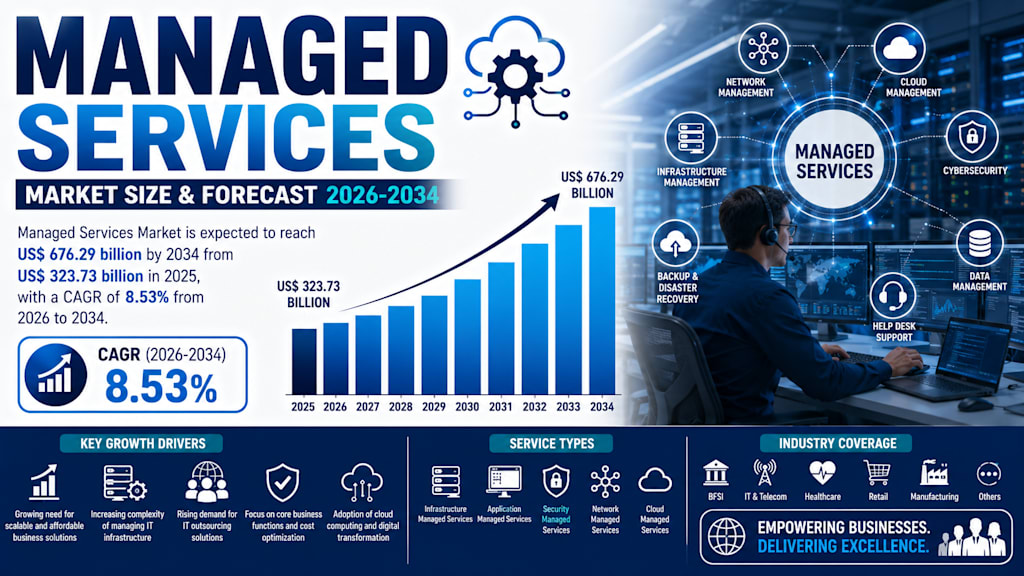
The global managed services market is entering a powerful expansion phase as enterprises increasingly outsource IT infrastructure, cybersecurity, cloud operations, and network management to specialized providers. According to Renub Research, the managed services market is projected to rise from US$ 323.73 billion in 2025 to US$ 676.29 billion by 2034, growing at a CAGR of 8.53% between 2026 and 2034.
The market’s growth reflects a broader shift in how organizations manage technology. Modern IT ecosystems are becoming too complex, expensive, and security-sensitive for many businesses to handle internally. As a result, enterprises are increasingly relying on managed service providers (MSPs) to oversee cloud infrastructure, cybersecurity operations, data backup, network monitoring, disaster recovery, and remote IT support.
Today, managed services are no longer viewed simply as outsourced technical support. They are evolving into strategic partnerships that help organizations improve efficiency, strengthen security, reduce operational costs, and accelerate digital transformation initiatives.
Why enterprises are rapidly adopting managed services
One of the strongest drivers behind the market’s growth is the increasing complexity of enterprise IT infrastructure. Organizations now operate across hybrid cloud environments, multi-cloud systems, remote work platforms, data-heavy applications, and highly interconnected networks.
Managing these systems internally requires advanced expertise, 24/7 monitoring capabilities, and continuous technology upgrades. Many businesses lack the resources or specialized talent needed to handle these environments effectively. Managed service providers fill this gap by offering scalable expertise, proactive maintenance, and continuous system monitoring.
Digital transformation is also accelerating demand. Businesses across healthcare, banking, retail, manufacturing, telecommunications, and government sectors are modernizing operations through cloud migration, automation, analytics, and AI integration. Managed service providers help enterprises deploy and maintain these technologies while minimizing operational disruption.
Another major factor is cost optimization. Instead of maintaining large in-house IT teams and infrastructure, organizations can access subscription-based managed services that provide predictable operational costs and flexible scalability. This model has become especially attractive for small and medium-sized enterprises seeking enterprise-grade IT capabilities without major capital investments.
Cybersecurity has become a defining growth driver
Cybersecurity concerns are now one of the biggest forces shaping the managed services market. The rise in ransomware attacks, phishing campaigns, data breaches, and sophisticated cybercrime operations has dramatically increased enterprise demand for managed security services.
Renub Research highlights alarming industry statistics showing that 343.3 million individuals were affected by 2,365 cyberattacks in 2023, while data breaches increased by 72% compared to the previous record year. The average cost of a data breach reached US$ 4.45 million, creating major financial and reputational risks for businesses.
Email-based attacks remain one of the most common entry points for cybercriminals. Around 35% of malware attacks were delivered through email in 2023, while 94% of firms reported experiencing email security issues. These risks are encouraging organizations to outsource cybersecurity operations to specialized providers capable of delivering continuous monitoring, threat detection, incident response, and compliance management.
Industries such as banking, healthcare, retail, and government are particularly dependent on managed security services because of strict regulatory requirements and the sensitive nature of customer data.
Cloud adoption is transforming the market
Cloud computing has become another major growth engine for managed services providers. Enterprises are increasingly moving workloads to hybrid and multi-cloud environments in order to improve flexibility, scalability, collaboration, and operational efficiency.
However, cloud migration introduces its own challenges, including infrastructure optimization, security management, compliance monitoring, and cost control. Managed service providers are stepping in to help organizations manage these increasingly complex cloud ecosystems.
The integration of AI, automation, predictive analytics, and remote monitoring technologies is also transforming how MSPs operate. Providers are using intelligent automation tools to proactively identify system issues, optimize workloads, improve response times, and reduce downtime.
This shift toward intelligent managed services is becoming one of the most important competitive differentiators within the industry.
Competition is becoming more intense
The managed services industry is witnessing rising consolidation activity as providers compete for larger enterprise contracts and specialized vertical expertise.
Renub Research notes that there were 182 consolidation transactions in Q2 2024 alone, as companies pursued acquisitions focused on AI capabilities, cybersecurity expertise, and industry-specific specialization.
Large global consulting firms, cloud hyperscalers, telecom providers, and pure-play MSPs are all competing aggressively for market share. While scale remains important, niche providers are finding opportunities in specialized areas such as clinical IoT security, edge infrastructure management, renewable energy monitoring, and compliance-focused cybersecurity services.
Investment in AI is becoming especially important. Accenture, for example, has reportedly developed a US$ 450 million generative AI pipeline aimed at automating code repair, policy compliance, and client service operations.
At the same time, partnerships between managed service providers and major cloud platforms are becoming critical for business growth. Strong certifications and ecosystem relationships with hyperscalers often provide access to co-selling opportunities, funding programs, and enterprise customer pipelines.
Data privacy and vendor dependency remain key challenges
Despite strong market growth, enterprises still face concerns when outsourcing critical technology operations to third-party providers.
One of the biggest concerns is data security and privacy protection. Businesses handing over sensitive customer records, financial data, and operational systems to managed service providers must trust those vendors to maintain strict security standards and regulatory compliance.
Any major breach involving a managed service provider can severely damage customer trust and business continuity. This is particularly sensitive in industries such as healthcare, banking, and government where regulatory oversight is strict.
Vendor dependency is another important issue. Organizations that rely heavily on a single managed services partner may face operational risks if service disruptions occur or if they later decide to migrate to another provider. Integration challenges involving legacy infrastructure, cloud systems, and multi-platform environments can also create technical complexity and migration costs.
United States remains a dominant market
The United States continues to lead the managed services industry due to strong enterprise digitalization, high cloud adoption, and growing cybersecurity concerns. Companies across healthcare, retail, manufacturing, banking, and government sectors are increasingly outsourcing cloud operations, cybersecurity management, and network monitoring to improve efficiency and reduce operational complexity.
The rise of hybrid work models and multi-cloud infrastructure is also increasing demand for managed IT support and remote monitoring services.
Renub Research cites data from Check Point showing that cyberattacks against U.S. organizations increased by 56% year over year in 2024, with firms experiencing an average of 1,300 attacks per week. Healthcare organizations saw attacks rise by 110%, while utilities experienced a 234% increase.
These escalating threats are significantly boosting demand for managed cybersecurity services.
India is becoming a major managed services hub
India’s managed services market is growing rapidly due to expanding digital transformation initiatives, strong cloud adoption, and the country’s large IT services ecosystem. Enterprises across banking, healthcare, telecommunications, manufacturing, and e-commerce sectors are increasingly adopting managed services to reduce infrastructure complexity and improve scalability.
India’s skilled technology workforce and competitive IT outsourcing capabilities are helping both domestic and international MSPs expand operations.
The country is also seeing rapid growth in managed security services as cybersecurity threats and compliance requirements increase. Small and medium-sized enterprises are increasingly turning to managed service providers to gain access to advanced technologies without major upfront investment costs.
Government initiatives supporting digital infrastructure and cloud adoption are further accelerating market growth across India.
UAE and UK markets continue expanding
The United Kingdom market is benefiting from increasing enterprise digitalization, remote work adoption, and cloud migration initiatives. Businesses are increasingly using subscription-based managed IT services to improve scalability, cybersecurity, and operational efficiency.
Meanwhile, the UAE market is witnessing steady growth due to smart city investments, cloud infrastructure development, and digital modernization initiatives across government, banking, healthcare, and energy sectors. Expansion of data centers and AI-enabled IT management solutions is also supporting demand for managed cloud and cybersecurity services.
recent company developments
Accenture secured a US$ 1.6 billion U.S. Air Force Cloud One task order in April 2025 to strengthen automated cloud governance and financial management systems.
Arrow Electronics launched a new AI platform for North American channel partners in March 2025 while expanding managed AI deployment services.
Accenture reported Q1 FY2025 revenue of US$ 17.7 billion, including an 11% rise in managed services revenue to US$ 8.6 billion.
Dell Technologies expanded 5G and edge partnerships with Ericsson and Nokia in November 2024 to strengthen edge-management capabilities.
IBM Corporation continued expanding sustainability-focused monitoring solutions that combine IT and operational technology data management.
Rackspace Technology strengthened hybrid multi-cloud and AI service capabilities through new cloud infrastructure partnerships.
Cisco Systems increased focus on AI-powered network monitoring and cybersecurity automation services for enterprise clients.
Microsoft Corporation expanded Azure-based managed cloud and security solutions to support enterprise digital transformation initiatives.
Tata Consultancy Services strengthened managed cloud, cybersecurity, and automation service offerings for global enterprises.
Verizon Business continued investing in managed network and security services to support hybrid workforce environments.
Final thoughts
The managed services market is evolving from a support-driven outsourcing model into a critical pillar of enterprise technology strategy. Businesses are increasingly relying on managed service providers not only for operational efficiency but also for cybersecurity resilience, cloud optimization, AI integration, and digital transformation leadership.
Renub Research’s forecast of US$ 676.29 billion by 2034 reflects how deeply managed services are becoming embedded in the future of global enterprise IT.
As cyber threats grow more sophisticated and IT ecosystems become more complex, demand for scalable, intelligent, and secure managed services will likely continue rising across every major industry worldwide.
About the Creator
Enjoyed the story? Support the Creator.
Subscribe for free to receive all their stories in your feed.
Comments
There are no comments for this story
Be the first to respond and start the conversation.