
Lithium-Ion Battery Market Set for Powerful Expansion as EVs, Clean Energy, and Electronics Fuel Global Demand
From electric vehicles to renewable energy storage, the lithium-ion battery market is entering a decisive growth phase, with strong opportunities across major regions and application segments.

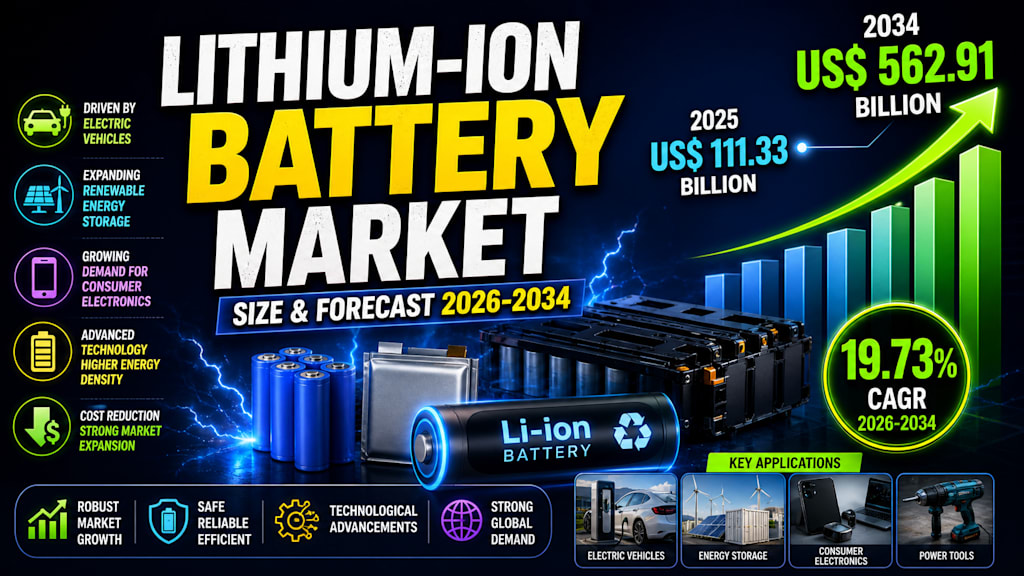
The lithium-ion battery market is moving into one of the most important growth cycles in modern energy and transportation history. According to Renub Research, the market is expected to rise from US$ 111.33 billion in 2025 to US$ 562.91 billion in 2034, expanding at a compound annual growth rate of 19.73% from 2026 to 2034. That growth outlook reflects more than a simple rise in battery demand; it points to a broader shift in how the world powers vehicles, devices, factories, homes, and grids.
At the center of this expansion is the lithium-ion battery itself: a rechargeable energy storage technology valued for its high energy density, light weight, long cycle life, and relatively low self-discharge. These qualities have made it indispensable across electric vehicles, consumer electronics, medical equipment, and stationary storage. In other words, lithium-ion batteries are no longer just a component in the background. They are becoming one of the core building blocks of the global clean-energy transition.
A Market Powered by Electrification
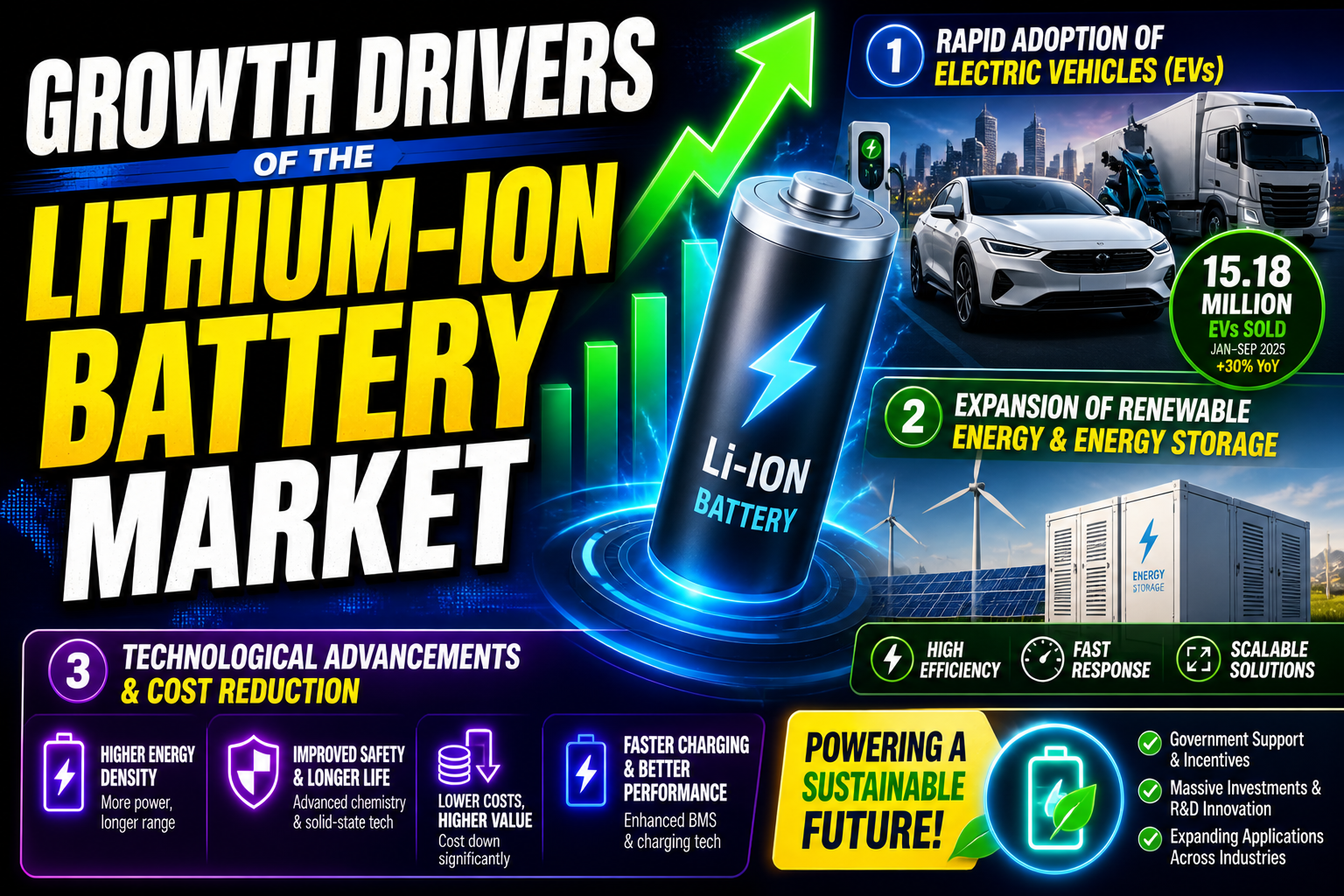
The strongest force behind the lithium-ion battery market is the rapid adoption of electric vehicles. EVs need batteries that can deliver long driving range, fast charging, durability, and improved cost efficiency, and lithium-ion technology continues to meet those requirements better than most alternatives. Governments around the world are also supporting the shift with incentives, emission rules, and cleaner transport targets, which is accelerating demand even further. Renub Research notes that electric buses, trucks, and two-wheelers are also contributing significantly to the market’s growth.
This momentum is visible in the numbers. The report highlights data from EV Volumes showing that the global EV market reached 15,183,434 sales between January and September 2025, a 30% year-on-year increase. That surge is important because every additional electric car, bus, or two-wheeler adds to battery demand not just today, but over the full lifecycle of the vehicle. Battery manufacturers are therefore scaling production capacity aggressively to keep pace with automakers and fleet operators.
The passenger EV segment remains the largest and fastest-growing application area. It is the part of the market where battery requirements are especially demanding, since drivers expect long range, safe performance, and shorter charging times. At the same time, electric buses are becoming a major growth opportunity because cities are replacing diesel fleets with cleaner alternatives. Public transport agencies want lower emissions, lower noise, and better long-term economics, and lithium-ion batteries are central to that transition.
Renewable Energy Is Turning Batteries into Grid Infrastructure
Another major growth driver is the expansion of renewable energy and energy storage systems. Solar and wind power are essential to decarbonization, but they are also variable by nature. That is where lithium-ion batteries have become highly valuable. Their fast response, high efficiency, and scalability make them ideal for stationary storage applications, where they help stabilize the power supply and balance energy availability.
This is one of the most overlooked reasons the lithium-ion battery market is becoming so important. It is no longer only about mobility. It is also about grid resilience, backup power, peak shaving, renewable integration, and energy security. As governments continue to support clean electricity systems, battery storage is becoming a strategic necessity rather than just a technical add-on. Renub Research’s report clearly positions stationary storage as a significant and growing application area.
Innovation is also strengthening this segment. The report mentions industry developments such as AI-based analysis platforms for renewable energy trends, reflecting how battery markets are increasingly linked to digital tools, forecasting systems, and smart infrastructure planning. This is a sign that the battery industry is evolving beyond chemistry and manufacturing into data-driven energy management.
Technology Improvements Are Changing the Economics
The lithium-ion battery market is not growing only because demand is rising. It is also growing because the technology itself is improving. Advances in battery chemistry, including high-nickel cathodes and solid-state research, are helping to increase energy density, improve safety, and extend lifespan. At the same time, large-scale manufacturing has reduced unit costs over the years, making lithium-ion batteries more commercially attractive in more sectors.
Fast-charging capability and better battery management systems are also pushing the market forward. These improvements matter because end users care not only about battery capacity but also about reliability, charging speed, and long-term performance. As costs decline and efficiency improves, lithium-ion batteries are expanding into more markets, including industrial equipment and logistics applications. The report also cites new product and capacity developments from companies such as The Raymond Corporation, showing how battery innovation is moving across the supply chain.
This technological progress is especially important because it changes the economic equation. Lower battery costs help make EVs more affordable, improve the business case for stationary storage, and support wider adoption in consumer devices and industrial fleets. As a result, lithium-ion batteries are becoming both a technology story and a market infrastructure story.
The Challenges That Could Shape the Next Decade
Despite its bright outlook, the lithium-ion battery market faces real constraints. One of the biggest is raw material supply. Lithium, cobalt, and nickel are essential inputs, but their availability is limited and their prices can be volatile. As EV and storage demand rises, these pressures can affect costs, sourcing strategies, and production planning. The mining side also brings environmental and geopolitical complications that manufacturers cannot ignore.
Safety remains another serious challenge. Lithium-ion batteries are highly capable, but they also carry risks such as overheating, thermal runaway, and fire, especially in large-scale applications. That means manufacturers must invest heavily in design, testing, thermal management, and safety standards. Those investments add cost, but they are necessary if the market wants to scale sustainably.
Recycling is the third major challenge. As more batteries reach end of life, the industry needs better collection, recovery, and reuse systems. Without strong recycling infrastructure, valuable materials may be lost and environmental pressure may increase. The report makes it clear that recycling solutions will be central to the next stage of market maturity.
Why Battery Chemistry Matters
The report also shows how the market is shaped by component and product-type segmentation. On the component side, cathodes play a critical role because they directly affect battery performance, energy density, cost, and safety. Common cathode materials include Lithium Cobalt Oxide, Lithium Iron Phosphate, Lithium Nickel Manganese Cobalt, and Lithium Nickel Cobalt Aluminum. Each chemistry serves different needs, which is why the market is not moving in one direction only.
Lithium Cobalt Oxide continues to be important for consumer electronics such as smartphones, tablets, and laptops, where high energy density is crucial. Meanwhile, electrolytic solutions remain a vital area because they help transport ions between electrodes and influence battery lifespan and safety. Research into solid and gel electrolytes shows how much room there still is for innovation inside the market itself.
Among product types, Lithium Iron Phosphate, Lithium Nickel Manganese Cobalt, Lithium Nickel Cobalt Aluminum Oxide, Lithium Manganese Oxide, and Lithium Titanate each occupy different niches. This diversity is important because the battery market is becoming more specialized. In EVs, stationary storage, and electronics, buyers want different combinations of cost, safety, range, and performance.
Regional Growth: The Market Is Global, but Not Uniform
The United States lithium-ion battery market is expected to see strong growth, supported by EV adoption, domestic manufacturing investments, clean-energy incentives, and large-scale storage projects. The report also highlights the role of gigafactory expansion and battery recycling innovation in strengthening the U.S. supply chain. This makes the American market not just a consumer of batteries, but a growing production hub as well.
The United Kingdom market is being shaped by decarbonization policy, zero-emission vehicle goals, renewable integration, and battery recycling activity. Domestic manufacturing is still developing, but research and circular-economy initiatives are helping the market mature. This is a good example of how policy and innovation can work together to support battery ecosystems.
India is another high-potential market. Rising demand for electric two-wheelers, electric cars, and energy storage systems is driving battery consumption, while new gigafactory projects and manufacturing investments are strengthening local capacity. Since India is still heavily dependent on imported battery technologies, the push toward domestic assembly and cell production could reshape the country’s battery future over the next decade.
Saudi Arabia is also emerging as a notable market, especially as the country diversifies its energy mix and expands renewables under Vision 2030. Battery storage is becoming central to solar integration and broader infrastructure development. The report points to large-scale storage milestones as evidence that the region is moving quickly from planning to deployment.
Industry Competition and Strategic Positioning
The lithium-ion battery market is also being shaped by major companies competing across chemistry, capacity, and geography. Renub Research notes key industry players including BYD Company Ltd., Samsung SDI Company Limited, GS Yuasa Corporation, Johnson Controls Inc., and Exide Technologies. Their activity suggests that the market is not just expanding; it is also becoming more strategically contested.
Competition is likely to intensify around supply chains, battery performance, recycling technologies, and localized manufacturing. That matters because the winners in this market will probably be the companies that can balance innovation with scale, safety, and cost control. In a market growing this quickly, execution will matter just as much as invention.
Final Thoughts
The lithium-ion battery market is entering a defining era. With the market projected to jump from US$ 111.33 billion in 2025 to US$ 562.91 billion in 2034, the next decade will be shaped by electrification, renewable energy storage, technology innovation, and supply-chain restructuring. The opportunity is enormous, but so are the challenges around raw materials, recycling, and safety.
What makes this market especially compelling is that it sits at the intersection of transportation, energy, electronics, and industrial modernization. That gives lithium-ion batteries a rare kind of relevance: they are not serving one trend, but several at once. For investors, manufacturers, policymakers, and technology leaders, this is a market that deserves close attention.
About the Creator
Enjoyed the story? Support the Creator.
Subscribe for free to receive all their stories in your feed.
Comments
There are no comments for this story
Be the first to respond and start the conversation.