
LED Modular Display Market Experiences Rapid Growth as Digital Transformation Fuels Demand for High-Impact Visual Communication
Rising adoption of digital advertising, expansion of smart city projects, and advances in display technology are driving strong growth across the global LED modular display industry.

The way businesses communicate with consumers has undergone a dramatic transformation over the past decade. Traditional static signage is increasingly being replaced by dynamic digital displays capable of delivering vivid, real-time content that captures attention and enhances engagement. From massive outdoor billboards and sports arenas to retail stores and corporate offices, LED modular displays have become a cornerstone of modern visual communication.
Organizations today operate in highly competitive environments where attracting and retaining audience attention is more challenging than ever. As a result, demand for bright, flexible, and high-resolution display solutions continues to rise across numerous industries. LED modular displays have emerged as one of the most effective technologies for meeting these evolving communication needs.
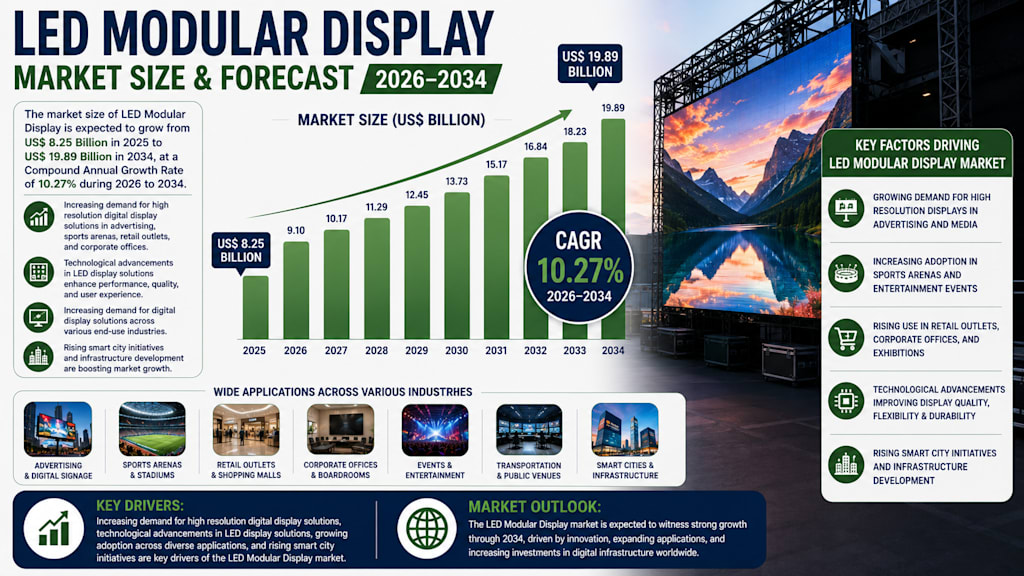
According to Renub Research, the global LED Modular Display Market is projected to grow from US$ 8.25 billion in 2025 to US$ 19.89 billion by 2034, expanding at a compound annual growth rate (CAGR) of 10.27% between 2026 and 2034. This impressive growth reflects increasing investment in digital advertising, smart infrastructure, entertainment venues, and next-generation display technologies.
Understanding LED Modular Displays
An LED modular display is a large digital screen composed of multiple smaller LED display modules connected together to form a seamless visual surface. Each module contains numerous light-emitting diodes (LEDs) that work together to display images, videos, animations, and real-time information.
One of the key advantages of modular displays is flexibility. Individual modules can be combined in various sizes, shapes, and configurations, allowing organizations to create custom display solutions tailored to specific environments and applications.
LED modular displays are widely recognized for their brightness, durability, energy efficiency, and ability to operate effectively in both indoor and outdoor settings. Their superior visibility makes them ideal for locations where clear communication and audience engagement are essential.
Today, these displays can be found in shopping malls, transportation hubs, sports stadiums, corporate offices, airports, entertainment venues, retail stores, conference centers, and public information systems worldwide.
Digital Advertising Is Driving Market Expansion
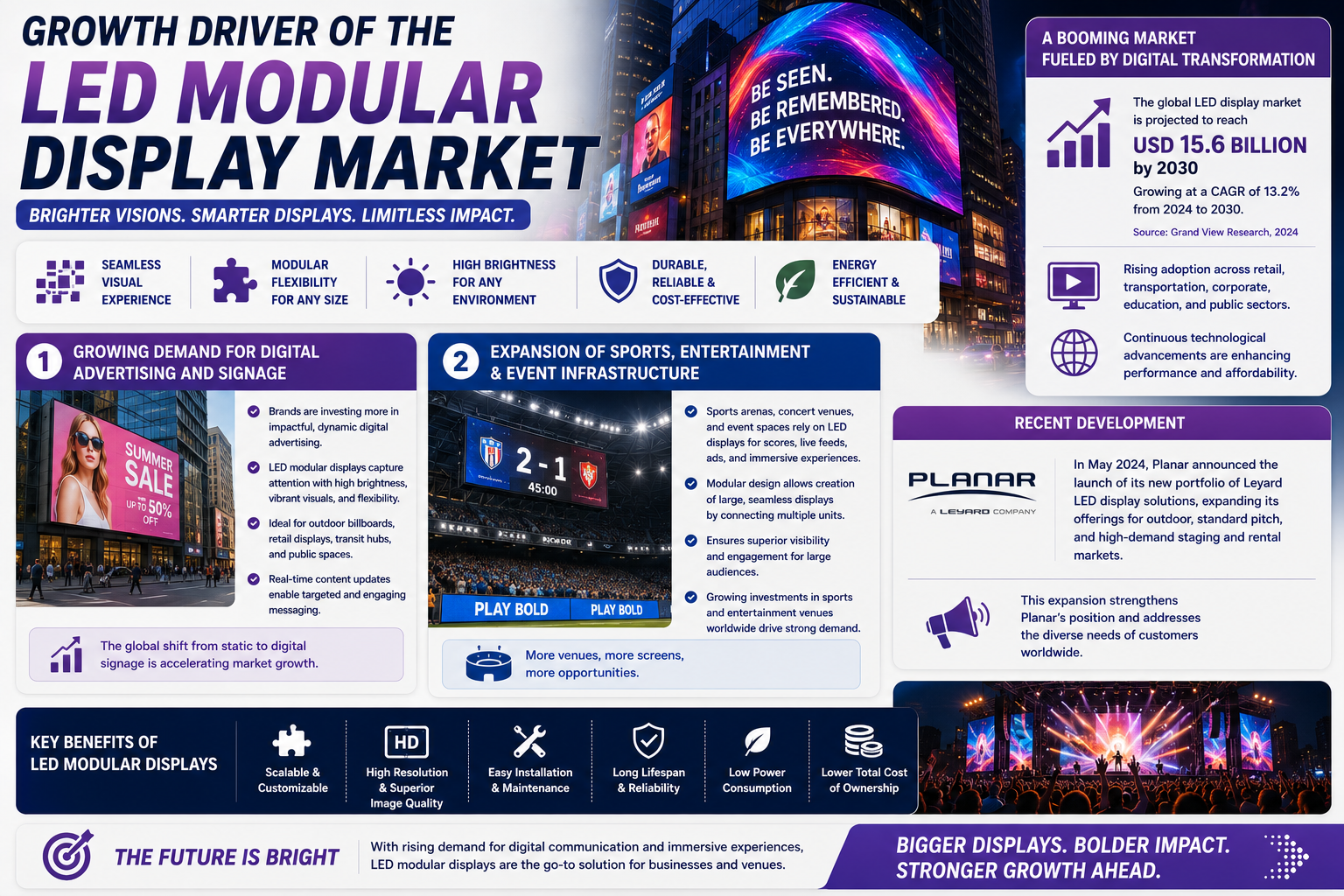
One of the most important growth drivers for the LED modular display market is the rapid expansion of digital advertising.
Businesses increasingly rely on visually engaging content to attract consumers in crowded marketplaces. Traditional print advertising often struggles to compete with the dynamic capabilities of LED displays, which can present videos, animations, promotions, live updates, and interactive content in real time.
Digital billboards and LED advertising screens offer advertisers greater flexibility because content can be updated instantly without physical replacement costs. This enables businesses to respond quickly to changing market conditions, promotional campaigns, and customer preferences.
The growing popularity of digital out-of-home (DOOH) advertising is creating substantial opportunities for LED display manufacturers and solution providers. As brands continue investing in high-impact visual marketing strategies, demand for modular LED displays is expected to increase significantly.
Sports and Entertainment Infrastructure Is Creating New Opportunities
The expansion of sports arenas, concert venues, and entertainment facilities is another major contributor to market growth.
Modern audiences expect immersive experiences that combine live action with high-quality visual content. Large-scale LED displays play a critical role in delivering instant replays, scoreboards, event information, advertisements, and interactive entertainment experiences.
Sports organizations and venue operators increasingly invest in advanced display technologies to enhance fan engagement while generating additional revenue through sponsorship and advertising opportunities.
Concerts, festivals, exhibitions, and live events also rely heavily on LED display systems because they provide exceptional visibility and can be configured for temporary or permanent installations.
The continued growth of the global sports and entertainment industries is expected to remain a significant catalyst for LED modular display adoption.
Technological Advancements Continue Improving Performance
Rapid innovation in display technology is significantly enhancing the capabilities of LED modular displays.
Modern systems offer higher resolutions, improved brightness, greater color accuracy, enhanced energy efficiency, and more reliable performance than earlier generations of display technology. These improvements are expanding the range of applications for LED solutions across commercial and public environments.
Manufacturers continue investing in research and development to improve pixel density, viewing angles, durability, and installation flexibility. As a result, LED displays now provide exceptional image quality even under challenging outdoor conditions where visibility is critical.
Advancements in manufacturing processes are also helping reduce production costs, making LED technology more accessible to businesses of various sizes.
The combination of improved performance and increasing affordability continues accelerating market adoption globally.
Smart City Initiatives Are Supporting Market Growth
Governments worldwide are investing heavily in smart city projects designed to improve urban infrastructure, communication systems, and public services.
LED modular displays play an important role within these initiatives by providing platforms for public information, transportation updates, emergency notifications, advertising, and community engagement.
Smart cities increasingly rely on digital signage networks to communicate with residents and visitors in real time. LED displays offer the flexibility and visibility necessary for these applications.
As urban populations continue growing and cities become more connected, demand for advanced display technologies is expected to rise significantly.
The integration of LED displays into smart infrastructure projects represents a long-term growth opportunity for the industry.
Indoor LED Modular Displays Gain Popularity
Indoor LED modular displays represent one of the fastest-growing segments within the market.
Businesses, educational institutions, transportation centers, shopping malls, hotels, and corporate offices increasingly use indoor LED displays for communication, branding, information sharing, and customer engagement.
These systems provide exceptional image clarity, vibrant colors, and high resolution even when viewed from short distances. Their lightweight construction and flexible installation options make them suitable for a wide range of indoor environments.
Organizations value indoor LED displays because they enhance customer experiences while enabling dynamic content management. Whether used for advertising, presentations, announcements, or entertainment, these displays offer substantial advantages over traditional signage solutions.
As digital transformation continues across commercial environments, indoor LED display demand is expected to remain strong.
Outdoor LED Displays Continue Dominating Advertising
Outdoor LED modular displays remain among the most visible and influential forms of digital communication.
Designed to withstand environmental conditions such as sunlight, rain, dust, and temperature fluctuations, these displays are commonly used for billboards, transportation systems, sports venues, and public information applications.
High brightness levels ensure visibility even under direct sunlight, making outdoor LED displays particularly effective for large-scale advertising and public communication.
The modular structure of these systems allows organizations to create displays of virtually any size, supporting highly customized installations.
As outdoor advertising continues shifting toward digital formats, demand for outdoor LED modular screens is expected to grow steadily.
Retail and Corporate Sectors Embrace Digital Communication
Retailers increasingly use LED displays to enhance customer engagement and improve shopping experiences.
Large digital screens enable businesses to showcase promotions, product information, videos, and brand messaging in visually compelling ways. Dynamic content often attracts more attention than traditional static signage, helping retailers increase foot traffic and sales.
Corporate organizations also utilize LED displays for internal communications, presentations, video conferencing, and event management. Modern workplaces rely on advanced visual communication tools to improve collaboration and information sharing.
As businesses continue modernizing customer-facing and internal communication systems, LED modular displays are becoming increasingly important components of digital transformation strategies.
Regional Markets Continue Expanding
United States
The United States remains one of the largest and most technologically advanced markets for LED modular displays. Strong demand from retail, entertainment, transportation, and corporate sectors continues driving adoption. Investments in digital advertising and large-scale display installations further support market growth.
United Kingdom
The United Kingdom is experiencing increasing demand for LED displays across retail, transportation, public information, and event management applications. Businesses are embracing digital communication technologies to improve customer engagement and operational efficiency.
India
India represents one of the fastest-growing markets due to rapid urbanization, infrastructure development, and expanding digital advertising networks. Shopping malls, entertainment venues, corporate offices, and sports facilities increasingly utilize LED display technologies to enhance communication and customer experiences.
Saudi Arabia
Saudi Arabia's ongoing investments in tourism, entertainment, smart cities, and commercial infrastructure are creating substantial opportunities for LED display manufacturers. Large-scale development projects continue driving demand for advanced digital communication solutions.
Challenges Facing the Industry
Despite strong growth prospects, the LED modular display market faces several challenges.
One of the most significant barriers is the high initial cost associated with installation. Large-scale display systems often require substantial investments in hardware, software, infrastructure, and technical expertise.
Maintenance and repair costs can also be considerable, particularly for outdoor installations exposed to harsh environmental conditions. Individual module failures may require specialized servicing to maintain display performance.
Technical complexity presents another challenge. Proper installation, calibration, content management, and system integration often require skilled personnel and ongoing support.
Manufacturers continue developing solutions designed to reduce costs, simplify maintenance, and improve reliability, helping address these challenges over time.
Market Forecast: Strong Growth Through 2034
According to Renub Research, the global LED Modular Display Market is expected to increase from US$ 8.25 billion in 2025 to US$ 19.89 billion by 2034, representing a CAGR of 10.27% during the forecast period from 2026 to 2034. Growth will be driven by expanding digital advertising networks, increasing investments in sports and entertainment infrastructure, technological advancements, and the continued development of smart city initiatives.
The market's outlook highlights the growing importance of advanced visual communication technologies across modern economies.
Final Thoughts
The LED modular display industry is experiencing rapid growth as businesses, governments, and organizations increasingly rely on digital communication to engage audiences and share information. The technology's flexibility, brightness, durability, and visual impact make it an essential tool for advertising, entertainment, transportation, and corporate communication.
With Renub Research forecasting growth from US$ 8.25 billion in 2025 to US$ 19.89 billion by 2034, the market is positioned for substantial expansion. Ongoing innovation in display technology, smart infrastructure development, and digital transformation initiatives will continue driving demand worldwide.
About the Creator
Enjoyed the story? Support the Creator.
Subscribe for free to receive all their stories in your feed.
Comments
There are no comments for this story
Be the first to respond and start the conversation.