
Layer 2 Scaling: Making Blockchains Actually Fast
Understanding How Layer 2 Networks Improve Blockchain Speed and Reduce Costs

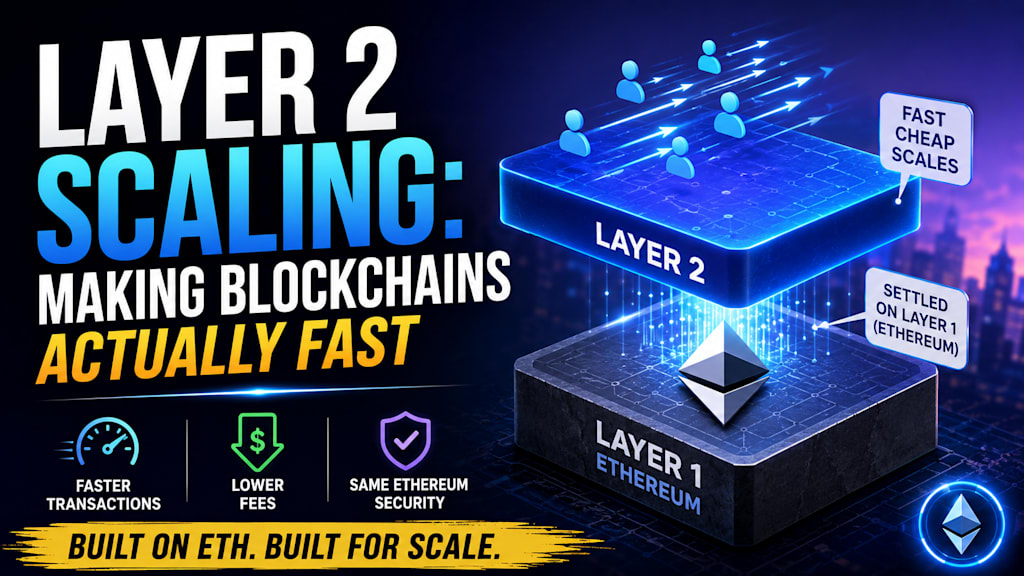
Blockchain technology promised to revolutionize finance, ownership, and trust. But somewhere between the paper and the real world, it ran into a wall. It was a very slow and expensive wall. If you've ever tried to send a transaction on Ethereum during peak hours and watched your gas fees balloon past the value of what you were sending, you've felt this problem firsthand. Layer 2 scaling is the answer the industry has been building toward, and it's finally delivering.
The Problem: Blockchains Are Deliberately Slow
This might surprise you: blockchains aren't slow by accident. They're slow by design.
A blockchain achieves trustlessness by requiring every node in the network to independently verify every transaction. The more nodes verifying, the more decentralized and secure the network. But that consensus process takes time. Ethereum's base layer (Layer 1) processes roughly 15–30 transactions per second. Visa takes care of about 24,000. No, that gap is not a bug. It's just the price of being decentralized.
The challenge, then, isn't to "fix" Layer 1. It's to build on top of it in a way that inherits its security without inheriting its bottlenecks. That's exactly what Layer 2 networks do.
What Is Layer 2?
Layer 2 (L2) refers to a secondary framework built on top of an existing blockchain (Layer 1) that processes transactions off-chain and then settles the final state back on-chain. Think of it like a busy restaurant: instead of the head chef personally plating every dish (Layer 1), a team of sous chefs handles the bulk of the preparation and only brings the final plates to the pass (Layer 2 settling to L1).
The result? Faster throughput, dramatically lower fees, and the same underlying security guarantees.
The Main Approaches
Rollups are currently the dominant L2 technology. They bundle hundreds or thousands of transactions together, execute them off-chain, and post a compressed summary back to Layer 1.
There are two flavors:
- Optimistic Rollups (like Arbitrum and Optimism) assume transactions are valid by default and only run computation if someone raises a fraud challenge. They're simpler to build but have a withdrawal delay of several days.
- ZK Rollups (like zkSync and Starknet) use zero-knowledge proofs to cryptographically verify every batch of transactions. Withdrawals are near-instant, but generating proofs is computationally intensive. As ZK proof technology matures, this approach is increasingly seen as the long-term winner.
State Channels allow two parties to transact back and forth off-chain indefinitely, only touching the blockchain to open and close the channel. The Bitcoin Lightning Network uses this model. It's extremely efficient for repeated bilateral payments but less suited for complex smart contract interactions.
Plasma was an earlier approach that created child chains anchored to the main chain. While mostly superseded by rollups, elements of its design live on in modern solutions.
Real-World Performance: The Numbers Matter
The impact of L2 adoption is tangible. On Arbitrum One, transaction fees regularly sit below $0.05. On zkSync Era, simple transfers cost fractions of a cent. Compare that to Ethereum mainnet during congestion, where fees of $20–50 were common in 2021.
Transaction speeds have also transformed. Arbitrum and Optimism confirm transactions in under two seconds. Base (Coinbase's L2) has processed millions of daily transactions with the kind of UX that would feel familiar to users of any fintech app.
The Ethereum Price Prediction Angle: Why L2 Success Matters to Investors
Any serious ethereum price prediction has to account for the role of Layer 2 networks. Here's why: L2s don't compete with Ethereum — they depend on it. Every rollup pays fees to post data to Ethereum's base layer, which creates sustained demand for ETH as the settlement currency. As L2 activity grows, so does the economic activity secured by and settled on Ethereum.
Some analysts argue that a robust L2 ecosystem could actually suppress short-term ETH fee revenue by moving activity off-chain. The stronger ethereum price prediction thesis, on the other hand, says that L2 adoption greatly increases Ethereum's total addressable market, adding millions of users who would never have put up with $30 gas fees. This gives ETH long-term value as the reserve asset of a thriving multi-chain economy.
Conclusion
Layer 2 scaling is no longer a theoretical solution to a theoretical problem. It's live, it's working, and it's processing billions of dollars in transactions daily. The blockchain that once charged you $40 to swap tokens now has an ecosystem where you can do the same for less than a penny, with the same ultimate security guarantees. The era of blockchains being "too slow for real use" is ending. Layer 2 is how we get to the other side.
About the Creator
Muhammad Irfan Afzal
I write clear, practical, engaging articles on technology, online safety, and modern digital life. My goal is to help readers understand complex. My aim to provide value, awareness, and real-world solutions for everyday digital challenges.
Enjoyed the story? Support the Creator.
Subscribe for free to receive all their stories in your feed.
Comments
There are no comments for this story
Be the first to respond and start the conversation.