
Latin America Non-Lethal Weapons Market Set for Strong Growth Amid Rising Security Concerns
Governments Across Brazil, Mexico, and Argentina Increase Investment in Safer Crowd-Control Technologies as the Market Approaches USD 653 Million by 2033

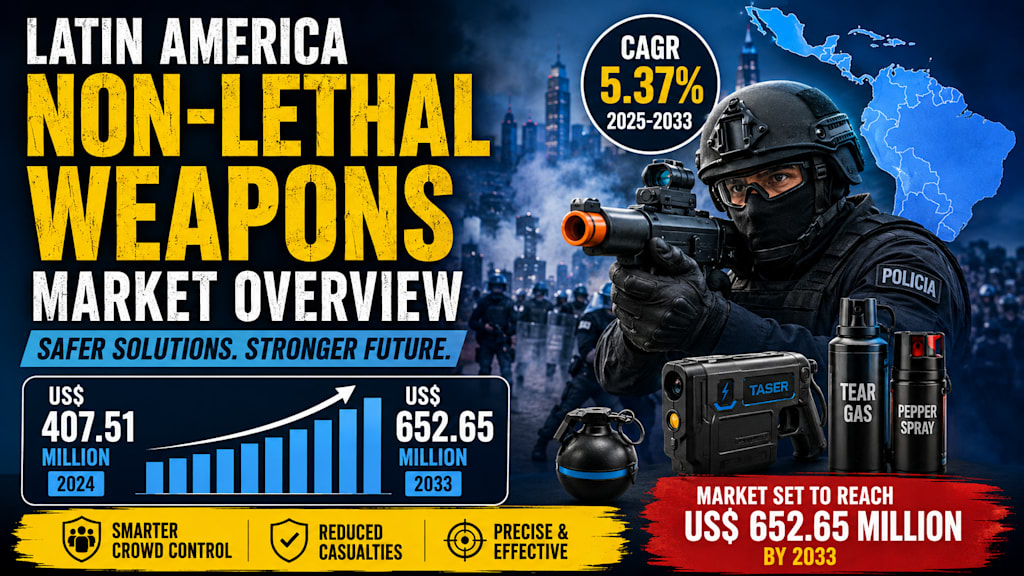
The Latin America non-lethal weapons market is entering a new era of expansion as governments across the region focus on modernizing law enforcement while reducing casualties during protests, riots, and urban security operations. Rising crime rates, increasing political unrest, and stronger human rights awareness are encouraging security agencies to adopt safer alternatives to lethal force.
According to Renub Research, the Latin America Non-Lethal Weapons Market is expected to grow from US$ 407.51 million in 2024 to US$ 652.65 million by 2033, expanding at a CAGR of 5.37% during the forecast period from 2025 to 2033.
From tear gas and rubber bullets to electroshock devices and acoustic deterrent systems, non-lethal technologies are rapidly becoming a central component of modern policing strategies across Latin America.
Why Non-Lethal Weapons Are Becoming Essential in Latin America
Latin America continues to face significant public safety challenges. Countries including Brazil, Mexico, Venezuela, and Argentina frequently experience political demonstrations, prison riots, gang violence, and organized crime activity. These situations place tremendous pressure on law enforcement agencies tasked with maintaining public order while avoiding unnecessary civilian casualties.
Traditional military-grade force has increasingly come under scrutiny due to human rights concerns and public criticism. As a result, governments are shifting toward non-lethal alternatives that can control dangerous situations without causing permanent harm.
Non-lethal weapons provide authorities with more flexible response options during high-risk scenarios. These systems are specifically designed to incapacitate or disperse individuals temporarily rather than inflict fatal injuries.
Popular non-lethal weapon categories include:
Tear gas and pepper sprays
Rubber bullets
Stun grenades
Electroshock devices
Acoustic crowd-control systems
Directed energy technologies
The growing use of these tools reflects a wider transformation in public safety strategies throughout the region.
Growing Urbanization Is Driving Market Demand
Urbanization is playing a major role in shaping the future of the Latin American non-lethal weapons market.
As major cities across Brazil, Mexico, Colombia, and Argentina continue to expand rapidly, law enforcement agencies face increasingly difficult crowd-management situations. High population density raises the risk of civilian casualties whenever force is used during riots, demonstrations, or emergency situations.
In crowded urban settings, authorities require technologies capable of neutralizing threats without triggering widespread harm. Non-lethal weapons are increasingly viewed as the safest operational solution in these environments.
Large sporting events, political gatherings, labor protests, and social movements have become more common across metropolitan regions. Governments are therefore investing heavily in safer riot-control solutions that reduce long-term injuries while preserving public order.
The need for controlled escalation tactics is expected to remain one of the strongest growth drivers for the market throughout the next decade.
Rising Crime Rates Continue to Pressure Security Agencies
Latin America has some of the world’s highest urban crime rates, and this ongoing security challenge continues to fuel demand for advanced policing technologies.
According to international security organizations, urban crime rates in South American cities increased sharply between 2020 and 2023. Organized criminal groups, drug trafficking networks, and violent gangs continue to create instability across many regions.
Law enforcement agencies are increasingly deploying non-lethal systems during:
Anti-gang operations
Border patrol activities
Prison security
Riot control
Public demonstrations
Tactical arrests
Unlike conventional firearms, non-lethal systems provide officers with tools to de-escalate confrontations while minimizing fatalities.
This approach not only improves operational flexibility but also helps governments address growing criticism regarding police brutality and excessive use of force.
Technology Is Reshaping Modern Crowd-Control Systems
Technological innovation is dramatically improving the effectiveness and precision of non-lethal weapons across Latin America.
Modern systems now include:
Smart targeting technologies
Acoustic deterrent devices
Improved electroshock systems
Precision kinetic projectiles
Directed-energy crowd-control solutions
These advancements reduce unintended injuries while improving operational accuracy for law enforcement officers.
New-generation systems are specifically engineered to provide proportional responses during rapidly evolving tactical situations. Many devices now incorporate advanced sensors, improved range capabilities, and safer impact mechanisms.
The expansion of domestic manufacturing across Latin America is also helping accelerate market growth. Local suppliers are increasingly developing cost-effective solutions designed specifically for regional operational needs.
This shift toward localized production is reducing dependence on imports while improving affordability for government agencies facing budget limitations.
Brazil Emerges as a Major Market Leader
Brazil represents one of the largest and fastest-growing markets for non-lethal weapons in Latin America.
The country has faced growing challenges related to urban violence, prison riots, organized crime, and mass public demonstrations. Brazilian security agencies are therefore accelerating investments in safer crowd-control technologies.
Law enforcement agencies throughout Brazil are integrating non-lethal systems into their daily operational strategies, especially in densely populated urban areas.
Tear gas launchers, rubber bullets, electroshock devices, and acoustic deterrents are becoming increasingly common during large-scale security operations.
Brazil’s focus on balancing public safety with human rights accountability is expected to continue driving strong market demand over the next several years.
Government modernization initiatives are also creating opportunities for international defense contractors and local technology suppliers operating within the non-lethal weapons sector.
Mexico Expands Adoption of Non-Lethal Security Solutions
Mexico is another major growth market within the region.
The country continues to battle organized crime, cartel violence, civil unrest, and public security challenges. These conditions have increased pressure on police and military forces to adopt safer intervention methods.
Mexican security agencies are increasingly deploying non-lethal technologies for crowd management and urban tactical operations.
Authorities are focusing on tools that can reduce fatalities while improving operational control in volatile environments.
The transition toward more humane policing strategies is expected to accelerate as public awareness regarding human rights and police accountability continues to rise.
As modernization programs expand, Mexico is likely to remain one of the region’s most important markets for non-lethal defense technologies.
Private Security Sector Adds New Growth Opportunities
The rapid growth of private security services across Latin America is creating another major revenue stream for non-lethal weapon manufacturers.
Private security firms are increasingly responsible for protecting:
Commercial properties
Residential communities
Industrial facilities
Transportation infrastructure
Public events
As security threats evolve, private operators are investing heavily in non-lethal systems that allow personnel to manage risks without resorting to deadly force.
Industry reports suggest that private-sector spending on non-lethal security equipment has increased substantially over recent years.
Training programs for private security personnel are also expanding rapidly, creating additional demand for electroshock devices, chemical deterrents, and tactical protection systems.
This growing commercial market is expected to become a major contributor to long-term industry growth across the region.
Challenges Continue to Impact Market Expansion
Despite strong growth potential, the Latin America non-lethal weapons market still faces several important challenges.
Public Trust and Human Rights Concerns
Many citizens across the region remain skeptical about police use of force due to historical cases involving abuse and excessive violence.
Even though non-lethal weapons are designed to reduce fatalities, improper usage can still cause severe injuries. Without clear regulations and accountability systems, public criticism may continue to limit adoption in some areas.
Governments must therefore focus on:
Officer training
Transparency
Oversight mechanisms
Human rights compliance
Community engagement
Building public trust will remain critical for the long-term success of non-lethal policing strategies.
Infrastructure and Budget Limitations
Many law enforcement agencies in rural and economically disadvantaged regions lack the infrastructure needed to support advanced non-lethal technologies.
Challenges include:
Limited maintenance capabilities
Poor storage facilities
Weak communication systems
Inadequate training resources
Budget constraints
These operational barriers can reduce the effectiveness of non-lethal systems and slow broader market adoption.
However, ongoing modernization programs and international defense partnerships are expected to gradually improve infrastructure conditions across the region.
Competitive Landscape Continues to Intensify
The Latin American non-lethal weapons industry includes both international defense contractors and regional manufacturers competing for market share.
Major companies operating in the market include:
Byrna Technologies Inc.
General Dynamics Corporation
Moog Inc.
Raytheon Technologies Corporation
Rheinmetall AG
Textron Inc.
Combined Systems Inc.
Safariland Group
Axon Enterprise Inc.
Condor Tecnologias Não-Letais
These companies are investing heavily in innovation, product expansion, and strategic partnerships to strengthen their regional presence.
The market is expected to witness increasing competition as governments prioritize advanced public safety solutions over traditional force-based methods.
10 Recent Developments in the Non-Lethal Weapons Industry
1. Byrna Technologies Expands into Argentina
In July 2024, Byrna Technologies announced that the City of Buenos Aires ordered 500 Byrna SD launchers for police use.
2. Axon Enterprise Improves Taser Technology
Axon introduced upgraded taser systems with enhanced targeting and accountability tracking features.
3. Rheinmetall Advances Crowd-Control Systems
Rheinmetall expanded research into precision non-lethal ammunition for urban tactical operations.
4. Textron Enhances Tactical Defense Solutions
Textron strengthened its non-lethal defense portfolio for military and law enforcement applications.
5. General Dynamics Focuses on Urban Security
The company increased investment in next-generation public safety technologies.
6. Condor Tecnologias Expands Latin American Operations
Brazil-based Condor increased regional distribution of tear gas and riot-control equipment.
7. Moog Develops Advanced Defense Technologies
Moog introduced improved stabilization systems for tactical non-lethal deployment platforms.
8. Combined Systems Expands Riot-Control Product Lines
The company launched updated crowd-management solutions for international law enforcement agencies.
9. Governments Increase Training Investments
Several Latin American countries expanded tactical training programs focused on non-lethal engagement methods.
10. Local Manufacturing Capacity Continues to Grow
Regional suppliers across Brazil and Mexico increased domestic production capabilities to reduce import dependence.
Final Thoughts
The Latin America non-lethal weapons market is evolving rapidly as governments attempt to balance public security with human rights responsibilities.
Rising crime, urban unrest, and political instability are creating strong demand for technologies capable of managing dangerous situations without excessive casualties.
At the same time, advances in smart targeting systems, electroshock technologies, and crowd-control equipment are transforming the capabilities of modern law enforcement agencies.
While challenges related to infrastructure, training, and public trust remain significant, the overall market outlook remains highly positive.
As Latin America continues investing in safer and more accountable policing strategies, non-lethal weapons are expected to become an increasingly important part of the region’s long-term public safety framework.
About the Creator
Enjoyed the story? Support the Creator.
Subscribe for free to receive all their stories in your feed.
Comments
There are no comments for this story
Be the first to respond and start the conversation.