
Latin America & Caribbean Automotive Tire Market Expands as Vehicle Ownership, E-Commerce, and EV Adoption Accelerate Demand
Rising vehicle registrations, expanding transportation infrastructure, and increasing demand for fuel-efficient and all-terrain tires are driving steady growth across Latin America and the Caribbean automotive tire industry.

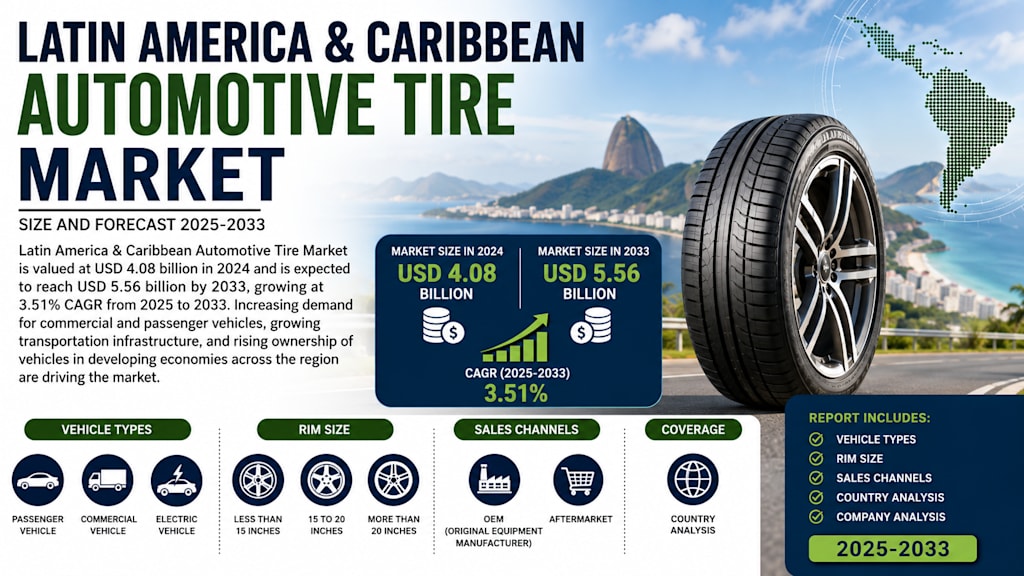
Latin America & Caribbean automotive tire market enters a new growth cycle
The automotive tire market across Latin America and the Caribbean is steadily evolving as rising vehicle ownership, expanding urban transportation, and growing mobility needs reshape the region’s automotive ecosystem. According to the latest market analysis, the Latin America & Caribbean Automotive Tire Market was valued at USD 4.08 billion in 2024 and is expected to reach USD 5.56 billion by 2033, growing at a CAGR of 3.51% from 2025 to 2033.
This growth reflects more than just rising vehicle numbers. It signals a broader shift in regional transportation behavior, changing consumer expectations, and the modernization of tire retail and distribution channels. As passenger vehicles, commercial fleets, and electric mobility solutions gain momentum across the region, tire manufacturers are increasingly focusing on durability, fuel efficiency, road adaptability, and affordability.
From Brazil and Mexico to the Caribbean island economies, automotive tires have become central to supporting personal mobility, logistics, tourism, and public transportation. The market now represents an important intersection between automotive manufacturing, infrastructure expansion, e-commerce growth, and sustainability initiatives.
Vehicle ownership growth remains the strongest market catalyst
One of the primary drivers behind the region’s tire market expansion is the increasing number of vehicles on the road. Rising disposable incomes, urbanization, and expanding middle-class populations are encouraging consumers to purchase personal vehicles at a faster pace than before. At the same time, commercial transportation continues to grow as economies rely more heavily on logistics, freight movement, and tourism-driven transportation services.
The report highlights that Brazil and Mexico remain the dominant contributors to regional vehicle registrations. According to data cited from the International Organization of Motor Vehicle Manufacturers (OICA), new vehicle registrations across Latin America increased by 7.65% in 2023, reaching 5.35 million vehicles. Brazil accounted for 2.30 million registrations while Mexico represented 1.41 million, together contributing nearly 70% of the region’s total registrations.
This rise in vehicle ownership directly increases both OEM tire demand and replacement tire demand. Every new vehicle requires original equipment tires, while the expanding vehicle fleet creates recurring opportunities in the aftermarket segment. In regions with poor road quality or high traffic congestion, tire wear tends to occur faster, making replacement cycles shorter and supporting long-term industry revenues.
E-commerce is transforming the tire buying experience
One of the most important structural changes in the market is the rapid expansion of digital tire retailing. Consumers are increasingly purchasing tires through online marketplaces, comparing specifications, prices, and reviews before making decisions. This shift is especially important in Latin America, where e-commerce adoption has accelerated dramatically in recent years.
Online sales platforms are improving access to tire products in both urban and underserved rural markets. Consumers can now purchase premium brands, fuel-efficient tires, all-terrain models, and specialized products without relying solely on local retailers. This transformation is pushing tire manufacturers and distributors to strengthen logistics, inventory management, and last-mile delivery capabilities.
The report also references significant investment activity within the retail ecosystem. In November 2022, L Catterton announced major investment support for CantuStore, Brazil’s largest omnichannel aftermarket tire retailer and distributor. The move highlights growing confidence in digital tire retailing and aftermarket expansion throughout the region.
Fuel efficiency and durability are shaping purchasing decisions
Consumers across Latin America and the Caribbean increasingly prioritize tires that can handle challenging road conditions while improving fuel economy. Poor road infrastructure in some areas, long-distance travel needs, and rising fuel prices are pushing buyers toward durable and fuel-efficient solutions.
All-terrain tires are seeing stronger adoption in countries where drivers regularly move between urban roads and rough rural terrain. Commercial operators, agricultural transport users, and SUV owners particularly value products that combine long lifespan with higher traction and load-bearing capabilities.
Environmental concerns are also beginning to influence purchasing behavior. Low rolling resistance tires, which help improve fuel efficiency and reduce emissions, are attracting more attention among environmentally conscious consumers and fleet operators. This trend is encouraging manufacturers to develop advanced tire compounds and performance-oriented products suited to regional driving conditions.
Passenger vehicle tires dominate overall demand
Passenger vehicle tires continue to hold the largest share of the regional market. Rapid urbanization, increasing personal mobility, and post-pandemic recovery in vehicle sales are supporting demand across Brazil, Mexico, Chile, and other emerging markets. Consumers primarily seek affordable, durable, and fuel-efficient tires suitable for everyday commuting and long-distance driving.
The replacement market remains especially strong because of frequent tire wear caused by traffic congestion, high temperatures, uneven roads, and extensive vehicle usage. In many countries, used car markets are also expanding rapidly, further supporting demand for low-cost replacement tires.
This segment is expected to remain the backbone of the industry throughout the forecast period, particularly as more households enter the middle-income category and vehicle ownership becomes increasingly accessible.
Electric vehicle tire demand is emerging rapidly
While still a relatively small segment, electric vehicle tire demand is gaining momentum across the region. Governments in countries such as Chile, Brazil, and Colombia are encouraging electric mobility adoption through incentives, infrastructure investments, and sustainability initiatives.
EV tires differ from conventional products because they require lower rolling resistance, enhanced durability, and quieter operation to support electric drivetrain performance. Tire manufacturers are responding by introducing innovative compounds, reinforced structures, and intelligent tire technologies specifically designed for EV applications.
As EV adoption grows over the next decade, this niche segment could become one of the most technologically advanced areas of the regional tire market.
The 15 to 20-inch tire segment remains dominant
The report identifies the 15 to 20-inch rim category as the leading segment within the market. These tire sizes are widely used in passenger vehicles, SUVs, and light commercial vehicles because they offer a strong balance between performance, comfort, aesthetics, and affordability.
The growing popularity of SUVs and pickup trucks, especially in Brazil and Argentina, is reinforcing demand within this category. Consumers increasingly favor larger vehicles for both personal and commercial use, creating consistent demand for compatible tire sizes.
In addition, the aftermarket for this segment remains highly active because of wide product availability, strong compatibility across vehicle models, and competitive pricing.
OEM partnerships continue to shape competition
Original Equipment Manufacturer (OEM) partnerships remain strategically important for major tire brands operating in Latin America and the Caribbean. Brazil and Mexico, both major automotive manufacturing hubs, generate substantial OEM tire demand as automakers require high-quality tires for new vehicle assembly.
Automotive manufacturers increasingly expect tire suppliers to deliver products that improve fuel efficiency, safety, handling, and environmental performance. These partnerships also help tire companies strengthen brand visibility and long-term customer loyalty.
The transition toward electric and hybrid vehicles is further changing OEM requirements, pushing tire manufacturers to innovate faster and develop specialized products tailored to next-generation mobility platforms.
Country-level market trends highlight regional diversity
The market varies significantly across countries, reflecting differences in economic stability, infrastructure quality, industrial development, and consumer spending behavior.
Brazil remains the region’s largest tire market
Brazil continues to dominate the Latin American automotive tire landscape due to its large vehicle fleet, broad road network, and strong automotive manufacturing sector. Demand remains robust for both OEM and replacement tires. Consumers prioritize affordability and durability because of heavy urban traffic and extensive daily driving requirements.
The country also benefits from domestic manufacturing capacity, reducing reliance on imports and improving supply chain resilience. Manufacturers operating in Brazil are increasingly investing in sustainable tire technologies and advanced product development.
In April 2023, the AGRITERRA 02 SP tire featuring Very High Flexion technology was introduced in Brazil for agricultural vehicles, demonstrating the growing focus on specialized performance products.
Mexico strengthens its OEM influence
Mexico remains a critical automotive manufacturing and export center, supporting strong OEM tire demand. International automakers operating in the country require high-performance tires that meet strict quality and efficiency standards.
Mexico’s urbanization and expanding middle class are also driving replacement tire demand. E-commerce availability and growing access to premium tire brands are helping consumers adopt fuel-efficient and all-weather products.
In April 2024, Yokohama Rubber marked a major milestone for its new passenger car tire factory in Mexico, reflecting the country’s strategic importance within the global tire supply chain.
Argentina faces economic pressure but maintains demand
Argentina’s tire market faces challenges linked to inflation, currency fluctuations, and economic instability. Consumers are often more price-sensitive, leading to increased interest in affordable or retreaded tires.
Despite these challenges, strong agricultural activity and road freight transportation maintain healthy demand for truck and tractor tires. Long-distance transport operations require durable heavy-duty tires capable of handling difficult terrain.
In October 2024, Giti opened its first official outlet in Mendoza, Argentina, providing tire sales, repair, balancing, and alignment services.
Cuba depends heavily on replacement demand
Cuba’s aging vehicle fleet creates consistent demand for replacement tires. Import restrictions and limited new vehicle availability mean that consumers rely heavily on maintaining older vehicles.
The market often depends on used or retreaded tires because of affordability concerns and limited product availability. Supply chain restrictions and import dependency remain major operational challenges.
Recent developments from key companies
The competitive landscape includes major global players such as Hankook Tire & Technology Co., Ltd., Continental Corporation, Michelin, Pirelli Tyre C. S.p.A., The Yokohama Rubber Co., Ltd., and Bridgestone Corporation.
Here are 10 notable recent developments influencing the regional market:
L Catterton invested heavily in Brazil’s CantuStore to strengthen omnichannel tire retail operations.
Prinx Chengshan showcased advanced tire technologies at the Latin Tyre Expo 2024 in Panama.
Yokohama Rubber expanded manufacturing capabilities through its new Mexico passenger tire facility milestone.
Giti launched its first official retail outlet in Mendoza, Argentina.
AGRITERRA 02 SP tires featuring VF technology were introduced in Brazil for agricultural applications.
Michelin continues expanding fuel-efficient and environmentally focused tire solutions globally.
Bridgestone is strengthening smart tire and sustainability-focused product development strategies.
Continental continues focusing on premium performance and connected tire technologies.
Pirelli remains active in high-performance and premium tire innovation for changing mobility trends.
Hankook Tire & Technology continues enhancing advanced tire technologies targeting modern passenger and EV markets.
Market outlook remains positive despite challenges
Although economic instability, inflation, and currency volatility remain concerns across several countries, the long-term market outlook remains positive. Increasing vehicle ownership, infrastructure development, digital retail expansion, and rising transportation demand continue to support growth.
Challenges such as import dependence, supply chain costs, and pricing pressure will likely persist, particularly in smaller Caribbean markets and economically unstable economies. However, manufacturers that focus on affordability, durability, fuel efficiency, and regional customization are expected to perform strongly over the coming years.
Final thoughts
The Latin America & Caribbean Automotive Tire Market is evolving into a more technologically advanced and consumer-focused industry. Growth is no longer driven solely by rising vehicle numbers. It is increasingly tied to digital commerce, sustainability trends, mobility modernization, and specialized tire innovation.
With the market projected to rise from USD 4.08 billion in 2024 to USD 5.56 billion by 2033, the industry is expected to remain an important pillar of the region’s transportation and automotive economy. Companies that can balance affordability, performance, fuel efficiency, and regional adaptability will likely emerge as long-term leaders in this steadily expanding market.
About the Creator
Enjoyed the story? Support the Creator.
Subscribe for free to receive all their stories in your feed.
Comments
There are no comments for this story
Be the first to respond and start the conversation.